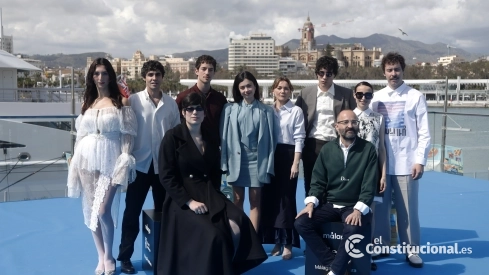
The new adaptation of My Dearest Señorita premiered yesterday during the Malaga Film Festival and arrives on Netflix with the intention of updating one of the most iconic titles of Spanish cinema and doing so from a contemporary perspective. Directed by Fernando González Molina, the film recovers the spirit of the original work, but focuses on a question barely explored in cinema: intersexuality.
The story follows Adela, (Elisabeth Martínez's first leading role) a woman deeply marked by religion and social conventions who, little by little, begins to discover her true identity. In this process, she is accompanied by different key figures: the town's parish priest, played by Paco León; her grandmother, embodied by María Galiana; and a young masseuse with whom she will end up falling in love, played by Anna Castillo, opposite the boy she supposedly liked since school, brought to life by Eneko Sagardoy.
During the Málaga Festival, the director explained that the biggest challenge was to bring to the present a story with so much weight in cultural memory. “The challenges we have faced when adapting Mi querida señorita are all those you can imagine,” he pointed out. “First, the ‘brain-draining’ of facing bringing such an iconic film to 2026. But also, when Los Javis proposed it to me, it seemed to make sense to do it because there were issues that needed to be shed light on, such as the intersexuality of the character, a collective that has rarely been represented on screen.”
A intersex protagonist to tell the story
One of the great successes of the project is the signing of Elisabeth Martínez as protagonist. The actress, intersex and without previous experience before the cameras, assumes the absolute weight of the narration. Her performance, marked by naturalness, sustains Adela's inner journey while the character goes through doubts, discoveries and contradictions. During the Málaga Festival we were able to speak with her, and she explained that the reception of the film was being “very lively and warm”.
Martínez recognized that one of the great challenges was to transfer the story to a contemporary perspective without losing the essence of the character. “As for what concerned me most, I wanted to be as faithful as most experiences are. Adela is somewhat an amalgam of experiences of a lot of intersex people,” he pointed out. At the same time, he explained that he also had to approach another dimension of the character from empathy and research. “And in the part more of Alana (Alana S. Portero, screenwriter of the film), of gender identity, trying to understand everything I could, trying to show respect for that which did not personally affect me.”
The film also aims to open a public conversation about a still little-known reality. During the press conference, he also stated that "it explores the what does it matter: none of us fit in, and we must seek a community of people who support you because you are unique and you have to understand and love yourself as you are".
An adaptation brought to 1999
The story moves the history to 1999, a narrative decision that, according to explained Fernando González Molina, allows to place the plot in a moment of social transition.
"It made no sense to place it in 1970s Spain, but neither in the present", the director pointed out. "1999 was a symbolic year and also a time when many of us were experiencing similar processes of personal discovery".
The importance of representation and the chosen family
On that path, Adela will find refuge in a new chosen family formed by a single mother played by Lola Rodríguez and a party-loving young man brought to life by Manu Ríos, in a very different register from what he has shown in previous works.
We spoke with Lola Rodríguez during the film's red carpet, who claimed the visibility that her role in ‘Mi querida señorita’ brings in terms of representation: “I have been able to inhabit motherhood, I have been able to have a baby... well, it's something you have to go see... she is an imperfect mother full of nuances, with a lot of love and in the end, being a trans or cis woman: it doesn't matter, I am an actress after all and that's what should happen: we should all be able to have opportunities and explore what it is to be human”.
For his part, Manu Ríos —somewhat unrecognizable in the film— highlighted the emotional weight of his character within the story. As he explained, the story revolves around “finding a place, finding a chosen family”, and added that his character ends up becoming “Ade's refuge”.
The film, in addition to its political charge, maintains a pop and hopeful tone that seeks to connect with new generations and reclaim the freedom of identity through an intimate story about acceptance, community, and self-discovery, and will arrive in theaters on April 17 and can be enjoyed on Netflix starting May 1.