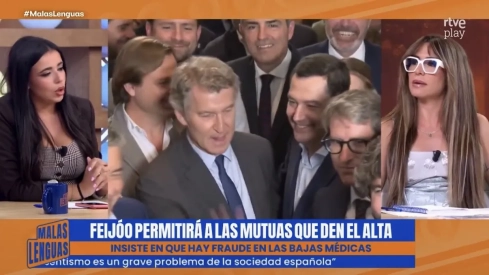
Alberto Núñez Feijóo has opened a new debate on the management of sick leave after announcing that, if he comes to power, he will strengthen the role of mutual insurance companies and allow them to issue medical discharges in "certain pathologies". The leader of the PP has also defended that these entities can perform diagnostic tests and has insisted on the need to pursue fraud in sick leave.
"There is fraud in absenteeism due to sick leave. Yes, let's pursue it," Feijóo affirmed during a meeting with the business association Cecot in Terrassa. He then defended his proposal: "We are going to strengthen the role of mutual insurance companies. Yes. We are going to facilitate that mutual insurance companies perform diagnostic tests. Yes. We are going to facilitate that in certain pathologies mutual insurance companies can issue discharges. Yes." The popular leader linked these measures to the need to act against those who, according to his approach, take advantage of the system.
Feijóo's words received an immediate response from the Minister of Inclusion, Social Security and Migration and government spokesperson, Elma Saiz, who defended the criteria of public health doctors. Saiz questioned whether the decision on when a worker is fit to return to their job could be transferred to mutual insurance companies. "Being sick is not cheating," she stated, before differentiating between a mutual insurance company being able to collaborate in diagnosis or recovery and having the capacity to decide that a worker is already recovered.
The debate also reached a television program, where Esther Palomera introduced the issue by addressing Sarah Santaolalla directly. The collaborator considered Feijóo's proposal to be particularly serious and recalled other controversies related to his statements on absenteeism and sick leave. "I believe that of all Mr. Feijóo's political career, this may be one of the most serious statements of his political career," Santaolalla maintained.
The collaborator took her criticism to specific situations to explain the consequences that, in her opinion, the measure could have. "From here to slavery is one step," she affirmed. Santaolalla raised what would happen if a sick person had to face pressure from their company to return to their job before being recovered. "For a person who is sick tomorrow to tell their boss [...] to go with a cast is very serious," she pointed out.
Santaolalla went even further when referring to workers with serious illnesses. "Not only did he do that, but now he is also saying that your boss will be the one to tell you if you are going to work with a broken ankle, if you are going to work with a diagnosis of lung cancer even if you have an appointment for chemotherapy," he stated. From his point of view, the proposal means "putting workers' rights down the drain" and "kicking the working class."
Santaolalla's intervention then provoked a response from Arantxa Sánchez, who defended a different vision on the role of mutual insurance companies. "Mutual insurance companies are already giving sick leave and discharges, Sarah," she recalled, specifying that they do so when there is an illness or work accident. "They are doctors. Are we going to question that?" she asked. Sánchez thus questioned distrusting a doctor's judgment for working for a mutual insurance company and defended that the work these professionals already do in the field of work accidents and illnesses should also be taken into account. "Why shouldn't they be able to do it for other illnesses?" she asked.
🏥 Feijóo quiere que las mutuas puedan dar el alta médica en determinadas patologías
— Malas Lenguas (@MalasLenguas_Tv) September 29, 2026
🗣️ El líder del PP plantea darles más competencias para combatir el absentismo y habla de perseguir el “fraude”
⚖️ Elma Saiz responde: “Estar enfermo no es hacer trampa”
👉 @SarahPerezSanta en… pic.twitter.com/yQ9HfAKEaF
The exchange ended up raising the tension among the collaborators. "Don't you see the difference? Do you really not see it?", responded another participant in the debate, questioning the comparison between the functions already performed by mutuals in work accidents and occupational diseases and the possibility of extending them to common illness leaves. A difference that, in his opinion, also involves respecting the criteria of public health doctors when determining whether a worker is truly in a condition to return to their job.
The debate thus leaves two clearly opposing positions: on the one hand, those who advocate for expanding the participation of mutuals in the management of sick leaves; on the other, those who believe that the decision on when a worker is fit to return to work should remain linked to the public health system.