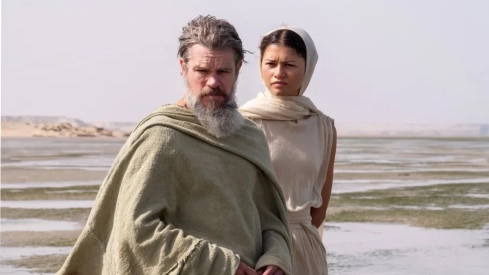
Neither the World Cup nor the boycott campaign promoted for months by Elon Musk and sectors of the far right have stopped the premiere of The Odyssey, the new film by Christopher Nolan. The adaptation of Homer's classic has debuted with 264.1 million dollars at the worldwide box office, becoming the best opening of the filmmaker's entire career and practically recovering the production cost —estimated at 250 million dollars— in just three days. The film has also received an excellent reception from the public, with a rating of A on CinemaScore, which reinforces the forecasts of a long commercial run.
One of the main obstacles for the launch was the campaign of criticism led by Elon Musk and amplified by the so-called fachosfera, which attacked the cast for considering that the film offered a "woke" vision of the classic tale. The criticism focused especially on the choice of Lupita Nyong'o as Helen of Troy and Elliot Page as Sinon, questioning the historical fidelity of the adaptation. Despite this, the public has responded massively to Nolan's proposal.
The premiere also coincided with the decisive stage of the World Cup, held in the United States, including the match for third place and the final between Spain and Argentina, a schedule that could have affected attendance at cinemas. Even so, the film grossed 124.5 million dollars in the United States, the third best opening of the year, only behind Toy Story 5 and Super Mario Galaxy. Industry analysts consider that, without the coincidence with the championship, the figure would have been even higher.
In Spain, The Odyssey has also achieved the best opening of Christopher Nolan to date. The film reached 4.47 million euros during its first weekend, clearly surpassing the 2.7 million achieved by Oppenheimer in 2024. Friday and Saturday drove most of the box office, while on Sunday, coinciding with the World Cup final, revenues dropped to about 600,000 euros, although without preventing the film from consolidating itself as one of the great cinematic phenomena of the summer.
After having seen the film, I bet that The Odyssey is already positioned as a candidate to be among the great contenders of the next international awards season. Christopher Nolan does not limit himself to adapting Homer's poem, but rather builds a work of enormous narrative and emotional ambition that transcends the myth of Odysseus —Ulysses in the Latin tradition— to turn it into a profound reflection on identity, memory, power, the passage of time, and the price of returning home.
Far from being a simple adventure story, each episode of the journey works as a metaphor for human conflicts, forcing the viewer to constantly question what it really means to win, survive, or reunite with oneself.
With a narrative structure of millimetric precision that maintains the pace throughout the entire screening —without its more than three hours of footage ever feeling long—, an overwhelming visual language, a very fitting soundtrack by Ludwig Göransson and a direction of extraordinary ambition, Christopher Nolan manages to make a story written almost three millennia ago naturally dialogue with the concerns of the present. The result is a work that transcends classical epic to become a profound reflection on the human condition, confirming, once again, the filmmaker's ability to turn great spectacle into cinema that is as thrilling as it is intellectually stimulating.
Add ElConstitucional.es as a preferred Google source for free.
Stay informed about all the latest breaking news with the best information. Against disinformation, for democracy and social rights.