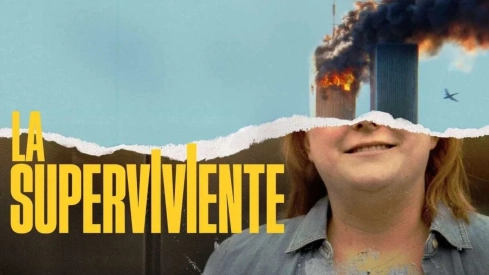
There are stories that seem written for a movie because they are too incredible to be true. That of Alicia Esteve is one of them. A Spanish woman who managed to build for years a completely fictitious identity as a survivor of the September 11, 2001 attacks, even becoming president of an association of World Trade Center victims.
Now, 25 years after 9/11, director Kike Maíllo recovers that story in 'La superviviente' (The Survivor), a documentary that not only recalls the fraud, but tries to answer a much more disturbing question: how did one person manage to maintain a lie of such magnitude for six years without anyone discovering it?
The answer forces us to delve into one of the most surprising episodes that arose around the New York tragedy.
From Alicia Esteve to Tania Head
The name that everyone came to know was Tania Head. According to the story she herself constructed, she had survived the attack on the 78th floor of the South Tower of the World Trade Center, above the place where the plane hit.
Her story was full of dramatic details. She claimed that a seriously injured man had given her his wedding ring to give to his wife. She also said that a volunteer helped her escape while her clothes were on fire and that she had lost her fiancé, David, in the North Tower.
The story had such an impact that Head ended up presiding over the World Trade Center Survivors' Network and even met with the then mayor of New York, Rudy Giuliani.
The problem was that practically all of it was false. Tania Head was actually Alicia Esteve, a young woman from Barcelona who was in the city studying when the attacks occurred, but who was never in the Twin Towers. Nor did the supposed engagement to David Scott Suárez, the Deloitte employee she claimed to have lost in the attack, exist.
Six years living a lie
One of the most disturbing aspects of the case is precisely its duration. The lie was maintained for six years, until two journalists from The New York Times, David W. Dunlap and Serge F. Kovaleski, began to investigate some elements of her story that did not quite fit.
In 2007, the newspaper finally exposed the fraud. By then, Alicia Esteve had achieved something much more complex than inventing a character: she had built an entire public identity around him, surrounding herself with people who considered her another victim of a tragedy that had deeply marked the United States. And that's where 'The Survivor' finds its main interest.
Kike Maíllo tries to understand the impostor
The documentary, directed by Kike Maíllo, known for films like Eva and Toro, starts from an obvious difficulty: Alicia Esteve has not wanted to participate in the project or offer her version on camera.
The director then chooses to reconstruct her story from documents, therapy recordings, and testimonies from people who were close to her. Actress and comedian Hannah Becker serves to give voice and presence to certain passages of that reconstruction, while Maíllo travels to the United States to speak with those who knew Tania Head.
Among them appear survivors from the association, people who held relevant positions before and after her, and even Sam Kedem, the psychologist who treated Head as a victim of the attack. The result avoids turning the case into a simple story of deception and opens up different interpretations about who that woman really was and what she sought by building such a character.
One of the most interesting elements of the documentary is that the testimonies do not offer a single image of Alicia Esteve. Some of those who knew her remember her as a person especially in need of prominence. Others, however, acknowledge that her work at the head of the association managed to give it enormous visibility and that it contributed to promoting some of its activities.
There is also an important fact to understand the dimension of the case: she did not directly obtain money thanks to her false identity. The story, therefore, is more complex than that of a simple swindler who invented a past to get rich.
The disturbing parallel with Enric Marco
Alicia Esteve's case inevitably recalls another of the great Spanish impostors: Enric Marco, who for years claimed to have been deported to a Nazi concentration camp and even presided over the Amical de Mauthausen.
Both stories share a particularly disturbing element: the ability to construct an emotional narrative capable of connecting with others until a lie becomes an identity. But The Survivor goes a step further by posing a question that is especially interesting: perhaps the true mystery is not only how she managed to deceive so many people, but why her story was so easy to believe.
A recommendation for this weekend
With the 25th anniversary of 9/11 as context, The Survivor finds a particularly appropriate moment to revisit a story that, although it happened almost two decades ago, still has many unanswered questions.
Kike Maíllo's documentary functions as a real thriller without the need for artifice: a woman invents an identity, manages to infiltrate the circle of those who truly suffered a tragedy, and maintains a narrative for years that eventually crumbles when someone decides to check if the pieces fit.
More than reconstructing a lie, The Survivor tries to understand why it worked. And that is precisely why it is worth watching this documentary: because behind Alicia Esteve's imposture there is also a reflection on memory, trauma, the need to belong, and the ease with which a well-told story can become, for the listener, a truth.
Add ElConstitucional.es as a preferred Google source for free.
Stay informed about all the latest breaking news with the best information. Against disinformation, for democracy and social rights.