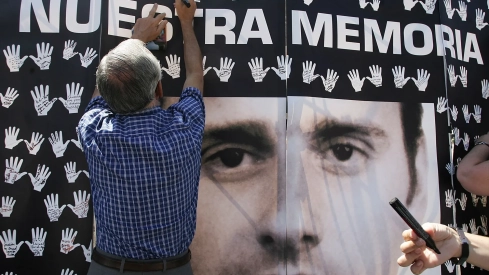
The kidnapping and murder of Miguel Ángel Blanco at the hands of ETA will return to screens almost three decades after one of the episodes that marked the recent history of Spain. Two new fiction films, 'Blanco' and 'El hijo de todos', are in the process of filming in the Basque Country and will reconstruct the 48 hours that kept the entire country on edge during July 1997.
Both productions will arrive in cinemas in 2027, coinciding with the 30th anniversary of the death of the Popular Party councilor in Ermua (Vizcaya). Although they share the same historical event, the feature films will approach the facts from different perspectives: one will follow the work of the journalists who reported the kidnapping and the other will focus on the suffering and experience of the Blanco Garrido family.
The filmings have turned Bilbao and other points of the Basque Country into scenarios of those events. The recovery of these events through cinema seeks to bring to new generations a story that many young people did not experience and that provoked an unprecedented citizen mobilization against ETA terrorism.
Who was Miguel Ángel Blanco and what happened during his kidnapping?
Miguel Ángel Blanco Garrido was born in Ermua on May 13, 1968. He was 29 years old when he was murdered by ETA. He was a councilor for the Popular Party in his town and worked as an economist in a consultancy. His life changed on July 10, 1997, when he was kidnapped by members of the terrorist organization while on his way to work in Eibar.
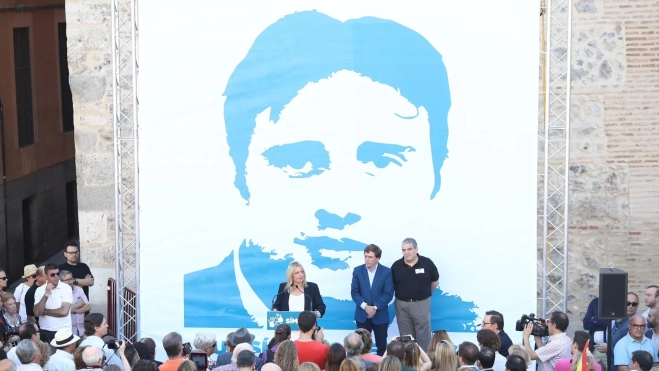
ETA announced the kidnapping and issued an ultimatum to the Government of José María Aznar: it demanded the transfer of the organization's prisoners to prisons in the Basque Country within 48 hours. If its conditions were not met, it threatened to murder the councilor. The news caused enormous commotion. During those hours, thousands of people took to the streets of different Spanish cities to demand his release. Concentrations, demonstrations and expressions of solidarity multiplied, especially in Ermua, where neighbors and political representatives gathered to demand that Miguel Ángel return alive.
However, ETA fulfilled its threat. On July 12, the councilman was found in a wooded area of Lasarte, in Guipúzcoa, with two gunshot wounds to the head. He was transferred to the hospital, where he died in the early hours of July 13, 1997. His assassination triggered one of the largest citizen responses against terrorism that had been experienced in Spain until then. The massive demonstrations and concentrations with hands painted white gave rise to what became known as the 'Spirit of Ermua', an expression of social unity against ETA's violence.
'Blanco' and 'El hijo de todos': two films to remember the case
One of the productions that will revisit those events is 'Blanco', a feature film directed by Félix Viscarret, known for works such as 'Patria', 'Bajo las estrellas' and 'No mires a los ojos'. Filming began on October 19 and is scheduled for release in theaters on July 9, 2027, coinciding with the 30th anniversary of the assassination. The film is produced by Nadie es Perfecto and the Basque production company Euskadi Movie, with the participation of RTVE and Netflix, and will be distributed by Universal Pictures International Spain. Mikel Bustamante will be in charge of playing Miguel Ángel Blanco.
The story will reconstruct the 48 hours after the kidnapping from the perspective of the journalists who were on the front line and had to report on what was happening. To do this, the project relies on journalistic investigation and direct testimonies from people who lived through those days. The cast includes Eneko Sagardoy and Jon Ander Urresti, along with Natalia Huarte, Carlos Scholz and Lander Otaola, who will play journalists related to the coverage of those events. Also participating are Miguel Garcés, David Lorente, Susana Abaitua, Urko Olazabal, Amaia Aberasturi, Israel Elejalde and Ramón Barea. The second production is 'El hijo de todos', directed by Álvaro Brechner, responsible for films such as 'La noche de 12 años'. In this case, the fiction will approach the story from the point of view of Miguel Ángel's family and the impact the kidnapping had on his parents and sister.
Pol Monen will play the councilman, while Laia Manzanares will portray Mari Mar Blanco, his sister. María Botto and José Luis García Pérez will embody his parents, Consuelo Garrido and Miguel Blanco, respectively. Asier Etxeandia will play Carlos Totorika, mayor of Ermua during those events. The feature film, whose filming is taking place in different locations in the Basque Country, has the collaboration of Mari Mar Blanco, who has participated in the development of the project to bring her family's memories and experiences closer to the film crew.
The title comes precisely from the words Consuelo Garrido uttered after learning of her son's murder: "ETA has not killed my son, it has killed everyone's son." A phrase that summarizes the feeling of solidarity that spread throughout Spain during those days. The production is driven by Bowfinger International Pictures, Vaca Films, Esto también pasará, Telecinco Cinema, and Pampa Films, among other companies, and has the participation of Movistar and Mediaset. The director has explained that the film aims to tell "the story of how fear was lost" and how the suffering of one family became a collective mobilization.
The documentaries and projects that have already recovered the story of Miguel Ángel Blanco
Although these two films will represent a new cinematic approach to the murder of the Ermua councilman, his story has already been addressed previously through documentaries, reports, and other audiovisual productions. One of the most recent projects is 'Miguel Ángel Blanco: the 48 hours that changed everything', a documentary directed by Jon Sistiaga and Juanjo López that arrived on Netflix on July 10, 2026. The production reconstructs the kidnapping and murder through 30 testimonies from people who had a direct relationship with those events.
Among the voices participating are those of Mari Mar Blanco, former Prime Minister José María Aznar, then Minister of the Interior Jaime Mayor Oreja, and the mayor of Ermua during those days, Carlos Totorika. Journalists, friends, co-workers, members of the police forces, and healthcare professionals who participated in the search and care of the councilman also intervene. The documentary also incorporates testimonies from people who tried to intervene to prevent the assassination and save Miguel Ángel's life, as well as more than 180 hours of archive material. Jon Sistiaga, who was 29 years old when he covered the events as a journalist, serves as the narrator of the production.
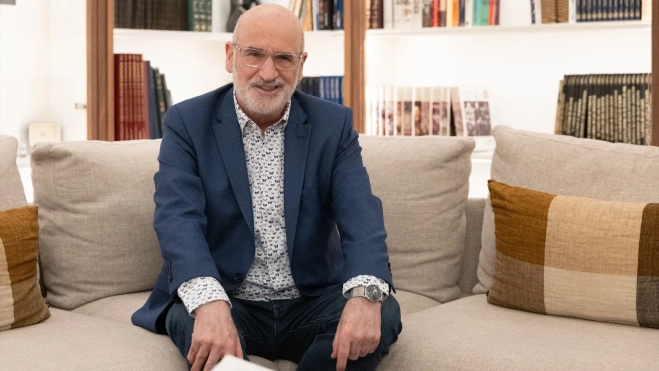
The story has also served as inspiration for other cultural works. This is the case of 'Maite', Fernando Aramburu's novel, which uses the context of Miguel Ángel Blanco's kidnapping and murder to address the consequences of terrorism and the fear experienced in the Basque Country. Added to these productions are numerous news specials and documentaries produced for the anniversaries of the assassination, which have recovered images of the demonstrations and testimonies of those who lived through those days.
With the arrival of 'Blanco' and 'El hijo de todos', cinema will once again focus on an episode that transcended the death of a councilman and left a deep mark on Spanish society. Two films that, from different points of view, aim to reconstruct what happened and keep alive the memory of one of ETA's most remembered victims.
