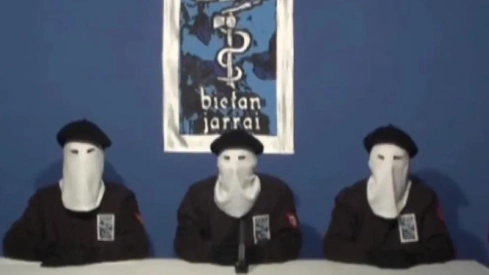
This Tuesday, October 20, marks fifteen years since ETA announced the definitive cessation of its armed activity. The 2011 statement marked the end of decades of assassinations, kidnappings, threats, and extortions that left a deep mark on Spain. The group announced its definitive dissolution in 2018, but differences over how to interpret its legacy remain present in Spanish politics.
The anniversary has once again pitted political parties against each other. While the PSOE claims the end of terrorism as a victory for democracy and recalls the role of Alfredo Pérez Rubalcaba, the PP insists that EH Bildu continues to have institutional presence without condemning ETA's assassinations. Vox shares the criticisms of the abertzale left, while the PNV and EH Bildu have issued their own statements on coexistence and the political future of the Basque Country.
The PP accuses EH Bildu of still not condemning ETA's assassinations
The Deputy Secretary of Autonomous Coordination of the PP, Elías Bendodo, has used the anniversary to question EH Bildu's role in institutions. During a press conference in San Sebastián, he stated that "ETA is still seated in institutions, both in Madrid, in Congress, and in Basque institutions."
Bendodo acknowledged that it is "good news that we are here 15 years later," but he accompanied that assessment with criticism of the abertzale formation. "We have actively and passively denounced that these people who now sit in institutions still do not condemn the almost thousand assassinations that the terrorist group carried out throughout our country," he declared.
The statements reflect the position that the PP maintains on EH Bildu: it considers that its institutional presence cannot be separated from its political past. Vox also maintains a critical position with the abertzale left and rejects that the end of the attacks means that the political objectives associated with ETA have disappeared. However, no literal statement from a Vox leader published specifically this October 20 has been located, so no specific words are attributed to him.
The PSOE claims democratic victory and remembers Rubalcaba
The PSOE has placed the anniversary in the realm of democratic memory and recognition for those who participated in the fight against ETA. One of the figures remembered this Tuesday has been Alfredo Pérez Rubalcaba, former Minister of the Interior during José Luis Rodríguez Zapatero's government and one of the socialist leaders linked to the final stage of the band.
The President of Congress, Francina Armengol, participated in a tribute to Rubalcaba, who passed away in 2019, during which a workroom for journalists in the Lower House was named after him. Armengol highlighted his ability to reach agreements and vindicated the value of politics based on dialogue and consensus.
The President of Congress defined the end of ETA as a "great victory for democracy" and a "fundamental milestone". She also warned that some have forgotten or intend for others to forget "how hard it was to recover rights and freedoms". With these words, she linked the memory of Rubalcaba with the need to preserve the memory of a period marked by violence and suffering.
EH Bildu rules out a return to violence while the PNV asks not to forget the victims
The general coordinator of EH Bildu, Arnaldo Otegi, has responded to questions about the anniversary and the recent arrests of two people in Irún investigated for alleged terrorism offenses. In an interview on Radio Popular-Herri Irratia, he assured that he does not contemplate "even a 0.1% chance" of a return to armed activity.
"Regarding this news, I want to emphasize that 15 years have passed since Aiete in which there has been no type of armed action by ETA," Otegi said. He also defended the contribution of the abertzale left to the process that led to the announcement of the definitive cessation of violence. "I don't know if there are nostalgics who think the country was better before, but we are not among them," he added. For its part, the Basque Nationalist Party has called for "a Basque Country without violence" and has asked for "not a step back" in the defense of freedom and democratic values. In its statement, the party warned that "peace, freedom, and coexistence have cost too much" to allow "a false closure."
The Basque Government, formed by PNV and PSE-EE, has also remembered the victims "murdered, kidnapped, coerced or threatened" and has demanded that those who have not yet recognized "the senselessness of violence" join the path of democratic coexistence. The regional Executive has warned that some people maintain a "moral debt" with Basque society that "does not expire." Fifteen years after the announcement of the definitive cessation of armed activity, the anniversary shows that the end of ETA is a historical fact, but that its interpretation continues to generate confrontations between parties. The memory of the victims, the recognition of the harm caused and the current role of EH Bildu continue to be the main points of disagreement.
The wounds left by terrorism are still present in Spanish society. However, not even a date that recalls the end of decades of violence has managed to unite the main parties around a common message. Differences over EH Bildu, the memory of the victims and the interpretation of what happened continue to mark the political confrontation. A division that leaves a question on the table: how can Spain build a shared memory of one of the most painful chapters of its history if its representatives still cannot agree on how to remember it?
