
Since the general elections of July 2023, the Spanish right-wing bloc has not stopped moving internally. The Popular Party and VOX no longer compete only for ideological hegemony, but for something more decisive: electoral efficiency in a system designed to reward whoever leads each space in the provinces. The historical series of the average of surveys from Electrográfica and Electocracia show a clear and persistent convergence. If that trend continues —and if undecided voters between PP and VOX continue to predominantly opt for the latter as they have since the ill-fated and fruitless strategic shift to the right by the PP—, the sorpasso would not be a rhetorical hypothesis, but a structural turning point with direct effects on the distribution of seats.
1. From a comfortable advantage to an accelerated convergence
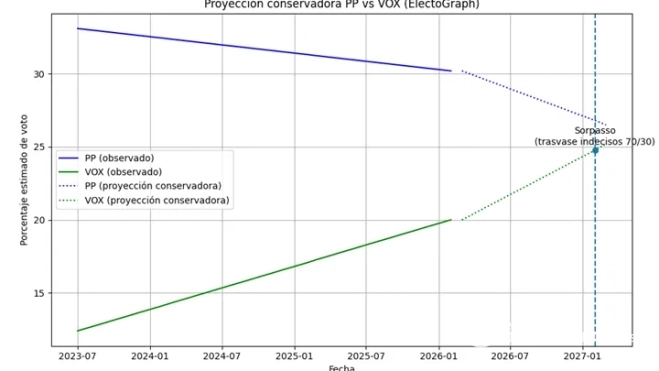
On 23-J 2023, the PP obtained 33.1% of the votes compared to 12.4% for VOX: a difference of more than twenty points. However, the average of surveys from ElectoGraph and Electrográfica at the beginning of 2026 places the PP in the range of 29–31%, while VOX is already moving around 19–21%.
The relevant reading is not just the level, but the slope: in just over two and a half years, the distance between both parties has narrowed by around eleven points. This is equivalent to an average convergence of close to 0.35 percentage points per month in favor of VOX against the PP, which nothing indicates will slow down.
2. The decisive factor: consolidated transfer and undecided PP–VOX
To that inertial trend, a key political element must be added: the net transfer of PP voters to VOX, already estimated at more than 1.3 million, and the existence of an additional pool of approximately 914,000 former PP voters undecided between both options.
If that bag were resolved maintaining the dynamic observed since 2023 —that is, with a majority bias towards VOX—, the effect would be double:
- VOX would add points directly.
- The PP would lose them simultaneously.
In terms of relative difference, this accelerates the closing of the gap. With a resolution within a twelve-month period and a prudent 70/30 distribution of undecided voters in favor of VOX, the additional convergence would be around 5 points in a single year.
A more softened projection of this transfer of undecided voters (for example, of 60/40) would place the sorpasso favorable to the party led by Santiago Abascal at the end of 2027 instead of the first quarter.
Paradoxically, who could change this dynamic is, either the PP by modifying its strategy until now, suicidal, of emulating VOX, legitimizing them in the eyes of their own voters, and changing it for a tone of greater propositional moderation; or the lefts to the left of the PSOE, who, aligning their strategy as proposed by Gabriel Rufián, “province by province”, would snatch 13 seats from VOX and only 6 from the PP, de facto preventing the sorpasso at least until 2028, and therefore, after the next general elections.
The political consequences of the overtaking in the vicinity of 100 seats would be, maintaining the current trend and without considering any comeback on the alternative left to the PSOE:
- The victory of Pedro Sánchez in votes and seats, which would be useless to form a coalition government due to the collapse on his left.
- The presidency of the Government for Santiago Abascal in a potential executive led by VOX, which would indeed add an absolute majority with the PP in the reactionary bloc, should they agree on a coalition government.
- An internal crisis in the PP that could lead to a change in leadership, where the best positioned to replace Feijóo are the regional presidents of Andalusia, Juan Manuel Moreno Bonilla, and Madrid, Isabel Díaz Ayuso.
3. Estimated date of the sorpasso: first quarter of 2027
With the data from Electográfica and Electocracia as a base (average of all polls) and under a scenario of continuity (PP stagnant or slightly down, VOX on the rise), the current differential —around 9–10 points— could close in about 12–14 months.
Result: The sorpasso PP–VOX would predictably occur in the first quarter of 2027.
This calculation is not a close electoral prediction, but rather a coherent extrapolation of already observed trends. Its relevance is not in the exact date, but in what it activates from that moment on.
4. Why the sorpasso changes the distribution of seats (even if the bloc holds)
The Congress is not elected in a national constituency, but in 52 provincial constituencies with very disparate magnitudes. In this context, the d'Hondt method clearly rewards the party that leads each political space in each province.
While the PP has been the dominant force of the right, it has easily captured the so-called remains: the last seats in medium-sized provinces. The problem is that that advantage disappears when it ceases to be the first of the bloc.
The sorpasso does not only imply a symbolic change; it implies that:
- VOX moves to compete for the last seat in better conditions.
- The PP enters a zone of inefficiency where small losses of votes cause complete losses of deputies.
- Given that VOX transforms between 68 and 73% of the undecided between them and the PP according to the following series of the same surveys (GAD3, Sociométrica, CIS, Sigma Dos, Ateneo del Dato, Target Point, NC Report, 40DB, GESOP or Invymark), the projection that it would exceed two million changes from blue to green of the ballot, that is, transforming 70% of the 914,000 who are still declared undecided, is conservative.
Key Data
- PP 23-J 2023: 33.1% – 137 seats
- VOX 23-J 2023: 12.4% – 33 seats
- ElectoGraph Average (2026):
- PP: ~29–31%
- VOX: ~20–21%
- Electocracia Average last three polls (2026, updated to March 2):
- PP: 30.6% (127-129 seats)
- VOX: 19.6% (69-71 seats)
- Estimated net transfer PP → VOX (current): >1.3 million votes
- Undecided PP–VOX: ~914,000
- Estimated date of sorpasso: Q1 2027
Implications by constituency size
Small provinces (≤5 seats)
- Very high effective threshold.
- A slight overtaking by VOX can leave the PP without representation or reduce it to a single deputy.
- Maximum risk of abrupt loss for the PP.
Medium Provinces (6–8 seats)
- Here a large part of the sorpasso in seats is decided.
- The last deputy usually depends on minimum margins.
- VOX, by surpassing the PP, can keep the remnants that today fall on the popular side in the average of polls.
Large provinces (Madrid, Barcelona, Valencia, Sevilla…)
- More proportional distribution.
- The effect is more gradual, but even so the PP loses relative advantage by ceasing to be clearly dominant.
5. Can the PP fall below 100 seats?
It is not an automatic consequence, but a real risk in a scenario of sorpasso consolidated. When a party enters a dynamic of loss of efficiency in small and medium provinces, the seat count ceases to be linear. The PP could maintain percentages close to 27–28% and, even so, experience an accelerated fall in representation, especially if VOX becomes its direct competitor for the last deputies.
Conclusion
The debate about the sorpasso between PP and VOX is not a debate of headlines, but of institutional architecture. While the PP was the undisputed leader of the right, the electoral system amplified its advantage. If it ceases to be so, that same system can turn against it. The projected series show that the convergence is not conjunctural. If it is maintained, 2027 can mark not only a change in leadership, but a change in competitive regime within the Spanish right.
Add ElConstitucional.es as a preferred Google source for free.
Stay informed about all the latest breaking news with the best information. Against disinformation, for democracy and social rights.