The recent collision between the Government of Spain and the techno-oligarchs who own large digital platforms is not a simple technical disagreement about regulation. It is, in reality, a conflict of sovereignty.
When President Pedro Sánchez announced in Dubai a package of measures to strengthen public control over social networks —protection of minors, platform responsibility, and possible prosecution of executives— the response did not come through diplomatic or legal channels. It arrived directly to millions of citizens, from their mobile phones, signed by the owners of the platforms themselves.
Therein lies the key to the problem: what are X or Telegram today?
Formally, private social networks.
Materially, political communication infrastructures with the capacity to alter the public opinion of entire countries.
Comparative Reach of Digital Platforms and Aggregated Press
(approximate data 2025-2026)
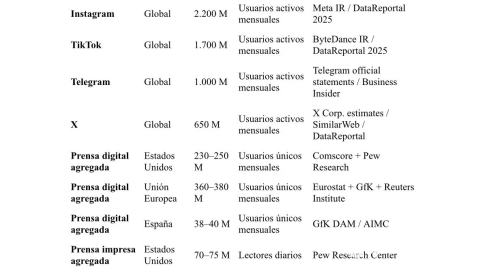
A single private platform (Instagram, TikTok, or Telegram) surpasses the entire digital press of the United States, Europe, or Spain in monthly reach. And, in fact, X (formerly Twitter) or Telegram, individually, reach more citizens than the entire Spanish press ecosystem.And, however, the press has to assume direct editorial responsibility for everything that is published, and platforms only limited legal responsibility.
X and Telegram: de jure social networks, de facto media outlets
The argument is uncomfortable but difficult to refute: X and Telegram fulfill structural functions of a communication medium today, but without submitting to the rules that govern them.
- They distribute political information on a large scale
- They rank content through opaque algorithms
- They allow (or promote) pressure, discrediting, or mobilization campaigns
- They have the capacity to set the public agenda in real time
The essential difference is that they do not assume editorial responsibility, even though their technical decisions produce clear editorial effects
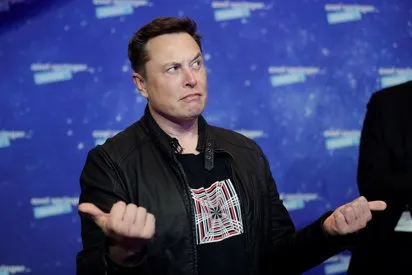
When Elon Musk, owner of X, publicly calls a European president like Pedro Sánchez a “tyrant” and a “traitor,” after referring to him as “Dirty Sanchez,” he does not do so as just another user: he does so from the pinnacle of the amplification system, with a reach that no European newspaper director possesses today, a tweet with 38 million impressions directed at the president of a government with a population of 49.4 million people
Dirty Sánchez is a tyrant and traitor to the people of Spain 💩 https://t.co/B3oyHrBYpR
— Elon Musk (@elonmusk) February 3, 2026
Likewise, when Telegram sends direct messages to its 8 million users in Spain warning against governmental measures, it is exercising direct political communication, without intermediaries or democratic controls.
Digital technofeudalism: private power, public impact
This phenomenon fits what several authors call technofeudalism:
a system in which global private infrastructures exercise functions that previously corresponded to the public space, without equivalent control.
The features are clear:
- Extreme concentration of communicative power in the hands of very few actors.
- Massive social dependence on these platforms for information, debate, and organization.
- Regulatory asymmetry: states (and media) respond to laws, platforms to terms of use.
- Capacity for direct political pressure on democratic governments.
Political agents and fake news
In this context, Musk or the founders of large platforms do not act solely as entrepreneurs, but as unelected political actors, capable of influencing national processes without being accountable to the affected citizensIn the case of X, owned by the richest man in the world, Elon Musk, the platform's pattern favors the amplification and design of hoaxes and fake news and facilitates impersonations. For example, in the United States elections that Donald Trump won, a report by the Center for Countering Digital Hate pointed out that demonstrably false claims by Musk about the electoral process (proven by fact-checkers) received around 2 billion views on X, out of the 17 billion that the tycoon's messages produced, more than double the political notifications from Democrats and Republicans combined
Another example of interference and propaganda were the fake pieces to discredit USAID, from the "news" video generated with AI, which was reposted by Musk and accumulated more than 4 million views, despite being debunked, to the subsequent campaign against this charitable organization. Along with that hoax, disinformation was actively spread about the organization's 50 million for "condoms for Hamas" (it was funds to prevent AIDS in Gaza located in Mozambique, not in Palestine), the 32,000 dollars to finance a "transgender" comic in Peru (67 million views of Musk's fake post, when no trans person appears in the comics), the 8 million into which they transformed the 42,000 dollars for subscriptions to the publication Politico, or the hoax that USAID paid celebrities to support Zelensky.
The European Commission fined X 120 million euros for transparency breaches (among them the verification system that can be misleading and facilitate deception and impersonation), in addition to other transparency and data access failures
Associated Press documented how X was pointed out by experts as especially problematic in the dissemination of deceptive content during Israel's genocide in Gaza, driven by virality dynamics and incentives managed by the platform itself. Directly, they amplify hoaxes on verified accounts because they are more profitable.
Basically, it's not just that hoaxes are constantly published on the social network, with the active participation of its owner; it's that the architecture (algorithm + verification + monetization) rewards false content and makes it scale.
Nudification and pornographic deepfakes: Digital violence against women and minors
To the problem of the extreme spread of disinformation, malinformation, and hoaxes are added the AI-created sexual deepfakes that provoke sexual violence against women and minors. UNICEF documented in February 2026 that at least 1.2 million children in 11 countries had their images manipulated in the last year to create sexualized content using AI and spread it on platforms like Telegram or X.
Thorn and Burson estimated in 2025 that 1 in 6 young people between 13 and 20 years old said they knew someone who, being a minor, was exposed to experiences related to deepfake nudity, and Columbia found in 2024 that online deepfake content is mostly pornographic and that the targets are overwhelmingly women.
The proliferation of these campaigns has caused on February 6 of this year that the United Kingdom activated a law that criminalizes the creation of non-consensual deepfake sexual images (and the regulatory debate is accelerating). The main problem with existing regulation is that it does not affect the platforms that amplify the messages, but only the material author of these sexual violences, who often hides under the anonymity allowed by the platforms.
Also this month of February, an investigation has been activated in France linked to X and the use of its chatbot for explicit deepfake sexual content, including allegations related to child abuse material. France has been one of the countries, along with Germany, that has shown explicit support for the President of the Government of Spain, Pedro Sánchez, in his announced measures for the protection of minors and regulation of platforms.
The “AI to undress” has lowered the cost of harm to almost zero, and that industrializes abuse: it is replicated, redistributed, and used for harassment, extortion, or humiliation. With the acquiescence of platforms that are not legally accountable for their subsidiary responsibility.
The underlying tide lies in sextortion: in 2024, the NCMEC's CyberTipline (United States) received more than 20.5 million reports of suspected child sexual exploitation through digital platforms; furthermore, the organization highlighted a relevant volume of "urgent" reports.
Thorn, in collaboration with NCMEC, has analyzed more than 15 million reports (2020–2023) to study the financial sextortion of minors and its growth.
These serious risks show how the regulation proposed by Spain does not respond to "isolated cases," but to a digital criminal economy with industrial-scale metrics.
Crimes facilitated by messaging and networks: drugs, weapons, Telegram
The EU Agency for Drugs (EUDA) warns that sellers in illegal markets are diversifying into social networks and encrypted messaging apps, which complicates the work of law enforcement agencies.
In fact, financial/crypto intelligence analysis like the latest from TRM Lab points to the use of encrypted apps like Telegram or Signal reducing entry barriers for buyers and facilitating trade outside of "classic" dark web markets.
Academic literature ratifies and quantifies (Dewey & Busetti, Easier, faster and safer: The social organization of drug dealing through encrypted messaging apps, 2024) how drug trafficking is operationally facilitated through encrypted apps, explicitly citing Telegram as the main environment for these criminal markets.
Europol's reaction (Operation RapTor, 2025) announced 270 arrests in a global offensive against online illicit trade networks (drugs, weapons, counterfeits), illustrating the volume of the digital criminal ecosystem, sheltered by platforms like Telegram.
Many criminal networks no longer "sell" in plain sight on open networks; they recruit openly and close the transaction in messaging (Telegram/others). This makes the platform not "the crime," but rather the necessary infrastructure for committing crimes.
Extremism and "ultra agenda": mobilization, propaganda, and bubbles
In Germany, a study in JMIR documents how Telegram was the central tool for organizing protests and how that ecosystem incorporated conspiracy theories and extremist content, outside the mainstream public discourse.
Also a recent academic investigation (Hohner, Kavahand and Rothut, Analyzing radical visuals at scale: How far-right groups mobilize on TikTok, 2024) addresses how far-right groups take advantage of the usability affordances of the platforms (design + dissemination + community) to mobilize, on TikTok, in this case applying visual mobilization strategies at scale
In Spain, the ‘Deport Them Now’ network —a far-right group with an international presence— used multiple channels on Telegram to spread hate messages, organize displacements, and coordinate “hunts” for migrant people in specific regions, such as Torre Pacheco
These channels acted as a meeting point for sympathizers of far-right organizations and to coordinate concrete actions in the locality, which facilitated groups arriving from other parts of Spain to participate in the disturbances.
A report from the Ministry of Inclusion highlights that in the critical period, more than 138,000 messages of hate and disinformation were counted, mainly directed against people originating from North Africa, many of which originated or were disseminated on Telegram and similar platforms.
The same channel was closed by court order after clearly inciting racist violence and calls to "hunt" immigrants, and one of the leaders was arrested and sent to prison for hate crimes. In this case, action could be taken against one of the promoters of a crime amplified by 138,000 far-right individuals. One of 138,000 squad members.
Regarding external propaganda and sanctioned channels, the Centre for Democracy and Rule of Law analyzed how the restrictions on Russian propaganda channels sanctioned by the European Union were bypassed through Telegram and how their propagandistic content continues to be disseminated. The EU sees its sanctions against the media becoming ineffective due to the action of platforms it does not regulate.
These platforms allow ideological micro-media with great capacity for recruitment and coordination, more difficult to observe and moderate (especially in messaging and channels). Hence the Spanish Government's proposal to quantify digital noise to curb it.
In my ongoing doctoral research at Complutense, directed by Doctor Fernando Peinado, I have quantified since October 2025 more than a hundred hoaxes, disinformation, misinformation, fake news, and deepfakes only in Spain, only on X, and only of a political nature, with an aggregate equivalent cost of more than 12 million euros in impacts. Efforts to neutralize these hoaxes by journalists, media outlets like El Constitucional, or fact-checkers barely partially neutralize these hoaxes with an equivalence of 7 million euros, 58%.
In 'El Constitucional' we already reported on how the hoaxes about the Adamuz train accident reached more than 26 million people only on X, generating reputational damage of 577,398 euros.
The State's response: regulation, limits, and head-on collision
The Spanish Government has put three key ideas on the table:
- Child protection through age verification.
- Platform legal responsibility for the content they amplify.
- Possible personal responsibility of executives in serious cases of non-compliance.
It is not an isolated occurrence. It is part of the European framework of the Digital Services Act (DSA), which explicitly recognizes that large platforms generate systemic risks for democracy, security, and fundamental rights.
Musk and Telegram's reaction paradoxically confirms the Government's diagnosis: if they were not real political actors, they would not need to react as such.
Europe faces a historic dilemma
The European Union faces a strategic decision:
- Accept that these platforms are simple technical intermediaries, or
- Recognize them as public communication infrastructures with democratic obligations.
The current model is unstable.
A newspaper director is required to answer to a judge for what he publishes,
but a global platform is allowed to influence political processes without equivalent responsibility, hiding behind technological neutrality.
The conflict between Spain and Musk is not an anecdotal case:
it is a dress rehearsal for what will happen throughout Europe in the coming years, and which Pedro Sánchez has accelerated with his measures announced in Dubai.
Conclusion: regulating is not censoring, it is democratizing power
The question is no longer whether to regulate, but who governs the digital public space:
* Democratic parliaments?
* Or boards of directors in Silicon Valley?
Considering X or Telegram as de facto media outlets does not imply censorship, but rather responsibility proportional to the real power they wield.
Denying that power, in light of the facts, is a form of political naivety that European democracies cannot afford.
Because when a businessman can speak directly to millions of citizens to discredit a government, the problem is not regulation.
The problem is not having it.
Add ElConstitucional.es as a preferred Google source for free.
Stay informed about all the latest breaking news with the best information. Against disinformation, for democracy and social rights.