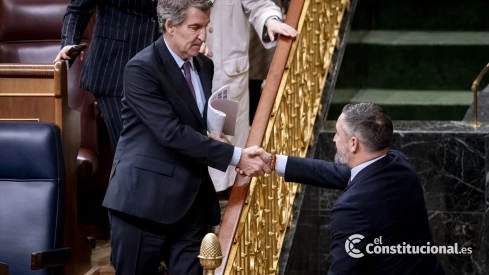
In Spanish politics there are moments when parties must decide which path to follow. In the case of the Popular Party, the strategic debate that opens up for the electoral cycle that will foreseeably culminate in 2027 is increasingly evident: to bet on institutional moderation that has proven effective in Andalusia or to continue with a strategy of confrontation and discursive mimicry with the far-right that, for now, has not generated sufficient majorities.
The experience of Juanma Moreno in Andalusia offers an empirical case that the national Popular Party would do well to study carefully.
An absolute majority built from the center
In the Andalusian regional elections of 2022, Moreno achieved a historic absolute majority for the PP with 58 seats and close to 43% of the vote, the best result ever obtained by the party in the community. The data is relevant for several reasons.
First, because it was achieved without the need for Vox. The previous legislature had depended on its parliamentary support, but Moreno oriented his strategy towards a broader political space: moderate voters, disillusioned social democrats, and centrist sectors that had traditionally backed the PSOE.
Second, because that majority was built from a deliberately moderate discourse, very far from the most polarized rhetorical frameworks that have dominated Spanish politics in recent years.
Third, because that discourse attracted in 2022 half of Ciudadanos voters in 2018 and more than 150,000 socialist voters (15.1% of its base in 2018).
This movement was key for the PP to win in traditionally left-wing strongholds and achieve the worst historical result for the PSOE in the region
The message is simple: stability, management, and institutional cooperation.
The political value of institutional cooperation
One of the most characteristic features of the Moreno style is its institutional respect towards the Government of Spain, regardless of its political color.
This does not mean absence of discrepancies, but a way of exercising opposition or the defense of autonomous interests without turning each crisis into a partisan battle.
A recent example was the institutional coordination after the train accident in Adamuz (Córdoba), where the Junta de Andalucía and the central Government coordinately activated emergency and victim care protocols. Juanma Moreno opted for an institutional and collaborative tone, avoiding the political instrumentalization of a serious event, which was the political route of Feijóo's national discourse.
This attitude inherits the achievement of the Doñana Agreement signed at the end of 2023 between Juanma Moreno and the then Vice-President for Ecological Transition, Teresa Ribera, after the infringement procedure opened by the European Commission for failing to comply with the ruling that condemned Spain for not taking care of the aquifers.
The agreement involved concessions from both sides for the common good (avoiding millionaire European sanctions), and had its correlate three months later when Ribera's ministry suspended the plan due to the amnesty ordered by the Junta for farmers who had planted crops illegally: again Juanma Moreno's attitude returned the “water to its course” (never better said, as both administrations agreed to share the costs of guaranteeing water in the midst of a drought).
Of water, but not due to its defect, but due to excess, after the severe storms that have recently affected Andalusia (February-March 2026), the president of the Junta has focused his strategy on a combination of own resources and a demand, again, for institutional cooperation at national and European level.
The key points of his/her/their stance and actions are:
- Plan "Andalucía Acts": Moreno announced a month ago the mobilization of 1,780 million euros through a reprogramming of the 2026 budget for direct aid and infrastructure reconstruction.
- Request to the Government of Spain: He has formally requested the activation of the state contingency fund to face losses that are described as "million-dollar", especially in agriculture, roads, and municipalities.
- Cooperation with the European Union: In his visits to Brussels, he has demanded the use of the EU Solidarity Fund and greater flexibility in the management of existing European funds to allocate them to recovery after the storm.
- Institutional Leadership: Moreno has claimed a role of "institutional loyalty" and unity to lead the reconstruction.
- Focus on Key Sectors: The aid is primarily directed at the primary sector (agriculture, livestock, and fishing), as well as the repair of more than 500 million euros in damages detected only in the road network.
This type of behavior, common in mature European democracies, reinforces the image of responsible leadership and contributes to generating trust among moderate voters.
The distance with the national strategy of the PP
In contrast, the Popular Party under the leadership of Alberto Núñez Feijóo has been shifting its discourse towards positions increasingly closer to those of Vox on issues such as immigration, historical memory or equality policies and attitudes such as the permanent confrontation with the central Government, which has led to more than a year without meetings with Pedro Sánchez, a period of lack of communication obviously detrimental to the country's interests, but what about those of the Popular Party?
The logic underlying that strategy is known: avoid vote leaks towards the radical right.
However, the recent electoral results invite to question their effectiveness.
In several autonomous communities —Castilla y León, Aragon or Extremadura— the PP has ended up depending as much or more on Vox than before to govern. Even being territories where the PP won the elections, the absence of absolute majorities forces negotiation with the far-right formation.
The failure of the national strategy regarding the regional power of the PP is emphasized in that in two of them (Extremadura and Aragon), the early elections occurred precisely in order not to depend on VOX, and in the third (Castilla y León), they allowed an advance of the PSOE contrary to the national discourse that the main governing party is written off.
In contrast to this evident failure in the objectives, the electoral success of the Party's local baronies in the three territories can be attributed to a strategy and discourse with a focus on the territorial clearly closer to Juanma Moreno Bonilla than to the line set by Alberto Núñez Feijóo at a national level.
The paradox is evident: trying to absorb the political discourse of the far-right has not reduced its political weight, but rather has consolidated it as an indispensable partner.
A worrying electoral transfer
The demographic data reinforce that perception. According to different recent electoral studies, more than 1.3 million PP voters have moved to Vox in recent electoral cycles, while a pocket of about 914,000 undecided voters remains between both parties in the conservative space.
That floating electorate is especially relevant ahead of the elections scheduled for 2027.
Various analyses published in media such as El Constitucional point to the fact that, if the trend continues, Vox could dangerously approach the PP in potential vote, opening the door to a scenario of sorpasso within the right-wing bloc, due to the impact that its current rate of undecided voter transformation (70/30 in favor of the far-right) would cause, if maintained, in medium and small provinces due to the effect of the D'Hondt Law.
For the Popular Party, that would be the worst of worlds: to lose the centrality of the conservative space without having consolidated an alternative majority.
The Andalusian precedent
The Andalusian experience suggests a different strategy.
Juanma Moreno did not compete with Vox on its discursive ground. On the contrary: clearly occupied the space of the European center-right, moving away from permanent confrontation and prioritizing management.
The result was double:
- managed to attract moderate voters from the PSOE.
- reduced the political dependence on Vox.
In other words, it widened the PP's electoral space instead of narrowing it towards the right.
That approach connects more with the tradition of European conservative parties like the German CDU or the Scandinavian popular parties, where institutional moderation is usually an electoral asset.
In fact, the antifascist tradition of the conservative and liberal right in all the countries around us bring Andalusia closer to Europe with the Juanma Moreno formula.
And the Ayuso formula?
The formula of Juanma Moreno in Andalusia is presented as a model of "pragmatic centrism" which, unlike Madrid's more polarizing style, seeks to broaden the electoral base by seducing the moderate voter. While the Madrid model is based on the mobilization of its own bloc through direct ideological confrontation with the central Government, Moreno has shown that it is possible to dismantle historical hegemonies of the left —such as Andalusian socialism— not through confrontation, but through management perceived as predictable, calm, and transversal.
Nationally, Moreno's success is more extrapolable because it responds to the diverse sociology of Spain, a country that mostly defines itself in center-left or center-right positions outside large urban areas (4.7 out of 10, with 0 being the extreme left and 10 the extreme right). The "Andalusian style" prioritizes institutional stability and the tacit pact with sectors of civil society that traditionally distrusted the Popular Party. In a scenario of parliamentary fragmentation, Moreno's ability to absorb practically all of Ciudadanos' vote and, simultaneously, attract more than 150,000 former PSOE voters, offers a more effective roadmap to achieve broad majorities in the Cortes Generales.
On the contrary, the formula of Isabel Díaz Ayuso, although unbeatable in Madrid's unique ecosystem, presents translation difficulties in territories with strong peripheral identities or more rural sensibilities. Moreno's discourse, rooted in a "constitutional Andalusianism" and modern, allows the PP to compete in regions where the excessively centralist or aggressive message generates rejection. His ability to manage the country's internal diversity without renouncing state principles is the asset that best fits the need to offer a government alternative that does not depend exclusively on the hardest right.
Ultimately, if the objective of the center-right is to recover Moncloa, the Andalusian mirror reflects a strategy of "quiet majority" that minimizes the fear of change. Juanma Moreno's management has shown that moderation in forms does not imply weakness in substance, but an electoral penetration tool capable of breaking stagnant ideological blocks. For a national electorate fatigued by tension, the Andalusian model offers an institutional normalization that, today, seems the most solid bridge towards an undeniable national victory.
The strategic debate of the PP
The question that opens for the Popular Party is evident: what model does it want to follow?
One is the one currently being applied nationwide, based on a very tough opposition to the Government and a discursive approach to Vox that has not prevented its growth at the expense of the populars.
The other is the one that has worked in Andalusia: moderation, political centrality, institutional cooperation, and management as the axis of the discourse.
It is not just a matter of style, but of electoral effectiveness.
If the PP's objective is to return to govern Spain with a broad majority, the most successful precedent within the party itself seems to already be on the table.
And comes from the south.
Add ElConstitucional.es as a preferred Google source for free.
Stay informed about all the latest breaking news with the best information. Against disinformation, for democracy and social rights.