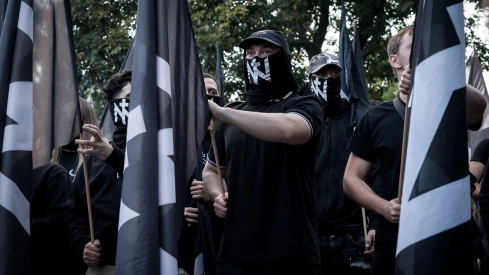
On September 1, the video agency Ruptly, linked to the Russian state media RT, broadcast images of Iván Rico, president of the Spanish neo-Nazi group Núcleo Nacional, during a visit to Kyiv. Eighty-five minutes later, the message was already circulating in Spanish on a channel affiliated with the Kremlin. When the National Police arrested 14 members of the organization last week, Russian state media revisited that trip to present Ukraine as a country that exports Nazism.
The journey of these images is one of the cases included in an investigation by Golden Owl, a company linked to the Science Park of the University of Alicante and specialized in open-source analysis. The study identifies contacts of Núcleo Nacional with ultra groups from 11 European countries and describes two currents within the organization. Part of its leadership sympathized with Moscow. Rico primarily associated with sectors of the European far-right favorable to Ukraine. The researchers explain how Kremlin media took advantage of both.
From pro-Russian contacts to images from Kyiv
Among the most stable relationships of the Spanish group, the study highlights the one it maintained with Der III. Weg, a German neo-Nazi formation with which there was an exchange of visits and organizational cooperation. The investigation also includes contacts with the Italian fascist movement CasaPound and with the youth wing of Die Heimat, the former German neo-Nazi party NPD. The links varied from country to country and extended from Portugal and France to Bulgaria, Romania, and Ukraine.
Within Spain, Golden Owl places one of the contacts with the Russian environment at the inauguration of Núcleo Nacional's headquarters in Madrid, in September 2025. Among the speakers was Koldo Salazar, who presents himself as a collaborator of RT and Sputnik and who, according to the investigation, received an award at the Russian Embassy months later. The report also includes the links of group leaders with Democracia Nacional, integrated into a far-right alliance linked to the circle of Konstantin Malofeev, a Russian businessman sanctioned by the European Union.
In the case of Kyiv, the police investigation maintains that members of Núcleo Nacional received military training during a trip to Ukraine in August. The Ukrainian Embassy in Spain has denied that the Azov Brigade trained members of the group. For Golden Owl, what can be openly followed is the use made of that visit. In the 38 pro-Kremlin Spanish Telegram channels examined by the team, 92% of the publications about Núcleo Nacional used the case to attack Ukraine.
The dissemination took place at a time when the group had already accumulated 115,000 followers on X and about 170 million views in the analyzed publications. Researchers link its pro-Russian sector with messages against the European Union and NATO and document how Russian state media reused the activities of its sector closest to Kyiv. The study leaves uncredited payments from Russia or orders from Moscow to the organization.
Closure of headquarters and an open judicial case
The National Police arrested 14 members of Núcleo Nacional on November 6 in an operation with 12 searches. Six days later, a judge in Gijón provisionally ordered the cessation of the group's activity, the closure of its headquarters in Madrid, Burgos, and Valladolid, and the blocking of its accounts. The case investigates possible hate crimes, illicit association, and illegal possession of weapons. The PSOE announced on Tuesday that it would join the proceedings after learning of the threats against Pedro Sánchez attributed to neo-Nazi leader Isabel Peralta in intercepted conversations.
Among those arrested was Enrique Lemus, one of the group's founders and president of Noviembre Nacional, the party registered by the same circle. Núcleo Nacional confirmed his death this Wednesday in Valladolid, at the age of 63, after suffering a heart attack. Lemus had been released with precautionary measures after testifying in Gijón.
Contact
We are listening. Get in touch.
