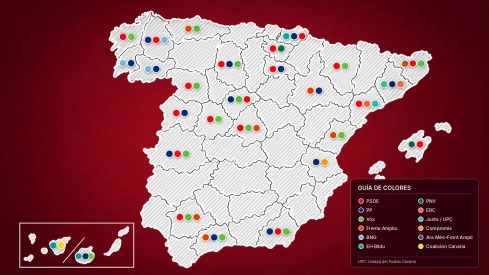
Pedro Sánchez's government is playing for its continuity this Sunday in a succession of provincial disputes that may end up being more important than the distance between the two major parties. Cáceres, Almería, Madrid, Málaga, Valencia, or Pontevedra concentrate some of the fights for the last deputies, with different adversaries and consequences that should be separated. A seat that goes from the PP to the PSOE brings a government alternative closer; one that changes from the PP to Vox keeps the sum of the right-wing parties intact, although it strengthens the far-right in a negotiation to enter La Moncloa.
The model published this Wednesday by 'elDiario.es', developed with 10,000 simulations based on the latest polls, identifies 47 seats at stake in 36 constituencies. Within that set, there are 27, distributed across 25 provinces, that can change the sum of PP and Vox against the rest of Congress. Madrid and Valencia each have two. The other disputes affect the distribution among parties that the model groups on the same side, a fundamental difference for interpreting how many of these battles can alter the majority of 176 deputies.
The right maintains the advantage. In that calculation, PP and Vox gather 168 safe or probable deputies if each party is counted separately. When studying both together, the figure rises to 177, because it incorporates seats whose specific recipient is still open between the two formations. These 177 do not constitute a guaranteed minimum either. The sum reaches an absolute majority in 87% of the simulations, with results conditioned by the polls used and by the way their possible error is estimated.
The SER update of November 24 uses another classification. It identifies 81 open seats, of which 47 can change blocks, and attributes 169 practically decided to the right-wing parties and 134 to the rest. Its right-wing bloc also includes Unión del Pueblo Navarro and Se Acabó La Fiesta. It would need seven of the 47 to reach 176; the rest, 42.
Behind this is the functioning of congressional elections. Votes are converted into deputies within each constituency, without a state pool that gathers votes that remain unrepresented. The D'Hondt method divides the votes of each candidacy by one, two, three, and successively, and awards seats to the highest quotients. For this reason, a party's third deputy can compete with another's second or with a smaller candidacy's first. In provinces that elect three or four representatives, there is much less space for that third or fourth force than in Madrid, which this year distributes 38, or Barcelona, with 32.
The mobilization that Sánchez seeks will have to translate into advances precisely where those quotients are closer. A 75% turnout, the goal that the PSOE has set in the campaign, lacks an automatic translation into seats. It matters who votes again and in which provinces. It also matters that a deviation in the polls can simultaneously affect many constituencies. A greater-than-expected socialist advance could move several deputies at once; a lower-than-estimated left-wing turnout would have the opposite effect.
Cáceres, Almería, and Madrid put the PSOE against the seats the right needs
Cáceres offers one of the clearest examples. It elects four deputies and in 2023 it distributed them equally between PSOE and PP. The possibility that Vox now obtains representation reduces the margin of both. The provincial projection collected by 'infoLibre', with data as of November 24, places the PP at an estimated 84 votes from snatching a deputy from the socialists. In a distribution with Vox's presence, retaining two seats would allow the PSOE to maintain half of the provincial representation; keeping one would leave the other three in the hands of the right. This distance expresses a tie within the calculation, with much greater uncertainty than 84 ballots, and would change if the votes of the other candidacies vary.
In Almería, with six seats, the dispute affects the second socialist deputy and the third PP deputy. Three years ago, the distribution was three for the Popular Party, two for the socialists, and one for Vox. Now, the 'elDiario.es' model places among its most frequent outcomes a distribution of three for the PP, two for Vox, and one for the PSOE, and another of two for each party. In the first, the right-wing parties would gather five of the six deputies; in the second, four. The estimate collected by 'infoLibre' places the PP 3,057 additional votes away from taking the socialist seat. The growth of Vox could increase the sum of the right-wing parties here, in addition to modifying their internal balance.
Madrid, Seville, and A Coruña present another direct fight for the PSOE, this time with Vox. In that same projection, the far-right appears 2,439 votes away from taking a deputy from the socialists in Madrid, 5,439 in Seville, and 4,859 in A Coruña. These are three disputes that directly affect the majority, although they take place in constituencies of different sizes, with 38, twelve, and eight representatives, respectively. In A Coruña, moreover, Vox's entry into a province where it was left without representation in 2023 is at stake. In Madrid, the additional deputy compared to the previous general elections expands the distribution that the polls will have to resolve to 38.
The socialist map extends to small provinces. The analysis by sociologist and former Más Madrid councilor Jorge García Castaño identifies opportunities against the PP in Salamanca, La Rioja, and Palencia, and against Vox in Huesca, Zamora, and Ávila. These are scenarios more favorable to the left than those contemplated by other models, which place several of these disputes mainly between the PP and Vox. The difference forces a distinction between a recovery opportunity and a consolidated tie. In Segovia or Palencia, an exchange between the two right-wing parties would alter their negotiating power; if the PSOE manages to enter that fight and win the seat, it would indeed reduce their combined sum.
Málaga and Valencia show why the "useful vote" changes parties
The situation changes in Malaga and Valencia, where projections place left-wing alliances disputing representation with the right. In Malaga, with eleven deputies, the calculation collected by 'infoLibre' places the Broad Front 4,253 additional votes away from taking a seat from the PP. In Valencia, which elects 16, it attributes the seat that the popular party would try to snatch with 11,693 more votes to Compromís-Front Valencià. There, the candidacy brings together Compromís and forces from the alternative left space, including Podemos. This is a relevant difference compared to territories where they run separately, because those votes compete within the same list to maintain representation.
García Castaño expands the opportunities for that space to Asturias against Vox, Seville against the PP, Castellón against the far-right, and Zaragoza, where the alliance of Chunta Aragonesista and Broad Front is running. He also points to the fifth deputy of the left-wing candidacy in Madrid and the third in Barcelona. His list brings together 21 seats among PSOE, left-wing alliances, and territorial forces. It is a map of objectives to achieve an alternative majority, built with the pre-election data from the Center for Sociological Research and local survey data, and should be read with that methodology. In Malaga, for example, it identifies Vox as an adversary, while the other projection points to the PP. Both see a dispute between blocs, but differ on which party would lose the seat.
Barcelona and the Balearic Islands allow for another situation to be observed. The estimate published by 'infoLibre' places the Broad Front 475 votes away from taking a deputy from the socialists in Barcelona and Ara Més-Front Ampli 1,559 votes away in the islands. In these specific distributions, the change would preserve the sum of both candidacies. It would affect their weight within a possible majority and their ability to negotiate their policies. Other scenarios, such as the one proposed by García Castaño, place the commons against Vox in Barcelona and the Balearic alliance against the PP. The identity of the last competitor changes as several candidacies evolve, something that limits voting recommendations based on a single provincial snapshot.
The electoral barrier adds another difficulty in Madrid, where Podemos presents Irene Montero separately. A candidacy needs to reach 3% of the valid votes in the province to participate in the distribution, and exceeding that threshold does not alone guarantee a deputy. The consulted estimates place Podemos below, with appreciable differences between models. Their eventual entry would force a recalculation of the last quotients of all forces, so it cannot be assigned in advance which party would lose the seat. In Catalonia, however, Podemos runs on the lists of Esquerra Republicana de Catalunya; in the Valencian Community it does so with Compromís and in the Canary Islands within Unidad del Pueblo Canario. Their representation options therefore require a different reading in each territory.
Galicia, Canary Islands and sovereignist forces can change the majority and the investiture
Pontevedra concentrates one of the tightest territorial struggles in the projections. The one published by 'infoLibre' places the PP 166 votes away from snatching a seat from the Bloque Nacionalista Galego (BNG) in a constituency that elects seven deputies. It would be a direct change in the sum of the right-wing parties. García Castaño also points out an opportunity for the BNG against the popular party in Ourense. In Lugo and Ourense, both with four representatives, the maintenance of the PP's third deputy has a particularly important effect, because it would allow it to gather three quarters of the provincial representation. Whether those seats end up in the PSOE or the BNG would produce the same loss for the Feijóo and Abascal bloc, although it would give different interlocutors for a subsequent negotiation.
In Las Palmas, with eight seats, the projection collected by 'infoLibre' places the Nueva Canarias candidacy 146 votes away from taking a deputy from the PP. The ballot with which that space runs is Unidad del Pueblo Canario, which also includes Podemos, Izquierda Unida and Sumar. García Castaño's analysis identifies a dispute there with Vox and another, in Santa Cruz de Tenerife, with Coalición Canaria. The distinction has political consequences. Subtracting a seat from the PP or Vox reduces their joint sum; taking it from Coalición Canaria modifies the weight of a force that can negotiate support or abstentions. The models that group the latter with the rest of the parties outside the PP and Vox are making a statistical classification, without guaranteeing a common position in the investiture.
In Girona, the estimate collected by 'infoLibre' places Junts and the PP at a distance of 2,776 votes for the last deputy, while García Castaño identifies ERC as the force that can dispute that seat with the popular party. In both cases, the PP's entry into a province where it did not obtain representation in 2023 is at stake. In Euskadi, battles of a different nature also coexist. A deputy that EH Bildu wins from the PP in Gipuzkoa reduces the right's options; an exchange between EH Bildu and the PSOE maintains the sum of both. This second dispute appears in 'infoLibre's' projection, with a distance of 1,895 votes. Something similar happens with the struggles between socialists and the Basque Nationalist Party in Álava, or between socialists, ERC, and Junts in Tarragona, when the seat remains among those candidacies.
The composition of these groups will then determine whether there is a majority willing to invest a president. Leaving PP and Vox below 176 does not ensure Sánchez's continuity, who would need to gather sufficient support or achieve more votes in favor than against in a second vote, held 48 hours after the first. Junts, the PNV, and Coalición Canaria retain their own conditions and negotiating capacity. The precedent of 2023 allows us to measure that difference between winning the elections and forming a Government. The PP obtained 137 deputies and the PSOE, 121. Feijóo failed in the investiture; Sánchez was elected president with 179 votes in favor and 171 against.
Contact
We are listening. Get in touch.
