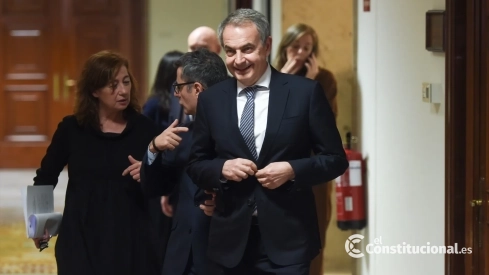
According to what 'El Constitucional' has learned from sources in Miami, Caracas, and Madrid, the mediation of José Luis Rodríguez Zapatero has been vertebral for the ongoing Venezuelan transition towards an advanced democracy that only required three previous milestones: Maduro's departure, the commitment to avoid the risk of civil war from Cabello and Sobrino (within Chavismo) and Machado and González (within the opposition), and total amnesty for prisonersThe work of former Spanish President José Luís Rodríguez Zapatero, a recognized central figure in partial releases of political prisoners (singularly, opposition leaders Leopoldo López and, more recently, Edmundo González), was for years interpreted as soft diplomacy without structural results, but the events of recent months, according to sources close to the three-way negotiation that has led to the start of the Venezuelan transition, force a more demanding re-reading. Sources familiar with the process point out to El Constitucional that the former Spanish president **did not limit himself to facilitating specific releases**, but rather is **the political architect of a deeper commitment**: a total, progressive, and verifiable amnesty for all political prisoners as a *sine qua non* condition for a full transition to democracy led by the pragmatic wing of Chavismo.
That commitment —delicate, opaque, and legally complex— would have been accepted by Washington after direct talks with Marco Rubio, and assumed by Caracas through Delcy Rodríguez, today a central figure in the Venezuelan executive branch.
The strong man of the United States in the three-way negotiation with Delcy Rodríguez and Zapatero, which lasted from the middle of last year, Secretary of State Marco Rubio, forged a close relationship with the former Spanish president on the occasion of the delicate negotiation for the release of 252 Venezuelans detained in El Salvador in exchange for 10 US citizens detained in Venezuela, where Zapatero was a central piece who, moreover, obtained from Chavismo the additional release of 80 Venezuelan political prisoners
This relationship of trust was key in the three transfers made by Rubio at the behest of Zapatero, with the argument of avoiding a more than probable civil war after the incursion of the American Delta Force and the arrest of President Maduro:
- That the operation did not include the Minister of the Interior, Diosdado Cabello (implicated in the same process) nor the Minister of Defense, General Vladimir Padrino, to avoid a chain reaction from the all-powerful secret service Sebin or the army under its control.
- *That instead of, as Rubio intended, trying Maduro in Florida, which applies the death penalty under reduced requirements, as jury unanimity is not necessary for capital punishment, he be tried in the so-called Mother Court of Southern New York, a much more rights-respecting court.
- *That the prominence and leadership in the Venezuelan transition should be "in the Spanish style" and not include the leader of the Venezuelan far-right and recent Nobel Peace Prize winner, María Corina Machado, but rather be headed by the Rodríguez siblings, Delcy and Jorge, then Vice President and President of the Parliament of Venezuela.
In exchange for those concessions, Zapatero obtained from the current president Delcy Rodríguez the double commitment of the **total liberation via general amnesty of all political prisoners,** recently announced by Rodríguez, and the call for free elections monitored by the United States and Europe in no more than 18 months (not yet announced)
From tactical releases to amnesty as political architecture
Until now, the releases of political prisoners in Venezuela achieved thanks to Zapatero's mediation, both with Chavismo and the opposition, had been read as tactical gestures, reversible and selective. The novelty of the current scenario is different: the recent releases are not presented as isolated concessions, but as milestones of compliance within a broader framework, whose ultimate goal is to empty the judicial repression inherited from the years of maximum confrontation of its political-penal content.
Zapatero has achieved something no other intermediary managed: turning amnesty —a legally sensitive concept for Chavismo and politically essential for the opposition— into an acceptable bargaining chip for the United States. Washington was not demanding a symbolic surrender from the regime, but rather measurable results, and the progressive emptying of political prisons meets that criterion without forcing an institutional collapse or a civil war.
Delcy Rodríguez and the credibility of compliance
The focus thus shifts to Delcy Rodríguez. Not as a decorative figure, but as a political guarantor of the agreement. The releases verified in recent months—including high-profile releases and agreed departures to third countries—reinforce the thesis that the commitment is being executed, albeit gradually and without excessive public proclamations. Discreetly
This staggered compliance serves a dual purpose:
- Internal: reduce tensions, de-escalates conflict, and neutralizes risks of violent fracture.
- External: allows the United States and the EU to verify progress without formally legitimizing the regime, keeping its sanctions framework intact as a tool of residual pressure.
It is no coincidence that Zapatero continues to be the only acceptable interlocutor for the three relevant capitals in the process: Caracas, Washington and, to a lesser extent, Moscow, which was personally informed by Delcy Rodríguez of the operation in the days prior to the North American incursion, offering guarantees of subsequent maintenance of Venezuela's commercial ties with Moscow and Beijing.
The delicate constitutional balance of the transition
From a comparative constitutional perspective, the scheme is reminiscent of other negotiated transitions, and particularly, the Spanish one: there is no immediate legal rupture, but a progressive deactivation of the penal-political conflict, which allows for the calling of electoral processes without prisoners, without bans, and without absolute victors
Herein lies the discomfort of the process:
- It does not fully satisfy those who demand immediate punitive justice (the hard wing of anti-Chavismo, embodied by María Corina Machado)
- It does not fit the narrative of epic overthrow.
- But it drastically reduces the risk of civil war, foreign intervention, or state collapse
The amnesty —a constitutionally controversial concept in any system— thus becomes an instrument of stabilization, not of indiscriminate impunity, provided it is accompanied by international verification and political reintegration.
Zapatero as a constitutional operator, not an ideologue
Zapatero's figure emerges, in this context, not as a champion of a regime, but as a political operator of an imperfect exit, aware that comparative constitutional law offers few viable alternatives when the alternative is a power vacuum
If the releases continue and the amnesty commitment is completed, history will have to record that the Venezuelan transition did not begin with a spectacular fall, but with a silent operation, negotiated in offices and executed without cameras.
And in the center of that operation —to the discomfort of almost everyone— José Luis Rodríguez Zapatero reappears: not as a symbol, but as an intermediary, the only one capable of turning the amnesty into transition architecture and of achieving that Delcy Rodríguez effectively begins to fulfill what was agreed upon
Add ElConstitucional.es as a preferred Google source for free.
Stay informed about all the latest breaking news with the best information. Against disinformation, for democracy and social rights.