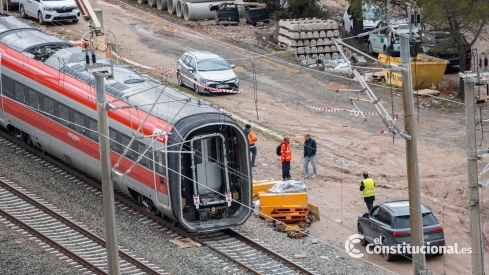
A Civil Guard report reveals that the high-speed line between Madrid and Andalusia registered an electrical anomaly on January 17, 2026, one day before the accident in Adamuz which left 46 dead and more than a hundred injured. Investigators conclude that that alteration was compatible with a rail break or a weld break in the track, but did not activate any automatic alert due to limitations in the configuration of the signaling system.
The document, sent to the Montoro court, rules out other hypotheses such as sabotage, terrorism, speeding or human error, and focuses the investigation on a structural failure of the infrastructure. According to the data collected, the tension on the track dropped anomalously from 9:46 PM on January 17, without reaching the necessary threshold to activate alarms, which prevented the timely detection of a potentially critical fault that could have prevented the derailment.
The researchers detail that the usual voltage on the line remained around two volts in the days prior to the accident. However, from 9:46 PM on January 17, a sustained drop was recorded to approximately 1.5 volts, an "unusual variation during the studied series," which covers from January 12. That alteration persisted for hours until, after the accident occurred on the 18th, the voltage dropped to zero.
These anomalies were registered in the SAM system (Maintenance Aid System), located at the maintenance base of Adif in Hornachuelos (Córdoba). However, said system is not designed to issue automatic alerts in these cases, but rather to be consulted when an incident already exists or during scheduled maintenance tasks, which delayed the possible detection of the problem.
Within the framework of the investigation, the agents also gathered information from the company responsible for the signaling, Hitachi Rail GTS Spain. The company acknowledged that it was technically possible to detect a rail break, but admitted that the system's reliability was limited due to its configuration. Specifically, an alert is only generated when the voltage drops below 0.780 volts, the so-called “occupancy threshold”.
