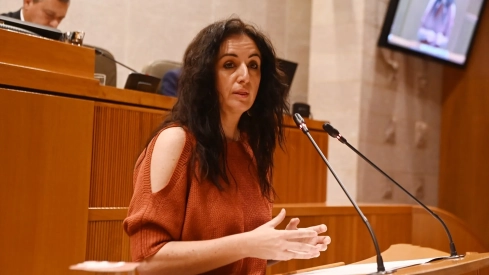
Izquierda Unida confirmed this Thursday that it will promote a candidacy for Congress for Teruel without Chunta Aragonesista, despite the announced withdrawal by its partner to avoid vote dispersion on November 29. The federal leadership of the organization coordinated by Antonio Maíllo supports its Aragonese federation and assures that work is already underway to present the list. The confrontation turns that renunciation into a crisis within the Frente Amplio, with two partners defending incompatible decisions regarding the same province.
The federal support goes a step further than the rejection expressed on Wednesday by IU Aragón. Sources from the leadership maintain that they share their federation's will to run integrated into Frente Amplio in all Aragonese constituencies, including Teruel. The party thus maintains its commitment to a candidacy within the common space, even though Chunta has decided to step aside. The preparation of that list still needs to be finalized and culminate in its electoral presentation.
The response comes less than a day after CHA president, Jorge Pueyo, announced that the coalition would concentrate its efforts for Congress in Zaragoza and Huesca. He justified the Teruel renunciation by the requests for "generosity and responsibility" received to "avoid vote dispersion" and facilitate a progressive majority. IU rejects that calculation and intends to maintain its own ballot to the left of the PSOE.
Chunta demands respect for the agreement
The dispute also affects who has the capacity to decide. The general secretary of CHA, Verónica Villagrasa, claims that the coalition agreement attributes to her party the power to choose in which constituencies the candidacy runs. For this reason, she demands that IU respect what was signed and maintains that any proposal to present a list must be transferred to the joint party table. The disagreement confronts IU's will to run with Chunta's interpretation of the pact.
The coordinator of IU Aragón, Marta Abengochea, had described the withdrawal as "nonsense" and defended that "political responsibility consists of also being where it is most difficult". This Thursday, she acknowledged in 'La Rebotica', on Radio Zaragoza, that her organization had already opposed introducing the clause that allowed CHA to make that decision. The Teruel coordinator, Dani Palomo, has for his part denounced a "disregard" for left-wing voters in the province and has asked why this renunciation applies in Teruel and not in Huesca or Zaragoza.
Within IU, the political argument of concentrating support on the socialists is also questioned. The leader and former deputy Nahuel González has written on X that "withdrawing to ask for a vote for the PSOE is not the solution". In his opinion, part of the discomfort that Vox takes advantage of comes from socialist policies on housing, economy or tourism. "If you renounce representing that discomfort, Vox will turn it into hatred," he maintains. His intervention expresses IU's resistance to leaving that electoral space to the PSOE, even where getting a deputy is more difficult.
Other Frente Amplio leaders have tried to de-escalate the confrontation. The Minister of Culture, Ernest Urtasun, defended this Thursday that the coalition will go out to "fight for each and every vote", although he admitted that there may be particular situations like Teruel that the affected parties will have to explain. The Minister of Social Rights and spokesperson for the candidacy, Pablo Bustinduy, has demanded that organizations stop focusing the conversation on their internal issues and on the lists.
Three seats and two strategies
The clash intersects with the PSOE's proposal to explore withdrawals in certain provinces to concentrate the progressive vote, according to information gathered by 'ElConstitucional.es'. The leaderships of both spaces deny that there is a negotiation for Congress and limit their agreement to the Senate. Emilio Delgado, head of the Frente Amplio list for Madrid, has also clarified that his references to conversations to "optimize" and "maximize" results alluded to internal debates within the coalition. Maíllo had already ruled out on Wednesday that this debate with the socialists had been opened.
Teruel allows understanding the electoral calculation that divides the partners. In the 2023 general elections, the PP obtained two of the three deputies with 26,586 votes, while the PSOE got the third with 22,226. Sumar received 4,126 ballots and was left without representation. Teruel Existe, which had achieved a deputy in 2019, also lost its seat despite gathering 11,348 supports. In a constituency of that size, gathering several thousand votes can be insufficient to enter Congress.
Even a complete transfer of Sumar's votes to the PSOE in those elections would have left the socialists with 26,352 supports, still 234 below the PP, without altering the distribution of deputies. That count helps measure the proximity between blocks, but it starts from a hypothesis of total transfer. The result of 29N will also depend on participation, on the preferences of those who lose their ballot, and on the evolution of the other candidacies. CHA prioritizes reducing fragmentation; IU defends preserving its own alternative for those voters.
In the Senate, there is an agreement between PSOE, CHA, and IU in the three Aragonese provinces, which is the framework in which Chunta maintains its participation for Teruel. The deadline to present candidacies ends on Monday, October 26. IU reminds that it has chosen its candidates for Congress and the Senate since the 13th and assures that its Aragonese federation is already working to have a Teruel list, now with the express support of the federal leadership.
