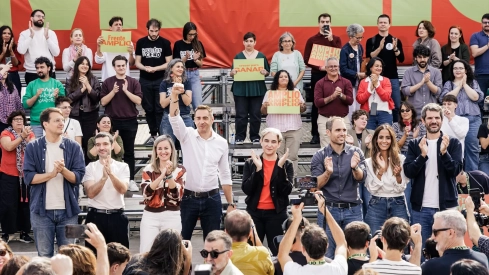
The PSOE has proposed that Frente Amplio renounce presenting candidacies for Congress in certain territories and incorporate people from its space as independents on the socialist lists. The proposal extends to Galicia, the Basque Country, and nine other provinces, according to sources from the space confirmed to 'ElConstitucional.es', who describe contacts and internal discrepancies, but no closed agreement.
The provinces indicated are Cáceres, Badajoz, Huelva, Jaén, León, Salamanca, Albacete, Ciudad Real, and La Rioja. The socialist intention is to gather the progressive vote on the same ballot where its dispersion can facilitate deputies for the PP and the far-right Vox. The proposals transferred for Galicia and Euskadi add another difficulty to the calculation, due to the presence of nationalist and sovereignist forces with consolidated representation.
Izquierda Unida opposes this integration and Frente Amplio, the coalition led by Ada Colau, publicly denies that it is negotiating the withdrawal of candidacies for Congress. The PSOE also officially maintains that it has never put a list pact on the table. The proposals confirmed by this newspaper do not allow us to affirm that there is a formal negotiation accepted by both organizations or a shared willingness of Frente Amplio to assume them.
The controversy comes just four days after the coalition presented itself in Madrid as an alternative to the PSOE and after the failure of the state agreement with Podemos. The issue directly affects its electoral autonomy, in full competition for the voters whom Pedro Sánchez has asked to concentrate their support on the socialist ballot.
Emilio Delgado opens the debate and IU refuses to move it to Congress
The Frente Amplio candidate for Madrid, Emilio Delgado, publicly boosted this possibility on Tuesday night. In an interview on 'La noche en 24 horas', on TVE, he assured that he wanted to be prudent to avoid hindering contacts and stated that he was sure there were "open conversations trying to maximize and optimize electoral results."
Asked about possible adjustments to the candidacies for Congress in some provinces, the Más Madrid leader replied that he assumed the conversations were heading in that direction. He also specified that he was not participating in those contacts and that his responsibility was that of spokesperson.
🗣️ Emilio Delgado (@EmilioDelgadoOr), candidato de Frente Amplio por Madrid: "Estoy seguro de que hay conversaciones abiertas intentando maximizar y optimizar los resultados electorales". #LaNoche24h pic.twitter.com/hADiGYmKXK
— La noche en 24 horas (@Lanoche_24h) October 20, 2026
The subsequent explanation from Frente Amplio is that Delgado was referring to the preparation of the joint lists for the Senate, where an agreement with the socialists does exist. The coalition maintains its commitment to present candidacies for Congress province by province and assures that its withdrawal is not being discussed in the decision-making bodies. Más Madrid and the Comuns have also publicly conveyed this refusal.
The federal coordinator of IU, Antonio Maíllo, set the limit this Wednesday in the Andalusian Parliament. He insisted that the understanding with the PSOE "is limited to the Senate" and added that this debate has not been opened for Congress nor does he believe it will be considered. His position coincides with IU's rejection of the formula known to this newspaper.
Colau left more room for dialogue when asked about this possibility on 'Al Rojo Vivo', from 'laSexta'. The candidate stated that "there will be conversations between parties to finalize them", referring to the lists. She did not announce withdrawals or specify territories, names, or conditions, so her words do not allow the socialist proposal to be considered accepted either.
The numbers change from one province to another
The nine provinces indicated outside Galicia and Euskadi elect forty deputies. In constituencies that distribute four or five seats, a candidacy can exceed the legal minimum of 3% of valid votes and be left without representation. This happened with Sumar in all of them in the 2023 general elections.
To check what a shared candidacy would have meant then, 'ElConstitucional.es' recalculated the distribution by adding the votes of PSOE and Sumar and keeping the support of the other forces constant. The exercise shows a gain of one seat in four provinces and no change in the other five. This is a retrospective comparison, not a forecast for November, and starts from a significant difference compared to the current situation, because that Sumar included Podemos.
In Badajoz, Huelva, and Jaén, all three with five deputies, the 2023 distribution was identical, with two for the PP, two for the PSOE, and one for Vox. The sum of socialist and Sumar support would have allowed the joint candidacy to obtain three representatives and leave the ultra formation without a seat. In Jaén, this advantage would have been especially narrow.
Salamanca is the fourth province where the sum would have changed the result. The PP obtained three of its four deputies and the PSOE, one; a shared list would have turned that distribution into a two-two tie. In contrast, Cáceres, León, Albacete, and La Rioja would have maintained their two popular representatives and two socialists. Ciudad Real would not have changed either, with two deputies for each of the major parties and one for Vox.
That the sum did not alter those five distributions does not prevent it from having effects in different elections. Its usefulness depends on the support of each candidacy and the last seat in dispute, so any calculation for 29N requires knowing how the vote has changed since 2023.
In Galicia, Lugo and Ourense offer the clearest incentive according to previous results. In both provinces, gathering the votes of the PSOE and Sumar would have transformed the three deputies of the PP and one socialist into a two-two tie. In Pontevedra, the four representatives that the two formations achieved separately would have been preserved, compared to the three popular ones.
A Coruña shows a different effect. The PP would have maintained its four deputies, while the joint candidacy would have obtained the other four, leaving out the BNG, which won one in 2023. In that scenario, the growth of the socialist list would have occurred at the expense of another progressive force, without reducing the representation of the right.
In Euskadi, the calculation also does not allow equating an improvement of the joint candidacy with an automatic loss of seats for the PP. In Bizkaia, the three representatives that PSOE and Sumar obtained separately would have been preserved. In Álava, the shared list would have gained a deputy from the PNV, with the PP maintaining its own; in Gipuzkoa it would also have displaced a seat from the PNV, in a province where neither the popular nor Vox obtained representation. The presence of EH Bildu and the PNV forces a distinction between the result of each party and the parliamentary majorities that could be built afterwards.
Rufián questions an integration that compromises their own alternative
Gabriel Rufián, ERC spokesperson and Podemos' electoral ally in Catalonia, questioned this Wednesday the possibility opened by Delgado. "There are many left-wing people perfectly aware of what is coming and who do not want to vote for the PSOE", he wrote on X. In his opinion, optimizing results requires offering those voters an alternative, while integrating into the socialist candidacy produces the opposite effect.
Hay que entender que hay mucha gente de izquierdas perfectamente consciente de lo que viene y que no quiere votar al PSOE.
— Gabriel Rufián (@gabrielrufian) October 21, 2026
Por lo que sea.
'Optimizar y maximizar resultados' es darles una opción de voto alternativa.
Integrase en el PSOE es justo lo contrario. https://t.co/Q90eNVBMZi
His answer connects with Podemos' defense of an autonomous project regarding the PSOE. On Tuesday, before Delgado's interview, Ione Belarra had already questioned the Broad Front's agreement with the socialists for the Senate and had called for rebuilding an alternative capable of overcoming its political limits. Those statements referred to the Upper House pact.
For the Broad Front, accepting the proposal in some territories would require explaining to its voters why they should choose a socialist ballot after advocating for a differentiated option. It would also force to specify what positions the incorporated independent individuals would occupy and what their parliamentary action would be if elected. So far, no such commitments are known.
The withdrawal of a candidacy also does not ensure that all its support goes to another. The final decision belongs to the voters, who can vote for the PSOE, choose a different force, or abstain. This uncertainty limits any operation based solely on adding previous results and gives electoral content to the objection raised by Rufián.
The deadline to register new coalitions closed last Friday, October 16, so the PSOE and the Broad Front could no longer form a formal alliance for Congress now, like the one agreed for the Senate. The presentation of candidacies ends on Monday, October 26, a date until which the possibility of incorporating independents into the lists and deciding where each formation runs remains open.
