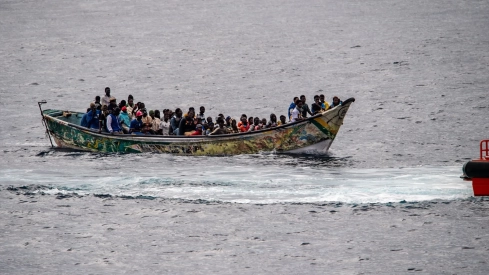
The president of the Cabildo de Gran Canaria, Antonio Morales, stated this Monday that the central Government has the “obligation” to address the “lack of personnel” denounced by organizations and associations of people who assist immigrants arriving on the archipelago's coasts.
In a statement, Morales stressed that there are urgent matters that “do not allow delays” in actions such as the rescue of a boat in danger, assistance to those who reach the coasts, or the need to provide “dignified reception,” and maintained that these decisions should not be conditioned by the electoral calendar.
Beyond the count of arrivals
The island president clarified that the latest figures for migrant arrivals to the archipelago express “the intensity of a situation that demands operational capacity, administrative coordination, and immediate decisions,” while also calling to “look beyond the count.”
In this context, he warned that turning these numbers into a partisan controversy, without addressing the conditions in which people are received, “would shift the debate from public obligations to a dispute over the narrative.” Morales insisted that the Canary Islands can respond in solidarity, but “should not be obliged to respond alone.”
“The willingness of island institutions, professional teams, and society does not replace the responsibility of the State. Nor does it make geographical proximity a sufficient criterion for distributing the effort of reception,” he added.
El Hierro, Lanzarote, and transfers to other islands
Morales indicated that arrivals to El Hierro and also to Lanzarote have consequences for Gran Canaria and Tenerife, and in some cases for Fuerteventura, where subsequent transfers are made. Therefore, he emphasized that these are not isolated island emergencies, but a shared reality that requires cooperation.
“Solidarity among islands is an essential response but has material limits,” he stated, before adding that territorial cooperation needs resources and planning, because otherwise, it runs the risk of becoming a permanent demand for sacrifice for those closest to the emergency.
In this vein, he defended that El Hierro “must be compensated,” as has already been agreed, with social, fiscal, business, and public investment aid.
Available places outside the Canary Islands
The president of the Cabildo de Gran Canaria also alluded to the fact that there are available places in the Humanitarian Reception Program outside the Canary Islands, while the archipelago's resources are under increasing pressure. In his opinion, the central issue is to ensure that this mechanism can be used through effective coordination.
Morales defended that maintaining transfers does not represent an exceptional concession to the islands, but a way of distributing the response within the state territory. In his opinion, the objective should not be to displace people “as if they were an administrative burden,” but to organize care itineraries compatible with their rights and with the capacity of services.
Therefore, he stressed that these transfers require foresight and continuity, and urged the Government of Spain to heed the warnings of associations, unions, and personnel who denounce a lack of staff and work overload.
Shared responsibility with the European Union
Morales concluded that listening to those directly involved is an unavoidable obligation, because the real capacity of a mechanism is not measured only by its formal existence, but by its operating conditions. “A service can be operational and, at the same time, work under difficult-to-sustain pressure. The professionalism of its members should not be used as an argument to postpone reinforcements,” he added.
Finally, he appealed to the shared responsibility of the Spanish Government and the European Union with the Canary Islands, in a response that, he explained, must connect rescue, reception, transfers, institutional cooperation, and diplomatic initiatives with Morocco, Gambia, Senegal, and Mauritania to prevent dangerous crossings and combat criminal networks.
Contact
We are listening. Get in touch.
