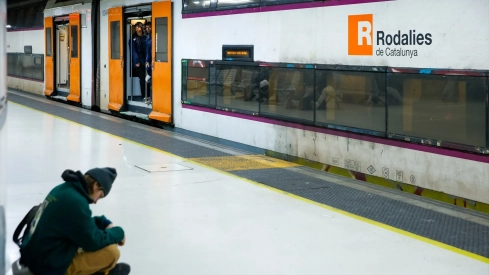
The Rodalies network faces a new day of incidents this Wednesday, marked by the lack of guarantees regarding train circulation and difficulties in transporting affected passengers. The situation is causing long queues at different stations, especially in Maresme, where alternative road services are overwhelmed.
During the early hours of the morning, some sporadic circulations occurred, although passengers did not have clear information about which trains would operate or at what times. At some stations, even, the public address system continued to announce initially scheduled services while travelers were informed that they should not take them into account due to the alteration of circulation.
Renfe reported early in the morning that the service is not operating normally due to causes beyond the company's control and apologized to users. The company recommended resorting to alternative means of transport given the network situation.
The problem is that the buses enabled to cover the affected sections are also unable to handle the volume of passengers who usually use Rodalies. Queues have spread through different municipalities and have generated significant waits to access road transport.
Drivers do not guarantee circulation
The conflict originates from the decision of Semaf, the majority train drivers' union, not to guarantee service provision until it has reports certifying that safety conditions allow for the resumption of circulations.
The director of Rodalies, Òscar Playà, explained in statements to El matí de Catalunya Ràdio that he received a communication from the union around one in the morning warning that the drivers could not ensure that the trains would depart.
Playà has argued that the origin of the situation is a labor dispute and not a safety problem with the infrastructure. The head of Rodalies pointed out that during the previous day, trains circulated safely on the sections that remained operational.
Semaf, for its part, maintains that the drivers have repeatedly demanded the suspension of the service and believes that it cannot guarantee circulation with maximum safety conditions until it has the corresponding reports.
The position has not been supported by UGT or CCOO, who have not joined the protest of the majority union.
The situation occurs after the incidents caused by the rains of recent days. This Tuesday, the train drivers already opposed the reopening of certain sections that Renfe intended to recover, considering that the infrastructure conditions required new checks.
🚆 El servei de Rodalies està pendent dels treballs d’adequació que es fan a la infraestructura després del temporal.
— Protecció civil (@emergenciescat) October 7, 2026
A mesura que es recuperen trams, es fan marxes exploratòries amb trens buits per garantir la seguretat.
🔗https://t.co/jyRWfHsaWB
The R1 remains without trains
The impact on the network is uneven. The R1 remains without train circulation, while in the rest of the lines a progressive recovery of service is expected, although conditioned by the availability of drivers and the state of some sections.
On the R2 Sud, circulation between Vilanova i la Geltrú and Sant Vicenç de Calders remains interrupted. The line was affected after a tree and part of an embankment fell on a train between Vilanova i la Geltrú and Cunit on Tuesday afternoon, an incident that also caused a small fire.
The tree has already been removed and Adif technicians are working in the area to check the state of the track and carry out checks on the catenary before restoring circulation.
Information problems have also been reported at other stations. In Girona, passengers who planned to use Media Distancia services have gone to Renfe customer service points in search of alternatives, while high-speed trains show high occupancy.
The confusion has been aggravated by contradictory messages at some stations. While the public address system continued to announce certain trains as if it were a normal day, other announcements subsequently informed travelers that the service was suspended or not guaranteed.
Road alternatives fall short
Renfe had prepared an alternative transport system since Monday for the sections where the rains had affected the infrastructure. However, the number of available buses is not being sufficient to transport all users affected by the interruption of the railway service.
In Granollers, the first buses to Barcelona began to arrive from early morning in a staggered manner. More than 400 passengers were waiting at the station, while the capacity of the available vehicles forced many travelers to remain in line waiting for new units.
The scenario is repeated in different parts of Maresme. In Mataró, long queues have formed to access the buses, while significant accumulations of passengers have also been registered in Arenys de Mar and Vilassar de Dalt.
Moventis buses covering the route between Mataró and Barcelona are running full and accumulating delays due to the increase in users caused by the interruption of Rodalies.
The situation highlights the difficulties of replacing by road a railway network that transports a high number of passengers daily. Although alternative services have been established in the affected sections, their capacity does not allow for immediately absorbing all travelers who have been left without a train.
For the moment, the day continues to be marked by uncertainty about the recovery of the service. The train drivers maintain their demand for safety reports before guaranteeing operations, while Renfe maintains that the infrastructure allows for operation and keeps alternative road services where trains cannot run.
