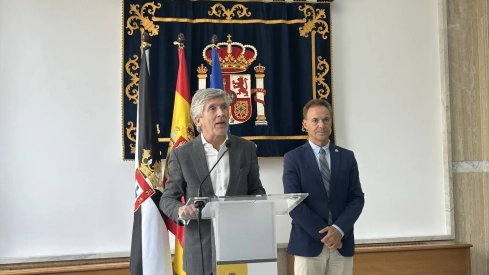
The Minister of the Interior, Fernando Grande-Marlaska, defended this Friday the Government's actions in Ceuta after the massive entry of migrants recorded at the end of July. During his fifth official visit to the city since the beginning of the crisis, he assured that the first phase of the operation has been successfully completed and highlighted the work of the State Security Forces and Corps to respond to an extraordinary situation.
According to data offered by the Interior Ministry, around 12,000 migrants have left Ceuta since August through voluntary returns or as a result of judicial and administrative resolutions. The Ministry has also doubled the resources allocated to processing immigration and international protection files, with a capacity of around 100 files per day.
The Executive is now focusing its efforts on a second phase that combines the reinforcement of security, the identification of people who remain outside reception centers and the improvement of border infrastructures. Marlaska has also set November 1 as the date to clear the settlements that still remain in the city's mountains, with the aim that residents can celebrate the traditional "Día de la Mochila" (Backpack Day) in these spaces.
More personnel and procedures
One of the main axes of the Government's response has been the reinforcement of police and administrative resources. The Interior Ministry maintains more than 600 additional National Police and Civil Guard officers in the city, while intensifying the identification of people who remain outside the authorized centers.
The Ministry has also increased the capacity to process files related to the administrative status of migrants. With an average of up to 100 files per day, the objective is to streamline procedures and resolve each case in accordance with Spanish and European legislation. Marlaska has defended that the recorded departures respond to voluntary decisions or legal resolutions, and has rejected that there have been disguised returns.
This action adds to the work carried out to clear the settlements that had formed on different beaches in Ceuta. According to the minister, this first part of the operation has allowed progress in the recovery of public spaces and improved safety conditions, both for residents and for migrants. The next phase seeks to extend this action to forest areas and other places where people still remain outside reception centers.
New works on the border
In addition to police actions, the Government is preparing new measures to reinforce Ceuta's maritime border. Marlaska has announced advances in the project to extend the breakwaters of El Tarajal and Benzú, two key points for controlling irregular entries by sea.
In El Tarajal, the plan contemplates a first extension of 15 meters towards the sea, which will later reach 100 meters through a vertical dike. The installation of a high-resistance containment net is also planned, which will replace the current provisional devices and seeks to hinder attempts to access underwater. Initial technical work has already begun, although full execution is still pending the necessary procedures, including environmental reports.
These actions are part of a broader strategy to improve surveillance and response capacity in the face of future crises. The Government had already announced that it would request European funding for the works and other border security measures. The commitment to reinforce infrastructure aims to complement the deployment of agents with lasting solutions, instead of limiting the response to specific interventions.
November 1, a key date
The next objective set by the Interior Ministry is to clear the settlements that remain in the mountains of Ceuta before November 1. The date coincides with Día de la Mochila (Backpack Day), a traditional celebration in which numerous families and groups of friends go out to natural spaces to spend the day together.
Marlaska recalled that the Government had already committed to clearing the beaches of Benítez, El Trampolín, and El Guano before October 11, a deadline that the Ministry considers met. Now, the Executive intends to continue with actions in forest areas, where people who settled there after the massive entry at the end of July are still located.
The fulfillment of this new commitment will depend on the development of the operation and the location of those who remain outside the reception centers. The Interior Ministry maintains that the priority is to restore normality in the city and maintain security, while the processing of files continues. With the police reinforcement, administrative streamlining, and new planned works, the Government seeks to consolidate a response that combines border control with compliance with the law.
