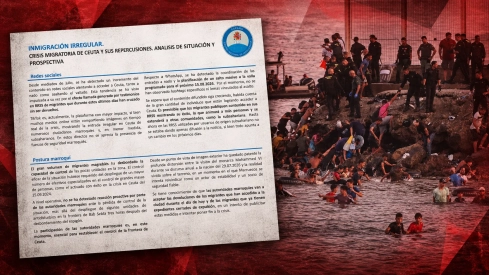
The reports declassified by the Government on the migratory crisis in Ceuta put the focus directly on Morocco's actions during the massive entry on July 30. An analysis prepared that same day concludes that the Moroccan authorities did not react proactively when the situation began to get out of hand and that the riot police reinforcement arrived about three hours after control of the border breakwater had been lost.
The document describes a morning in which the Moroccan Auxiliary Forces were overwhelmed and "did not intervene to prevent access to the sea," while increasingly numerous groups began to skirt the breakwater separating Morocco from Ceuta by sea. The flow ended up becoming an uncontrolled entry into Spanish territory before noon.
The subsequent assessment of Rabat is particularly harsh. Under the heading of "Moroccan Stance," the report states that the high number of Maghrebi migrants overwhelmed the capacity of the "few units" deployed in the area and considers that it would have been necessary to mobilize a greater number of specialized personnel in controlling large concentrations. As a reference, it recalls the device activated by Morocco during the crisis recorded in Ceuta on September 15, 2024, which it describes as successful.
Three hours until the riot police deployment
The analysis puts in writing one of its most compromising conclusions for the Moroccan authorities. "At an operational level, no proactive reaction has been detected on the part of the Moroccan authorities to the loss of control of the situation," it states, and initially limits the response to the deployment of some riot units at the Bab Sebta border "three hours after the breakwater overflow."
The chronology included in the report itself allows reconstructing how the crisis escalated. At 9:00 p.m. on July 29, the eve of Throne Day, the situation in Fnideq had already reached a "critical point," with a crowd waiting to jump into the water and try to reach Ceuta. During the following morning, the Auxiliary Forces were overwhelmed and access to the sea began to occur without sufficient control.
The Civil Guard initially tried to contain the migrants and group them in a fenced area of the border crossing, but from 11:00 AM that pocket ended up breaking, according to the document, due to the fear of those who were there of being returned. Before noon there was already an uncontrolled flow crossing the breakwater and a strong concentration of people had been generated on its Moroccan side. The report counts eight deaths throughout that day.
Meanwhile, columns of people formed from the nearby slopes and traffic jams occurred on the A7 between Tetouan and Castillejos. Moroccan local authorities even declared themselves overwhelmed by the events. The first riot police were not deployed in the vicinity of Bab Sebta until around 1:30 PM. Their arrival caused a significant part of those who remained in the area to throw themselves into the sea and try to swim around the breakwater.
The report also analyzes broadcasts made from the area during the concentrations. In some of them, in which numerous Moroccan citizens and also people of sub-Saharan origin were observed, analysts assure that no presence of Moroccan security forces was appreciated.
The criticism also extends to Rabat's political narrative. The document argues that the crisis revealed a "profound distortion" between the vision conveyed by Mohamed VI in his annual address to the nation on July 29 and the reality experienced on the ground just when Morocco sought to assert itself as "an actor of stability and a reliable security partner."
For the authors of the analysis, Moroccan collaboration was already essential to regain control. The same report indicated that Rabat was willing to accept the returns of those who had entered Ceuta that day, as well as migrants with already closed expulsion files. Intelligence services also interpreted this move as an attempt to publicize the measures taken and end the crisis.
Previous alerts already looked at Morocco
The tone is especially relevant when compared to the reports prepared before July 30. On the 28th, the National Immigration and Borders Center was already considering as a hypothesis a possible temporary relaxation of Moroccan controls during national festivities, which could function as a mechanism of political pressure and reinforce the perception of Spain's and the European Union's dependence on the migratory control exercised by Morocco.
Those first notes were still cautious. They spoke of a “possible geopolitical pattern” and of signals detected on networks, without accrediting that there was a deliberate decision by Rabat to facilitate entries. Two days later, once the overflow had occurred, the analysis already confirmed on the ground the absence of a proactive reaction, the insufficiency of the deployment, and the arrival of riot police reinforcement several hours later.
The July 30 prospective itself again related the chosen moment to Throne Day, a date used in calls disseminated on social media to try to cross into Ceuta and Melilla. Analysts pointed out that these messages recurrently referred to a supposed relaxation of Moroccan border controls during the celebrations.
The report also warned that the strong impact of that day's entry could fuel new movements towards the border. Displacements towards Ceuta had already been detected from different cities in Morocco and even from Nouadhibou, in Mauritania, and it was feared that the dissemination on networks would act as a catalyst for new arrivals and extend the pressure towards Melilla and the Chafarinas Islands.
The internal forecast even managed more than 20,000 crossings and warned that a scenario of that magnitude would seriously compromise Ceuta's health and assistance structures. By then, Spanish intelligence itself had written that regaining control of the border essentially depended on the participation of Moroccan authorities.
