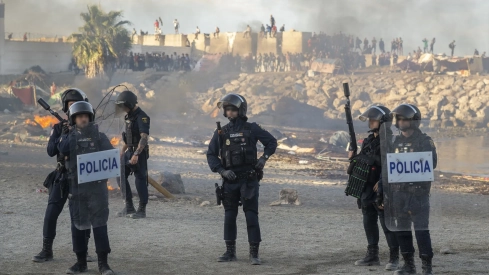
The entry of more than 70,000 people into Ceuta on July 30 and 31 was preceded by planning and had strategic direction on the ground. That is the main conclusion of the report prepared by the National Center for Immigration and Borders (CENIF) and sent to the National Court judge María Tardón.
'ElConstitucional.es' has had access to the content of the document, titled 'Report on the massive irregular entry into Ceuta'. Its 55 pages analyze photographs, videos, messages disseminated on social networks, and warnings handled by the Police before a crisis that overwhelmed the Spanish border for hours.
CENIF rejects that such a concentration arose accidentally or spontaneously. The investigators appreciate a "prior planning", an intellectual authorship prior to the events and another material that acted during its development through monitoring, control, and guidance functions.
The most delicate conclusion directly affects the Moroccan Security Forces. The report highlights their scarce presence at the border during the decisive hours and points to an "active guiding" of migrants towards the crossing points by Moroccan agents.
The graphic annex includes images of uniformed gendarmes who apparently indicate where to advance and direct groups towards the coast. People dressed in plain clothes also appear whose behavior leads analysts to suggest that they could belong to the Moroccan Intelligence services.
This identification stems from the analysis of material disseminated on social networks and media. CENIF lacks agents deployed in Morocco and the document does not expressly attribute to the Government of Rabat a specific order to organize the operation. The possible involvement of Moroccan agents constitutes a police conclusion pending judicial verification, not an already accredited political or criminal responsibility.
A plan to block the Spanish response
The choice of Ceuta, the points used to enter, the hours chosen, and the successive incorporation of different profiles form, for the investigators, a combination impossible to explain by simple coincidence. The report appreciates an execution divided into phases and adapted to the response of the Spanish authorities.
The identified objective went beyond crossing the border. The first phase would have sought to collapse the border management system by forcing the concentration of personnel on rescue efforts. The second aimed to "eliminate Spain's response capacity" while entries continued at other points.
The subsequent behavior of most of the people who crossed appears as another relevant element. The report estimates that only about 10% remained in Spanish territory and describes the return to Morocco as a relatively orderly and high-volume departure. CENIF maintains, based on this data, that the migratory purpose acted as a "formal cover" for a process with other objectives.
This interpretation coincides with the figures offered by the Government a few days after the crisis. Interior estimated that some 72,000 people had entered Ceuta and that nearly 70,000 returned to Morocco during the following days.
Analysts also detect a specialization that they place beyond the reach of organizations usually dedicated to irregular immigration in that area. The simultaneous concentration of thousands of people, their transfer to specific points, and the adaptation of the calls required, in CENIF's opinion, coordination, knowledge of the terrain, and real-time monitoring.
The report leaves the intellectual authorship unidentified and also does not determine which structure would have directed the entire process. It rules out the capacity of mafias based in Ceuta to deploy an operation of such dimensions, although it keeps open the possible intervention of other organizations. Israel, pointed out during the first days in some political hypotheses, is not even mentioned.
Social media played a decisive role. The document compiles calls disseminated before July 30 on Facebook, Instagram, TikTok, and messaging services. Some announced an "assault" on Ceuta, indicated the date, and encouraged advancing in small groups.
When entries began, messages simultaneously appeared claiming that the border was open and calling for more people to move to it. The activation and disappearance of profiles, the repetition of content, and its coordinated dissemination lead the Police to appreciate a pattern prepared to multiply the reach of the calls.
One of the most widespread messages misrepresented the Supreme Court's ruling on the returns of those who arrive by swimming. Its content was reduced to a simple and false phrase in those terms, "if you enter swimming, they cannot return you," which offered potential participants an apparent legal guarantee.
Messages also circulated about the extraordinary regularization process promoted in Spain and about an alleged lack of surveillance coinciding with the Feast of the Throne. The main celebration took place at the royal residence in M'Diq, located just over 20 kilometers from Ceuta, and part of the Moroccan forces was assigned to protect the royal family.
The Police believe that this coincidence fueled the perception that there was "tacit consent" to advance towards the border. The contrast came on August 15, when a large Moroccan deployment kept the border with Ceuta controlled for more than 48 hours and prevented a new massive entry.
The report that the Interior Ministry was unaware of
The document incorporates nine alerts and informative notes sent by the CENIF to the border posts of Ceuta and Melilla, to the General Commissariat of Immigration and Borders, and to the superior headquarters of Ceuta and Western Andalusia. Two were prepared during the days prior to the crisis.
One of them, dated July 29, warned of a high risk of entries by sea or by jumping the fence. The warning contemplated the possibility of an attempt to access, although it lacked an estimate of its magnitude and did not anticipate that tens of thousands of people would cross the next day.
Judge María Tardón had ordered the investigative team not to share the preparation or content of the report with their superiors. The document was delivered directly to the Audiencia Nacional, and Francisco Pardo, director general of the Police, maintains that he was unaware of its existence until the magistrate authorized its internal consultation this Wednesday.
After examining it, Pardo informed Fernando Grande-Marlaska that "there is no police report whatsoever" that attributes the planning or execution of what happened in Ceuta to the Moroccan Security Forces. The literalness of the document known hours later has opened an evident rift with that explanation.
The report separates both planes. It speaks of prior planning and strategic direction without formally identifying those responsible, while attributing to members of the Moroccan forces the guiding of people towards the entry points. It does not maintain that these agents designed the entire operation, but it does assign them active participation during its execution.
Interior has also downgraded the July 29 document to a usual alert that did not foresee a massive entry the next day. The CENIF, however, incorporates that warning within the sequence of information prior to the crisis and builds its conclusions through the subsequent analysis of everything that happened.
Félix Bolaños has asked for "maximum caution" and has defended that the Government did not hide information. The Minister of Justice explained that the Executive learned of the existence of the report through published information and that it had to study its content before drawing conclusions about Morocco.
The Prosecutor's Office of the Audiencia Nacional is now analyzing the document to decide if the facts fit into crimes of criminal organization, against the rights of migrants or against high bodies of the nation. It must also rule on the competence of this court to investigate the complaint filed by Iustitia Europa.
The images and messages have allowed the CENIF to reconstruct a coordinated operation and place Moroccan agents at points where migrants were guided. The Audiencia Nacional must determine who organized that mobilization, what orders those people received and how far the participation of the Moroccan authorities went.
