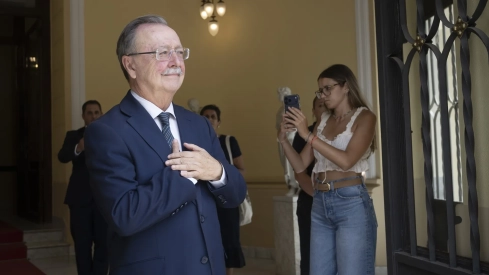
The Government of Ceuta has decided to see through the investigation into the massive entry recorded at the Tarajal border. The Governing Council, meeting this Thursday in an extraordinary session, has agreed to appear as a private prosecution in the case opened in the Audiencia Nacional for the events that occurred on July 30 and 31.
The City maintains that that episode "directly and seriously" affected its public assets and interests. During those days, the arrival of thousands of people put essential services under enormous pressure, altered public safety and tranquility, and overwhelmed the system for the protection of unaccompanied foreign minors, whose guardianship falls to the Ceuta administration.
The Executive of Juan Jesús Vivas intends for the procedure to allow determining the extent of these damages and to claim, if the investigation proves the existence of crimes, the corresponding criminal and civil liabilities. The institution believes it must intervene to defend its interests and the rights of those it presents as the victims of what happened, "in this case the people of Ceuta."
If the Audiencia Nacional accepts its appearance, the autonomous government will be able to participate in the case, provide the documentation it deems relevant, and convey to the judicial body its assessment of the damages sustained by the city and its public services.
An investigation pointing towards Morocco
The case is led by Magistrate María Tardón, who opened proceedings after a complaint from 'Iustitia Europa' and ordered several reports before deciding whether the Audiencia Nacional is competent to continue with the investigation. The chief prosecutor of this body, Jesús Alonso, has personally taken on the matter due to its "uniqueness and transcendence."
Among the documentation sent to the court is a police report that includes testimonies and images about the alleged "active guidance" of migrants by Moroccan agents. The document questions whether a mobilization of such magnitude could have been organized solely by human trafficking networks, although its conclusions will have to be examined within the procedure and there is still no judicial resolution attributing responsibilities.
Ceuta's decision comes after Pedro Sánchez appeared in Congress to argue that, for now, there is no conclusive evidence that Morocco designed or executed the operation. The president highlighted Rabat's subsequent collaboration in the returns and announced that the Government will make available reports public. Vivas described his explanations as "pathetic" and reproached him for avoiding pointing fingers at the neighboring country.
With its entry into the case, the Ceuta Executive seeks to have the questions about those two days resolved in court and for those responsible for the damages suffered by the city to answer for them if they can finally be identified.
