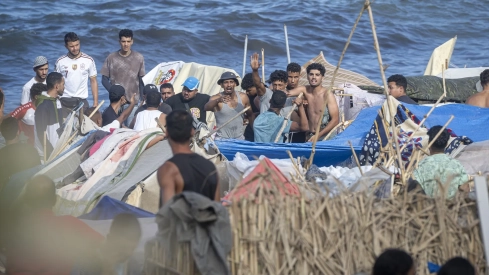
The Government has reinforced surveillance in Ceuta and Melilla due to messages circulating on social media calling for a new entry from Morocco this Wednesday, September 23, the day of legislative elections in the neighboring country. Foreign Affairs and Interior are working with Rabat to prevent another massive crossing, although Minister José Manuel Albares has specified that, for now, the calls are not "gaining traction" like those that preceded the crisis at the end of July.
The date appears in publications that present election day as an opportunity to cross the border. This call has not yet translated into a concentration of people near the perimeter, and another call disseminated for this Sunday, September 20, also did not lead to a massive entry. The Government has chosen to anticipate while its intelligence services monitor the evolution of messages and movements in the area.
Reinforcements on both sides of the border
The Minister of Interior, Fernando Grande-Marlaska, confirmed this Monday the preventive reinforcement of the two autonomous cities. As he explained, the deployment includes three units of the Civil Guard's Reserve and Security Group in each city, after evaluating the available information in coordination with Morocco and the European Union. He spoke of a "moment of concern," although he insisted on the preventive nature of the measures. The Government delegate in Melilla had already confirmed the arrival of additional personnel to that city.
On the Moroccan side, security forces have increased their presence around Fnideq, the border town with Ceuta. A report from the ground describes checkpoints on access roads, police vehicles, and agents deployed next to the Bab Sebta crossing. Morocco also carried out an intervention drill near the border last week.
Albares maintains almost daily contact with his Moroccan counterpart, Naser Burita, and has requested a "deterrent mechanism" prepared to act if necessary. The minister maintains that cooperation is also focusing on combating misleading messages about what happens after entering Ceuta. In his words, the information campaign seeks to prevent people from "risking their future and money in the hands of these mafias".
The Spanish Embassy in Morocco has disseminated warnings on social media and through the local press. "Entering Spain irregularly through Ceuta and Melilla does not grant the right to access the Peninsula, to remain in Spain, or to circulate freely within the EU," it states in one of its messages. The legation also asks that false interpretations of the recent Supreme Court ruling on sea entries not be spread.
1/4
— Embajada de España en Marruecos (@EmbEspanaRabat) September 19, 2026
ℹ️Información importante:
Entrar irregularmente en España a través de Ceuta y Melilla no da derecho a acceder a la Península, a permanecer en España o a circular libremente por la #UE. pic.twitter.com/iRnHRtbByB
Ceuta continues to address the July crisis
The prevention comes with Ceuta still focused on assisting those who entered at the end of July. Marlaska estimates that between 3,000 and 3,500 people remain outside reception resources, an approximate figure that shows the pressure the city is under before the new date indicated on social media. The Government continues to prepare accommodations, identify minors, and process the files of those who arrived during that crisis. The Executive also plans to continue transfers to reception spaces.
In Melilla, the Government of Juan José Imbroda has requested an urgent meeting of the Local Security Council before Wednesday. He wants to know what official information the security forces have about the calls and how the administrations would coordinate if pressure at their border increased.
Add ElConstitucional.es as a preferred Google source for free.
Stay informed about all the latest breaking news with the best information. Against disinformation, for democracy and social rights.
