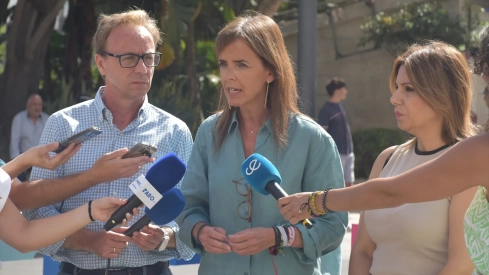
The Popular Party has estimated at more than 12,000 the number of migrants who still remain in Ceuta after the massive entry on July 30 and 31. The deputy secretary of Health and Social Policy of the party, Carmen Fúnez, demanded this Tuesday that the Government accelerate returns to Morocco and reinforce police presence and health resources in the city.
"Ceuta is not experiencing a normal situation in any case," Fúnez affirmed after visiting different points of the autonomous city for two days. The popular leader described an "absolutely exceptional" situation, with people camped on the beaches or concentrated in the vicinity of the Tarajal industrial estate.
Fúnez assured that some residents have expressed their fear of going out into the street and has demanded more agents to guarantee security. She considers it insufficient that reinforcements are concentrated on preventing a possible new massive entry starting on August 15. "What is needed are state security forces right now," she defended.
Returns with legal guarantees
The figure of 12,000 corresponds to an estimate by the PP. The Government has not yet provided a definitive public balance on how many people remain in Ceuta, although the different administrations agree that several thousand continue in the city awaiting the resolution of their situation.
The Minister of Foreign Affairs, José Manuel Albares, assured this Tuesday from Ceuta that all people who entered irregularly will be returned when appropriate, always within Spanish legislation and respecting judicial resolutions. He also stated that Morocco maintains its willingness to collaborate in the returns.
Minors are subject to a specific procedure. Their identity, age, and family situation must be studied individually before deciding on a possible reunification with their families, a transfer to the protection systems of other communities, or any return with guarantees.
The PP requests a health emergency
Fúnez also demanded that the Government declare a health emergency, activate the strategic disaster plan, and recognize Ceuta as a difficult-to-cover area to attract more professionals. The city's healthcare depends directly on the State through the National Institute of Health Management, unlike the autonomous communities that have transferred these competencies.
According to data provided to the PP by health representatives, emergencies have gone from attending between 100 and 150 patients daily to exceeding 500. Fúnez has also pointed out that there is a shortage of about 50 nurses, 20 Primary Care doctors, and a similar number of hospital specialists.
The popular leader explained that more than 90 people were waiting this Tuesday to be attended by five doctors, 12 nurses, and five auxiliary care technicians. During the night of the massive entry, seven doctors, 12 nurses, and five auxiliaries attended to more than 1,500 people with hypothermia, fractures, and symptoms of drowning.
The diagnosis clashes with INGESA's version. The organization denies that there is a collapse, assures that about half of the hospital beds remain available, and maintains that the reinforcements deployed have allowed ordinary activity to be maintained. Mónica García has also defended that the massive arrival has not forced the suspension of consultations nor has it interfered with the usual care for Ceutians.
The PP maintains that these general data do not reflect the pressure borne by emergencies or the structural lack of professionals. Fúnez has announced that her party will take its claims to Congress, the Senate, and the European Parliament.
Add ElConstitucional.es as a preferred Google source for free.
Stay informed about all the latest breaking news with the best information. Against disinformation, for democracy and social rights.
