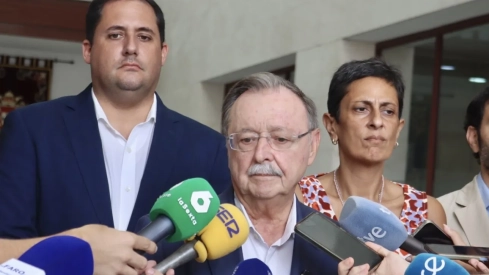
Juan Jesús Vivas has increased pressure on the Government this Monday to directly assume the management of the migratory crisis in Ceuta. The president of the autonomous city has demanded the urgent opening of a Foreigners Internment Center where people with expulsion files remain confined, in addition to a single state command to coordinate all actions.
Vivas has conveyed his demands to the Minister of Territorial Policy and Democratic Memory, Ángel Víctor Torres, during the meeting they both held in Ceuta. The popular leader believes that the city is still very far from having recovered normality after the massive entry from Morocco on July 30 and 31.
The Ceuta president has avoided offering a closed count, although he estimates that between 8,000 and 11,000 people still remain in the city, compared to the approximately 2,000 managed by the central Government. He has acknowledged that his estimate is based on the situation observed in the streets and on information provided by residents and police officers.
"There are thousands of people wandering our streets, our neighborhoods, thousands of homeless people, without a place to attend to and satisfy their vital needs," he said. Vivas has linked this situation to security, coexistence, cleanliness, and public services functioning problems.
A CIE and more resources
The main measure proposed by Vivas involves enabling a state facility to function as a CIE for those with open expulsion proceedings. "By saying this, we are saying that they will be confined," acknowledged the president, who intends to keep their freedom of movement restricted until the procedures conclude.
The decision rests with the State, and each admission would require judicial authorization. The Immigration Law establishes that CIEs do not have a penitentiary character, limits internment to the essential time, and sets a maximum duration of 60 days. Unaccompanied foreign minors are excluded from these centers and must remain under the protection of the competent administrations.
Vivas has offered the collaboration of the City to find possible locations, although he believes that Moncloa should resort to its own facilities. As he has argued, concentrating people awaiting expulsion there would allow their basic needs to be met, reduce their presence in the streets, and streamline administrative procedures.
To launch this plan, he has requested more officials in Immigration, Justice, and the Public Prosecutor's Office, in addition to reinforcements for the National Police and health services. Ceuta's health area is overwhelmed by a cyclical population increase that Vivas estimates at around 10%.
The president also wants to maintain the deployment of the Army in the streets, critical infrastructure, and strategic points until the situation stabilizes. To this, he has added a "substantial" increase in the personnel of the State Security Forces and Corps.
Coordination would be in the hands of a single command dependent on the Government of Spain, with the participation of all involved ministries and the Autonomous City. Its function would be to direct actions, distribute resources, and monitor compliance with the shock plan.
Vivas has also demanded a strong response at the border with Morocco. "On July 30, we saw that the border was in the hands of a third country, we saw that the border could be violated," he stated before warning that an entry like that cannot be repeated "neither on the 15th nor ever". For that date, new calls are circulating on social media encouraging attempts to reach Ceuta.
The Government prioritizes minors
Ángel Víctor Torres has made the care of the nearly 1,400 children and adolescents registered since the massive entry a priority. The minister has advocated for reunification with their families in Morocco, provided that ties are verified and there are sufficient guarantees to protect the best interests of the minor.
The process will require the collaboration of the Moroccan authorities, families, and the minors themselves. The Government is also studying enabling part of the old military hospital to expand reception resources, although it must first verify that the facilities meet the necessary safety and health conditions.
Torres has announced new visits to Ceuta by ministers José Manuel Albares and Margarita Robles to address relations with Morocco and military deployment. The Executive has also reinforced the staff of the Government Delegation, the Civil Guard, and the National Police.
The meeting ended without a commitment from the Government to open the CIE requested by Vivas or to accept the single command. The Ceuta president maintains his demand for an immediate response: "We are going to resist, but whoever can and should must help us resist."
Add ElConstitucional.es as a preferred Google source for free.
Stay informed about all the latest breaking news with the best information. Against disinformation, for democracy and social rights.
