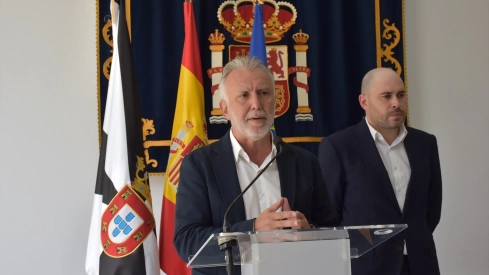
The Government of Spain has raised the figures of migrant people from Morocco who entered Ceuta on July 30 and 31. Despite having defended that there were 70,000 people, this Monday, the Minister of Territorial Policy and Democratic Memory, Ángel Víctor Torres, has increased the figure to 80,000, a figure he conveyed after meeting with the president of the autonomous city, Juan Jesús Vivas, who last Friday estimated that between 8,000 and 11,000 people are still in Spanish territory.
Similarly, he has announced a reinforcement of resources to assist the approximately 1,400 minors who have been identified so far. He has also advanced that this Tuesday the Minister of Foreign Affairs, European Union and Cooperation, José Manuel Albares, will visit Ceuta, and on Wednesday the Minister of Defense, Margarita Robles. In this regard, he has stated that the Government "is here today and will continue to be here."
The care of minors remaining in Ceuta has become one of the Executive's priorities. Torres explained that around 1,400 have already gone through the identification process, although he warned that the data is still open because identification efforts have not yet concluded.
Given this situation, the deployment in the city has been expanded. The personnel of the Civil Guard have increased by 40%, while those of the National Police have done so by 30%, with the support of the Armed Forces in the necessary tasks. This reinforcement is joined by the increase in personnel in the Government Delegation, which now has 50% more workers to accelerate identifications and process the necessary documentation to refer minors to other reception resources.
Regarding the destination of these children and adolescents, Torres has indicated that the priority is to facilitate their reunification with their families. However, he has acknowledged that this procedure presents difficulties, as it requires locating family members and having the consent of both the minor and their family and the authorities of the country of origin.
The Government plans to resort to the mechanisms contemplated in the reform of the Immigration Law to distribute minors among different communities when a migratory contingency situation is activated. Torres recalled that more than 2,000 minors have already been transferred from Ceuta, Melilla, and the Canary Islands to other territories, around 700 of them from Ceuta, with the aim of preventing the pressure of reception from concentrating in border cities.
The lack of reception places is another difficulty the city faces. The Executive is analyzing different spaces that can be enabled to care for minors, among them the old military hospital, whose facilities have already been inspected. Torres has defended that the objective is to offer a response "as adequate as possible" and has admitted that, although the situation is no longer that of the first moments of the emergency, the presence of minors continues to generate considerable pressure on Ceuta. "What we have to do is work with loyalty," he claimed.
Add ElConstitucional.es as a preferred Google source for free.
Stay informed about all the latest breaking news with the best information. Against disinformation, for democracy and social rights.
