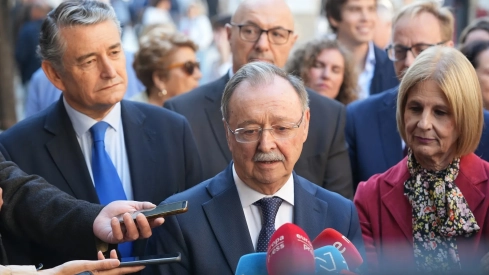
The president of the PP of Ceuta and president of the Autonomous City of Ceuta, Juan Jesús Vivas, insisted this Friday that, “three months after” the entry of migrants through the border with Morocco, the city is experiencing “an unsustainable situation”, far from normality, and has criticized those who claim otherwise because, in his opinion, they intend to convert this lack of normality into a new assumed reality.
In statements to the media during a visit to Jerez de la Frontera, alongside the candidate for Congress for the PP of Cádiz, María José García-Pelayo, and the coordinator of Presidency, Health and Emergencies of the PP of Andalusia and regional parliamentarian, Antonio Sanz, Vivas stated: “We will not allow it”.
Criticism of the Government and the CNI report
Juan Jesús Vivas assured that what happened in Ceuta “could have been avoided” if the National Government had acted as it should and had fulfilled its constitutional obligations, and criticized that it did not do so then “neither during, nor now”, which, in his opinion, has resulted in the rights of the 83,000 people living in the autonomous city being violated.
The popular leader described as “incomprehensible” that the report from the National Intelligence Center (CNI) about a possible entry of migrants into Spanish territory was not heeded, nor were the “alarm, attention, and urgency calls” that, he said, were conveyed from the city in the preceding days.
Vivas also reproached the President of the Government, Pedro Sánchez, for saying that the territorial integrity had been attacked and then immediately going on vacation, and also regretted that he did not maintain a firm attitude with Morocco, considering that country was allegedly responsible for the entry of thousands of migrants on July 30 and 31.
Consumption, crime, and pressure on services data
The president of the Autonomous City reiterated that what happened constituted “an attack on the territorial integrity of Spain”, jeopardized national sovereignty, and led Ceuta to an “absolutely unsustainable” situation that, he said, continues three months later.
Although he acknowledged that many of those migrants returned to their countries of origin, he warned that a number of people still remain in the city who, in his opinion, represent 20% of Ceuta's population. In that sense, he regretted that the Government has not provided the specific data on how many remain in the city, because, he said, “it is not even capable, or does not want or cannot or does not know, to give us something so fundamental and elemental”.
Vivas based this calculation on the fact that water consumption in Ceuta last October “increased by 20% compared to October 2025”, and added that nothing different from the entry of migrants has occurred there to justify this increase.
To this, he added other data that he attributed to the city's situation, such as a 60% increase in crime, with public order disturbances, brawls or fights that, he noted, have grown by 300% in October compared to the same month of the previous year. In addition, he said that hospital emergencies have skyrocketed and that notifiable diseases have increased by 80%.
“Ceuta's businesses, our SMEs and self-employed workers lose one million euros a day”, Vivas stated, before adding that, walking through the streets, what is perceived is “sadness, anguish, unease, uncertainty” and “the bitter feeling of being invaded”.
Political message and support for García-Pelayo and Feijóo
In his speech, the Ceuta president described this situation as “unjust” and also considered it “incomprehensible” that Pedro Sánchez announced that all state resources and capabilities would be used to solve the problem and that, three months later, Ceuta remains in the same situation, according to his diagnosis.
Despite this, Vivas highlighted the attitude of Ceuta's residents for “not throwing in the towel” or “closing the blinds and selling the house”, and affirmed that the people of Ceuta are demonstrating a courage and value to resist that, in his opinion, are an example for all of Spain. “Ceuta is wounded, but Ceuta is still standing and will not be subdued, and will move forward”, he stressed.
In electoral terms, he praised María José García-Pelayo, considering that, if she succeeds in the upcoming elections on November 29, she will be the vehicle that will allow Ceuta to see the light at the end of the tunnel and mark a before and after in the response to territorial integrity, sovereignty, and national security.
Regarding the candidate for the Presidency of the PP, Alberto Núñez Feijóo, Vivas pointed out that “Spain deserves a President of the Government who strengthens our borders, who truly supports our Security Forces, who protects our territorial integrity, who protects our sovereignty, who pays attention to the security of all Spaniards and who firmly defends national dignity”.