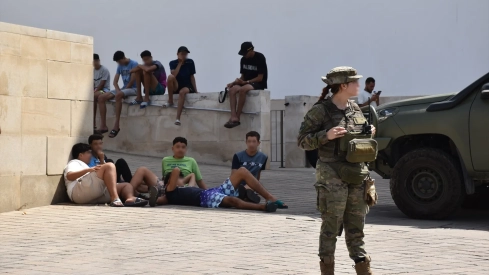
Amnesty International once again warns of the violence suffered by migrants in Ceuta. The organization has documented 28 new cases of beatings, humiliations, and abuses attributed to military personnel, including those of 13 minors, and denounces that the aggressions have continued after the Ministry of Defense announced an internal investigation into the initial accusations.
With this new investigation, published this Thursday, Amnesty raises to 50 the cases of ill-treatment, possible torture, and cruel, inhuman, or degrading treatment it has documented since the end of July in the autonomous city. Most are attributed to military personnel, although the figure also includes actions by members of the National Police and the Civil Guard, according to the organization itself.
The new testimonies describe blows with batons, kicks, punches, threats, and discharges with taser devices. Some of the interviewed individuals claim they were sleeping on the street when they were woken up and assaulted. Amnesty collected their accounts during a visit to Ceuta between October 23 and 26 and has had access to images and medical reports that, it explains, show injuries consistent with the reported aggressions.
Of the 28 new cases attributed to military personnel, 18 would have occurred after Defense announced it would investigate the initial complaints. The other ten are older and include four particularly serious episodes that, in the organization's opinion, could constitute torture. The report also includes seven cases of alleged ill-treatment by state security forces and bodies, a distinction that the organization does not clearly break down in its total figure of 50.
Beatings, threats, and minors on the street
One of the harshest accounts is that of M., a 20-year-old who earned a living as a mime on the streets of Ceuta. According to what he told Amnesty, several soldiers put him in a vehicle and took him to a secluded area, where they forced him to undress in front of a group of soldiers.
The young man recounts that one of them began to record him with his mobile phone and ordered him to dance. When, paralyzed by fear, he couldn't do it, they started hitting him. Afterwards, always according to his testimony, one of the soldiers pulled out a weapon, pointed it at him, and threatened him: “If you don't dance, I'm going to bury you right here.”
“Although I have reported it, what they did to me I will never be able to forget,” the young man told the organization. His case is part of the events prior to the end of September that Amnesty considers particularly serious due to the transfer of the alleged victims to remote locations, their immobilization, and the reported treatment.
The investigation also includes what happened, according to his account, to R., a father of three, who was sleeping on the Sidi Embarek road on the morning of October 24. He claims he woke up feeling a taser device on his chest and received several shocks. When he tried to flee, he tripped and fell to the ground. “I felt dizzy, vomited, and fainted, but no one took me to the hospital,” he recounted.
Among the testimonies are minors who continue to sleep on the street. Z., 17, claims he received a baton blow to the head while resting between cars and had to go to the hospital, where he received ten stitches. Another teenager, 15, says his phone, with which he was talking to his mother, was broken, and he also suffered blows and threats.
Amnesty estimates that at least 500 unaccompanied migrant minors continue to sleep on the streets of Ceuta, although it warns that the number could be higher. Their situation leaves them exposed to a lack of adequate accommodation and food, as well as to possible aggressions by military personnel, security agents, or individuals.
The demand to investigate and protect
The director of Amnesty International Spain, Esteban Beltrán, has denounced that the aggressions have continued despite the announcement from Defense. “We have spoken with migrant people who cannot sleep all night for fear that the military will wake them up with blows, punches, and kicks,” he stated.
The organization assures that it has contacted the Ministry of Defense and the Ceuta Prosecutor's Office, but that it has no record of specific military personnel being investigated or removed from service, nor of measures to protect victims and witnesses against possible reprisals. This lack of information is what Amnesty denounces; by itself, it does not allow concluding that there are no ongoing proceedings.
Defense announced an internal investigation at the end of September and sent the organization's first report to the Prosecutor's Office and the duty court. Subsequently, it also forwarded to the judicial authorities information about audios disseminated by elDiario.es in which alleged military personnel spoke of aggressions against migrants.
In addition, the public hospital in Ceuta had sent to the court at least twenty medical reports from migrant people who attributed their injuries to military personnel. The investigations must clarify the facts and determine any individual responsibilities.
Amnesty demands that these investigations be swift, independent, and exhaustive, and asks for the precautionary removal of military personnel involved in the reported aggressions. It also requests that those who report or testify as witnesses be protected and that temporary residence permits be considered for people in an irregular situation, so that the fear of expulsion or reprisals does not prevent them from seeking justice.
The report also questions the actions against No Name Kitchen, an organization that provides humanitarian aid to migrants in Ceuta. Amnesty considers that the procedure opened for an alleged crime of criminal organization lacks, so far, solid bases and criticizes the effect it may have on those who provide food, assistance, and accompaniment.
The organization has asked that the work of journalists, activists, and humanitarian entities in the city be guaranteed. Meanwhile, it insists that people who have reported aggressions can access protection, assistance, and justice.
