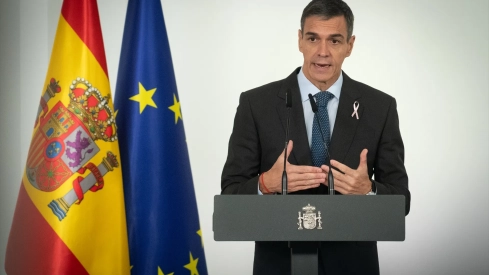
The Supreme Court has dismissed the complaint filed by Vox and several other complaints against Pedro Sánchez and the Council of Ministers for the massive entry of people into Ceuta from Morocco at the end of July, understanding that there are not enough elements to open a criminal procedure now against the privileged individuals named.
In a ruling reported by Europa Press, the Criminal Chamber dismisses, for the moment, the initiative presented by Santiago Abascal's party, as well as three complaints from Manos Limpias and two from private individuals. The court maintains that the qualifications made are not sufficient to specify the involvement of each defendant.
The High Court admits there are facts to examine, but no individualized responsibility
The resolution emphasizes that the documents and information provided "highlight the need to examine what happened," although they do not allow, at this moment, to transfer responsibility for the events to all the privileged individuals against whom the actions were directed.
This nuance is central to the decision: the Supreme Court does not close the door to a possible investigation, but it avoids opening it without a specific criminal attribution for each person denounced or complained against. The dismissal, therefore, affects the initial admission of the actions, not a definitive ruling on the merits.
The investigation remains active in the Audiencia Nacional and may return the matter to the Supreme Court
The ruling itself specifies that this decision "does not imply a definitive declaration of the atypical nature of the facts or the non-existence of criminal responsibility" of the denounced or complained against. In other words, the court does not rule out any hypothesis definitively, but demands more precise procedural support.
If the investigation carried out in the Audiencia Nacional regarding the events yields objective data that allows for the individualization of a criminally relevant participation of any privileged person, the investigating magistrate, María Tardón, must submit a reasoned statement to the Supreme Court for the high court to decide on its jurisdiction and on the initiation of the procedure.
Until that happens, the case remains outside the Supreme Court and awaits the instruction to provide concrete elements that allow for the separation of responsibilities.
