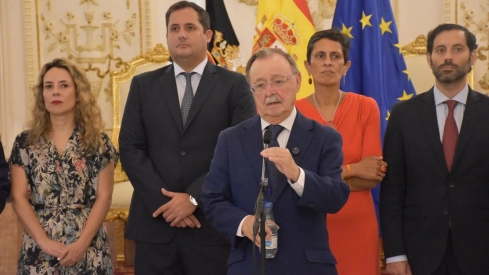
The president of Ceuta, Juan Jesús Vivas, increased pressure on Fernando Grande-Marlaska this Thursday and demanded the urgent return to Morocco of all people who remain in the city after the massive entry on July 30. The Minister of the Interior has informed him that the Government intends to accelerate departures, although he has avoided offering him a specific timetable.
"Ceuta cannot wait long. It cannot withstand this stress for a very long time," Vivas warned after meeting with Marlaska. The popular leader believes that the city remains in a situation of "maximum risk" for public safety, coexistence, public services, and national security.
Vivas has positioned the return as "the only way out" to restore normality and has summarized his position with a particularly forceful statement. "No regularization, no asylum, no transfer to the Peninsula," he stated before asking for returns to be executed within a "peremptory" and "very short" period.
The Ceuta president maintains that the prolonged stay of thousands of people increases the risk of serious incidents. "Every day that passes is worse because it increases the risk of something happening that no one wants to happen, that is irreversible and that we all have to deeply regret," he warned.

The meeting also revealed a significant discrepancy regarding the number of people remaining in Ceuta. Interior estimates that around 5,000 remain, while the Ceuta Government raises the figure to at least 9,000. Vivas admits that he lacks an exact census and obtains his estimate from the use of assistance resources.
According to his calculations, around 4,500 meals are distributed daily in Tarajal and social associations assist another 3,000 people. Protection centers have also incorporated 500 minors since the beginning of the crisis. To these figures, he adds around a thousand people who could remain outside official resources. This is an indirect estimate that may include overlaps, while Interior has not publicly detailed the complete methodology of its calculation either.
The request for asylum clashes with current legislation
Vivas has proposed that Ceuta receive singular treatment due to its condition as a European land border in Africa and that asylum applications can be dismissed from the beginning of the procedure. He also proposes that the city stop functioning as a place for processing international protection. Marlaska has listened to him, although he has not expressly responded to this request.
The proposal would require a profound reform of the current framework. Article 16 of Law 12/2009 regulating the right to asylum recognizes the right of non-EU citizens present in Spain to request international protection. Each petition must be individually assessed, through a personal interview and a reasoned resolution that examines the applicant's circumstances.
The law itself allows for the inadmissibility or denial of files at the border through accelerated procedures, but it requires that one of the foreseen causes concur and that there be an individual decision. A general rejection based solely on having entered during the crisis of July 30 currently lacks legal basis. The situation of minors also requires a specific evaluation of their best interest and their family circumstances.
Marlaska has sent a message from Ceuta very close to Vivas's regarding the fate of those who entered irregularly. "None of them will stay in Ceuta, go to the Peninsula, or be regularized," he assured, although he incorporated the exception of cases of maximum vulnerability protected by national and international legislation.
The Interior Ministry maintains that adults who do not have the right to international protection will be returned to Morocco when the corresponding procedures are completed. The minister has put the number of identified minors at 1,898 and has defended that expulsions and returns must be completed respecting the Immigration Law, the right to asylum, and judicial guarantees.
More police and immigration agents
Marlaska announced during his second visit to Ceuta since the massive entry the additional deployment of 45 police officers from the Prevention and Reaction Unit. Another 20 members of the Central Immigration and Borders Brigade will reinforce the processing of pending files and return procedures.
The deployment currently reaches 880 national police officers, 270 more than on July 30, and 714 civil guards, about 200 more than before the crisis. The minister has promised to maintain the necessary reinforcements to restore normality and has highlighted cooperation with Morocco in border surveillance.
Vivas believes that the deployment can only be considered sufficient when Ceuta residents regain a sense of security. He has also requested more health resources due to the temporary increase in population and the pressure on the city's healthcare centers.
Among his demands is the presence of Frontex at the Tarajal crossing. "The border that has been violated is not only the border of Spain, it is also the border of Europe," defended the president of Ceuta, who considers greater community involvement necessary both in surveillance and in the structural response to future crises.
The visit took place a day after Marlaska did not attend the extraordinary appearance called by the PP in the Senate. The minister is scheduled to explain the actions of the Interior Ministry in Congress on August 28, while Vivas continues to demand a much more immediate date to complete the returns from Ceuta.
