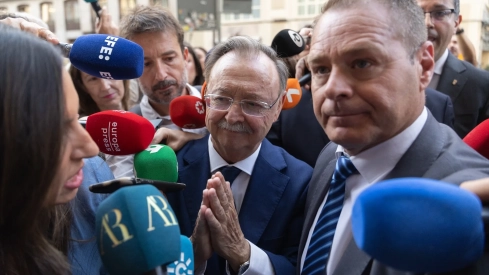
The president of Ceuta, Juan Jesús Vivas, this Wednesday increased pressure on Pedro Sánchez and placed Morocco at the center of the massive entry registered on July 30 and 31. "This is more than a failure," he stated on 'El programa de Ana Rosa', where he attributed "active or passive" collaboration to Rabat in what happened.
Vivas thus responded to the interview granted by the President of the Government to 'CNN' in New York. Sánchez acknowledged that the Moroccan border control mechanism had failed and assured that Spain has demanded "responses and actions" to avoid another crisis. The Ceuta president considers this explanation insufficient and doubts that tens of thousands of people could head towards the border without the knowledge of the authorities of the neighboring country.
"This is impossible," he maintained before concluding that Morocco was decisive "by action or by omission." Vivas used the terms "assault" and "invasion" during the interview, political expressions that the Government of Ceuta has used since July to describe an irregular entry of exceptional dimensions.
The possible active participation of Morocco remains pending accreditation. So far, no conclusive evidence has been made public that Rabat organized or executed the operation. The Audiencia Nacional maintains an open investigation into the mobilization, its logistics, the campaigns disseminated through the internet, and the eventual intervention of authorities, criminal networks, or coordinated groups.
Sánchez had weeks ago ruled out that intelligence services had solid evidence against Morocco. His recognition that border control failed now introduces a first public demand for accountability from Rabat, although Moncloa still considers it essential to maintain cooperation to manage returns and prevent new entries.
Vivas has also reproached the Executive for its "absolute lack of foresight." He recalled the May 2021 crisis and questioned that border protection has largely depended on Moroccan action. Among the measures he demands is the extension of the Tarajal breakwater with a hundred-meter wall and inverted combs, a project that the State has already begun to promote.
Rejection of camps and request for European aid
Vivas's second major warning is directed against the possibility of prolonging temporary camps. The Ceuta president has learned that the tents contracted by the Government will remain rented until August 2027 and fears that the emergency solution will end up becoming a stable structure.
"We are not going to allow Ceuta to be a mega-center for the temporary stay of immigrants," he warned. Vivas described the city as a "pressure cooker" and assured that economic, social, and emotional tension increases every day. He also promised that any institutional or citizen protest would be carried out in an "absolutely civic" and peaceful manner.
The duration of the rental allows the Government to maintain reception capacity for the coming months. The occupation and continuity of each facility will depend on the evolution of returns, asylum applications, transfers, and care for minors. Around 10,000 people remain in Ceuta, according to the latest estimates, after most of those who crossed in July returned to Morocco.
Vivas has demanded that all migrants return with the collaboration of Rabat. This process must be carried out with individual files and respect the guarantees applicable to applicants for international protection, minors, and vulnerable people. The Government defends that it is accelerating identifications and returns, although deadlines and administrative saturation have delayed the departure of thousands of people.
The Ceuta president now asks for a stable presence of the European Border and Coast Guard Agency (Frontex) and sufficient Spanish resources so that surveillance no longer depends on Morocco. This proposal partially coincides with the Government's plan to Europeanize the protection of Ceuta and Melilla, which includes a greater European presence and their future incorporation into the Customs Union.
Vivas's new offensive also comes after his change of position on the use of the port. The Ceuta president initially supported, along with the rest of the Situation Committee, the habilitation of these lands to host migrants. He subsequently opposed the location after neighborhood protests and technical reports that warned of security problems. His Government maintains that this support depended on technical suitability, although that condition does not appear in the published minutes.
Vivas will transfer his claims this Thursday to the 'Forbes Economic Summit 2026'. His intervention will be titled 'Ceuta, border of Europe: progress, cohesion and opportunity in the new Mediterranean' and will focus on the strategic role of the city within Spain and the European Union.
Add ElConstitucional.es as a preferred Google source for free.
Stay informed about all the latest breaking news with the best information. Against disinformation, for democracy and social rights.
