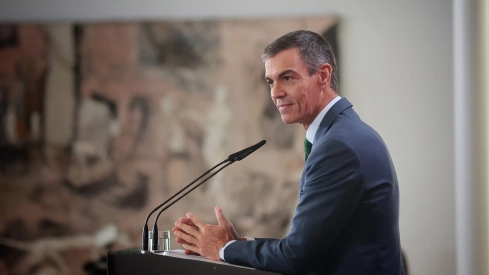
Pedro Sánchez has directly pointed to Morocco for the failure that allowed the massive entry of migrants into Ceuta and has confirmed that he intends to run again in the 2027 general elections. The President of the Government delivered both messages during an interview with journalist Christiane Amanpour on the American network 'CNN', taking advantage of his participation in the United Nations General Assembly in New York.
"It is clear that their border control failed," Sánchez said about Morocco. The head of the Executive explained that Spain has requested "actions and responses" from Rabat while continuing to investigate what happened on July 30 and 31, when tens of thousands of people crossed the border and overwhelmed the response capacity of the Spanish authorities for hours.
The choice of 'CNN' as an international showcase also carries an added political charge. The interview took place just days after Donald Trump banned journalists from this network, 'MS NOW', and 'Politico' from accessing the White House due to coverage he considers unfavorable. Sánchez defended multilateralism, human rights, and a democratic response against the advance of the far-right from that medium.
Sánchez points to Morocco and demands solidarity from Europe
Christiane Amanpour asked the president what failed for an entry of such magnitude to occur practically overnight. Sánchez responded by placing responsibility on three levels. The first affects the European Union, the second cooperation with Morocco, and the third the management of people who still remain in Ceuta.
The president recalled that Ceuta and Melilla are Spanish cities and also the external border of the European Union in Africa. From there, he reproached several European governments for their lack of support during the crisis. Spain, he argued, did show solidarity with Italy when thousands of people arrived in Lampedusa and with Denmark and Greenland when Trump questioned their territorial integrity.
"We ask for that same solidarity when it comes to Ceuta," he demanded. The message aims to place the crisis outside the strictly bilateral framework with Morocco. The border pressure on the autonomous city affects the entire community area, but much of the immediate management has fallen on Spain and the Ceuta authorities.
Regarding Rabat, Sánchez has claimed the relationship built over the last eight years, although he has introduced a much clearer demand than in his previous interventions. Morocco's status as a strategic partner does not prevent Spain from demanding explanations for a border device that failed and that must now guarantee both returns and the prevention of new entries.
Amanpour has also confronted the president with the documents declassified by the Government about the previous alerts. Sánchez has denied that these reports anticipated an avalanche of such dimensions. "They show that there was no clear evidence that something like this was going to happen," he maintained. The investigation remains open to clarify whether the Moroccan police were overwhelmed or if there was any deliberate decision behind their lack of response, a possibility that Rabat rejects.
The president has promised to fully restore normality in Ceuta, process international protection requests, and return to Morocco those who do not have the right to remain in Spain. He has done so by defending a migratory policy that combines border control, security, and respect for human rights.
"We will do that work with dignity. Migrants are not cattle, they are human beings," Sánchez affirmed. "That is what we must do in a great democracy and in a great country like Spain."
“Migrants are not cattle but humans.” The Ceuta migration crisis saw Spain experience a lack of solidarity from other EU countries, Spain’s Prime Minister @sanchezcastejon tells me.
— Christiane Amanpour (@amanpour) September 22, 2026
“We showed that solidarity for instance in Lampedusa… in Greenland… So we ask for that… pic.twitter.com/UUjjUeJKzX
Another mandate and a progressive response to the far-right
The interview has also left a relevant political confirmation. Asked about the judicial investigations affecting his wife and former collaborators, Sánchez has defended that the Government has acted forcefully in cases of corruption and has differentiated these actions from other cases that he considers part of an opposition offensive to force his departure.
The president has rejected these pressures and has linked his continuity to the political moment Spain and Europe are going through. "My responsibility as leader of a progressive Government in Spain and in Europe is to run again for another term," he assured. His objective, he added, is to complete the transformations developed during his more than eight years at the head of the Executive.
Sánchez had already expressed in recent weeks his willingness to be a candidate for the Spanish Socialist Workers' Party (PSOE) in 2027. Before the international audience of 'CNN' he went a step further by presenting that decision as a political responsibility in the face of the growth of the radical right and attempts to remove him before the polls.
Spain’s Pedro Sanchez @sanchezcastejon is embroiled in domestic scandals at home, with close associates being investigated over corruption. He tells me he won’t listen to opposition parties calling on him to quit, and insists it’s his “responsibility as a leader of a progressive… pic.twitter.com/W0h2bqBbLG
— Christiane Amanpour (@amanpour) September 22, 2026
The head of the Executive has acknowledged that the far-right grows by feeding on the legitimate frustrations of a part of the population. His response is to demonstrate management capacity. As he has argued, when these formations come to power, their difficulties in offering useful solutions are exposed, as he believes has happened in Sweden.
"What we progressives have to do is govern, give answers to citizens, fight inequality and raise minimum wages," he summarized. Sánchez has supported this thesis with the evolution of the economy and employment. Spain has reached 22.78 million employed people during the second quarter of 2026, while the unemployment rate has fallen below 10% and the Organization for Economic Cooperation and Development (OECD) forecasts a growth of 2.2% for this year.
The defense of his national project has linked with his international message. Sánchez has called for strengthening the United Nations against those who intend to replace shared rules with closed agreements between a small number of powers. Against that "minilateralism", he has advocated for a "maxilateralism" capable of incorporating more countries and strengthening collective action against climate change, artificial intelligence, wars, or inequality.
“It’s very important to strengthen the multilateral order and especially the UN,” Spain’s Prime Minister Pedro Sanchez @sanchezcastejon tells me at UNGA. “We need to strengthen our collective action.” pic.twitter.com/pbjLGMbPGN
— Christiane Amanpour (@amanpour) September 22, 2026
Sánchez has also taken advantage of the interview to support the election of the first woman as Secretary-General of the United Nations when António Guterres's term concludes. "Half of the population must also represent half of the leadership. This is the moment," he defended.
Add ElConstitucional.es as a preferred Google source for free.
Stay informed about all the latest breaking news with the best information. Against disinformation, for democracy and social rights.
