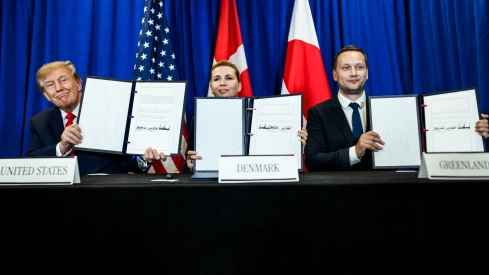
Donald Trump has turned his threat to keep Greenland into a military victory without needing to move borders. The United States, Denmark, and the autonomous Greenlandic Government signed an agreement this Tuesday in New York that considerably expands the American presence on the island, opens two new defense areas, and guarantees Washington a capacity for movement that covers practically the entire territory.
The signing took place on the sidelines of the United Nations General Assembly, with Trump seated next to Danish Prime Minister Mette Frederiksen and the head of the Greenlandic Government, Jens-Frederik Nielsen. The US president announced that the construction of two large military bases in Narsarsuaq and Mestersvig will begin "immediately", in addition to modernizing and expanding the activity of the Pituffik Space Base, the only American facility that remained operational on the island.
The text maintains the sovereignty of the Kingdom of Denmark and recognizes the right to self-determination of the Greenlanders. This legal protection clashes with the triumphant version disseminated by the White House, which speaks of alleged "permanent control over Greenland's security". Washington has obtained broad military prerogatives, although the agreement does not hand over the island to the United States nor does it grant Trump the territorial dominion he has claimed for months.
President Donald J. Trump, together with the Prime Ministers of Denmark & Greenland, sign the landmark security agreement granting the U.S. permanent control over Greenland’s security. pic.twitter.com/7YWg3Quqn9
— The White House (@WhiteHouse) September 22, 2026
An intact sovereignty on paper and a military key for Washington
The concessions are significant. US ships, aircraft, troops, and vehicles will be able to move between defense areas by land, sea, and air, including Greenlandic maritime spaces. Military aircraft will be authorized to fly over and land anywhere on the island, while submarines will be able to enter and move through its territorial waters. An accelerated procedure for studying future unmanned military installations is also established.
The United States will be able to propose new defense zones. Each request will have to be agreed upon with Denmark and Greenland, first in a permanent commission and then, if disagreement persists, in meetings of deputy ministers and ministers. The document thus remains far from the absolute freedom proclaimed by Trump, but it provides Washington with a stable structure to continue expanding its military deployment.
The pact also limits the presence of third countries. No State outside the North Atlantic Treaty Organization (NATO) will be able to install bases or maintain permanent forces in Greenland. Investments from countries considered a threat will also not be able to control sensitive sectors, exert significant influence, or access classified information. Supervision will be the responsibility of the Danish and Greenlandic authorities, in consultation with the United States and other allies.
Trump has presented this mechanism as a US veto over any investment that makes it uncomfortable. The letter of the agreement is more nuanced and requires cooperation between the parties. Even so, Washington gains the capacity to intervene in strategic economic decisions, especially those related to ports, telecommunications, critical minerals, energy, or infrastructure close to its military facilities.
The most delicate clause looks towards a possible independence. If Greenland decides to separate from Denmark, the new State must remain within NATO and assume the military obligations agreed upon with Washington. Self-determination is recognized, but future Greenlandic security policy is already conditioned by an agreement with no expiration date that can only be modified with the consent of all three parties.
The document includes counterweights demanded by Nuuk. New facilities will have to respect hunting, fishing, the environment, and traditional ways of life. The United States must also use Greenlandic companies for construction and maintenance contracts whenever they have the capacity to carry them out. These are important guarantees for a population of barely 57,000 inhabitants, although the enormous power difference between the signatories will remain present throughout the application of the pact.
The Arctic enters a stage of greater militarization
The American expansion recovers a deployment that Washington had been dismantling after the Cold War. The United States came to maintain 17 facilities and more than 10,000 troops in Greenland. Over the last few decades, it concentrated its presence in Pituffik, a base essential for space surveillance, early warning, and the detection of missiles that could cross the Arctic en route to North America.
The new agreement reverses that withdrawal. Pituffik will be a piece of the 'Golden Dome' anti-missile project, while Narsarsuaq will allow the recovery of an old base in the south of the island and Mestersvig will reinforce the eastern flank. The arrangement of the three facilities draws an American military corridor from north to south and from east to west, with the capacity to monitor maritime routes, air movements, and access to the North Atlantic.
Greenland concentrates several of the major interests that are transforming the Arctic. The melting ice facilitates new shipping routes, Russia maintains a powerful military infrastructure on its northern coast, and China seeks to increase its economic and scientific influence in the area. Added to this are the reserves of rare earths and critical minerals, indispensable for manufacturing electronic components, batteries, defense systems, and advanced technology.
That strategic value explains the need to reinforce the security of the region, but it has also served Trump to subject two allies to unusual pressure. The American president has threatened to buy Greenland, appropriate it, and even resort to force against a territory belonging to another NATO member. The agreement closes the crisis he himself opened and rewards part of that intimidation with bases, military access, and economic influence.
Frederiksen has defended that the pact strengthens Western deterrence and respects all Danish red lines. Nielsen has stressed that Greenland has participated as a signatory and that this time the agreement has been negotiated "with us," not simply "about us." NATO Secretary General Mark Rutte has also celebrated an expansion that, in his opinion, improves collective security in the Arctic and the North Atlantic.
The text must now complete parliamentary procedures in Denmark and Greenland before entering into force. After the ceremony, Nielsen addressed his fellow citizens to assure them that they can now "breathe a sigh of relief." He also admitted that rebuilding trust with Washington after Trump's threats will take time.
Add ElConstitucional.es as a preferred Google source for free.
Stay informed about all the latest breaking news with the best information. Against disinformation, for democracy and social rights.
