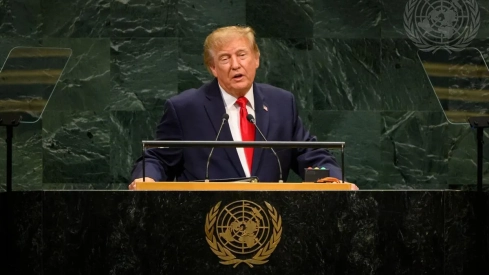
Donald Trump used the platform of the United Nations General Assembly this Tuesday to proclaim that he has brought peace to the world and, almost in the same breath, threaten to "annihilate" Iran. The President of the United States turned his intervention before world leaders into a display of force, self-promotion, and warnings against any country or institution that stands in his way.
"I have a big decision to make," he announced before presenting Tehran with only two options. The first would be to accept an agreement that prevents the development of nuclear weapons. The second, according to his own words, would consist of "annihilating the Islamic Republic" quickly. "Do I drive them into hell with no chance of survival or hope of greatness for future generations?" he even posed from the podium of an organization created precisely to prevent major powers from resolving their disputes through war.
Trump believes that the pact will come after the US legislative elections on November 3. He denied that the elections condition his decisions, although he placed the outcome of a seven-month war just beyond the ballot boxes. Republicans are playing for control of Congress, and the president faces the campaign with deteriorated popularity, soaring energy prices, and a conflict he promised to resolve in a matter of days.
The threat came just minutes after the United Nations Secretary-General, António Guterres, asked leaders to choose between power subject to law or governed by force. Trump responded with his own doctrine. "While others talked about peace, I made peace," he boasted before placing the destruction of an entire state among the options he considers on the table.
Trump: "I have a big decision to make: will a deal be made with Iran?…Do I drive them into hell with no chance of survival?…I believe we'll make a deal right after the election." pic.twitter.com/w3iWiK9lUi
— Bulwark Clips (@BulwarkClips) September 22, 2026
Iran, Cuba, and a new demonstration of power over America
The ultimatum complicates any attempt to recover the diplomatic path with Iran. Secretary of State, Marco Rubio, has assured that Washington is willing to hold a conversation with the Iranian delegation displaced to New York, although no meeting is yet scheduled. President Masud Pezeshkian had already warned before traveling that the US attacks, initiated when contacts still existed, had destroyed the trust necessary to negotiate.
Trump has asked other countries to join the economic isolation of Tehran and has again guaranteed that Iran will never have a nuclear weapon. His speech has avoided the accumulated cost of the war since the attack launched together with Israel on February 28. The conflict is approaching its seventh month, has strained the Strait of Hormuz, has raised oil prices, and has extended instability to Yemen and the Red Sea.
The military warning has also reached Latin America. Trump has defined cartels as "the Islamic State of the Western Hemisphere," has presented Mexico as the epicenter of their violence, and has assured that he will use the "unmatched military might" of the United States when he considers its interests threatened. The good relationship he claims to maintain with Mexican President, Claudia Sheinbaum, has again coexisted with another veiled threat of intervention in neighboring territory.
Cuba has received the most direct blow. The US president has announced that his Administration seeks "a fundamental change" on the island, which he has described as an "absolutely failed state." "It will fall," he proclaimed before assuring that freedom will soon come to the country. The Cuban delegation left the chamber while he was speaking. Its Foreign Minister, Bruno Rodríguez, later responded that Cuba has the right to remain an independent country and blamed Washington for suffocating the population through decades of blockade.
The other example chosen by Trump has been Venezuela. He has vindicated the military operation that ended in January with the capture of Nicolás Maduro and has celebrated the oil agreement reached with the provisional government of Delcy Rodríguez. "To the victor belong the spoils," he summarized when speaking of Venezuelan crude. The phrase lays bare a vision of international relations in which military interventions, natural resources, and changes of government are part of the same negotiation.
That approach extends to Greenland. Trump has celebrated the agreement signed with Denmark and the Greenlandic authorities to grant the United States permanent control over the island's security and block new investments from China or Russia there. After more than a year of annexation threats, Washington has managed to expand its military presence and project its power over the Arctic without abandoning the rhetoric with which it treated the territory as an available piece.
Trump has also called on countries to abandon the International Criminal Court (ICC), which he has called an "out-of-control institution" and a "group of evil people". The United States has never ratified the Rome Statute, but the Republican wants to prevent its military or its allies from being investigated. The attack comes days after a United Nations mission found reasonable indications of war crimes in two US attacks on Iran, one of them against a primary school.
The false figures of the great peacemaker
The speech has been riddled with a succession of false, exaggerated, or unverifiable claims. Trump has again claimed credit for ending "eight wars," a count that includes provisional truces, diplomatic conflicts, and agreements that have later broken down again. The war between Russia and Ukraine continues despite his promise to resolve it during his first day in the White House. The one in Iran remains open after seven months and now threatens to expand.
He has also assured that the United States has more ammunition than it could ever use. Reports on its arsenals describe a quite different situation. The war has reduced reserves of Patriot and THAAD interceptors, essential against missiles and drones, and calculations by the Center for Strategic and International Studies indicate that recovering certain stock levels will require several years.
Trump has also repeated that his attacks against alleged drug trafficking vessels have reduced drug entry by sea by 97%. The figure lacks support. The White House starts from a specific period of seizures by the Office of Customs and Border Protection, while seizures made by the Coast Guard increased by 200% during the last fiscal year. None of these data allow knowing how much drug actually manages to enter a clandestine market that constantly adapts its routes.
His triumphalism has also reached oil. Trump has stated that the United States and Venezuela together hold more than 60% of the world's crude oil. The sum remains around 22% when proven reserves are considered and is around 23% of current production. The Venezuelan industry needs years of investment to recover capacity and will hardly be able to cause the immediate price drop promised from the podium.
The president completed his speech by renaming artificial intelligence "superintelligence," dismissing warnings about its risks and rejecting any international regulation that could hinder large American companies. He compared these warnings to those made against climate change and presented the technological race as an absolute competition against China in which the winner "will win everything."
Trump ended by asking God to bless the United Nations. As he left the podium, there was still no meeting scheduled with Iran, the war remained open, and the threat to "annihilate" the Islamic Republic had already been uttered before the world's largest diplomatic forum.
Add ElConstitucional.es as a preferred Google source for free.
Stay informed about all the latest breaking news with the best information. Against disinformation, for democracy and social rights.
