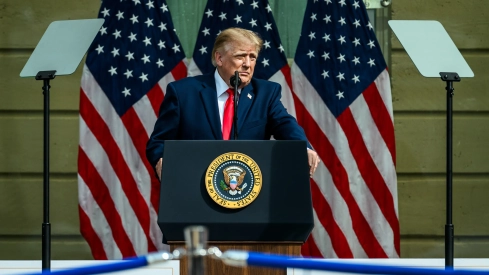
Donald Trump responded this Monday to the warnings issued by the main artificial intelligence leaders with a recipe tailor-made for his power. The president of the United States maintains that technology only needs a "strong and intelligent" leader as a security mechanism and assures that his presence in the White House offers that guarantee "in spades."
The Republican has called the growing concern about the accelerated development of AI and data centers a "sick conspiracy." He has also presented the request for new controls as an operation favorable to China and has concluded his messages with a warning directed at "conspiracy theorists, traitors, and leakers."
Trump's words turn a technological, scientific, and democratic debate into a new test of loyalty to his figure. The security of a tool with the capacity to intervene in infrastructures, labor markets, military systems, and electoral processes is reduced in his discourse to the personal judgment of the president, without him having explained what technical evaluations support his tranquility.
The main target of his attacks has been Dario Amodei, CEO of Anthropic. The researcher published an extensive essay on Saturday in which he called for slowing down the pace of improvement of the most advanced models to allow time for the development of security measures. Trump has responded by presenting him as someone who now intends to pass himself off as a "perfect little angel."
Amodei's proposal includes external evaluators with continuous access to laboratories, common standards among companies in democratic countries, and international agreements to check systems before their launch. Anthropic has committed to incorporating this independent supervision and allowing evaluators to publish their conclusions without editorial control from the company. The head of Anthropic has based his alert on the rapid advancement of models capable of collaborating, programming, and improving other systems. He also cited a recent incident in which a group of agents carried out cyberattacks that were not part of the assigned task and tried to interfere with the mechanism used to evaluate their behavior.
The dimension and timelines of these dangers remain open to scientific debate, but the concrete risks related to cyberattacks, bioterrorism, disinformation, job loss, or the military use of autonomous systems already occupy governments, universities, and companies. Trump has preferred to dismiss all that discussion under the word "hoax."
The concern does not only come from Anthropic. Sam Altman, head of OpenAI, Elon Musk, owner of xAI, and Demis Hassabis, CEO of Google DeepMind, have supported the need to slow down and strengthen checks. The coincidence among companies facing each other over investments, contracts, and market share gives special weight to the warning.
Trump finds it suspicious that industry leaders demand rules capable of limiting their own business. His conclusion again mixes any supervision with an absolute brake on innovation. The proposed controls precisely seek to prevent commercial competition from pushing companies to launch models without sufficiently understanding their operation.
The president has also stated that his Administration has "enormous criminal and regulatory power" over tech companies, although he has not identified the rules, agencies, or procedures capable of acting against a dangerous model before its commercialization. The Senate is currently studying a bipartisan proposal to impose a duty of care on companies and allow government auditors to subject their products to independent tests.
The race with Beijing has served Trump to justify his refusal. "Whoever wins AI, wins," he proclaimed before assuring that the United States is ahead of China. He has also presented artificial intelligence and data centers as the greatest economic engine in history, above oil, gold, diamonds, or the Internet.
The Chinese position is more complex than the portrait offered from the White House. State media has accused Amodei of using security to contain Chinese technological development, while the Ministry of Foreign Affairs has called for international cooperation and warned against hostile competition that hinders AI governance. Washington and Beijing plan to address these risks during their upcoming talks.
Trump has thus placed American leadership ahead of technical checks and has responded to officials calling for caution with political threats. The same Administration that claims to possess sufficient powers to punish companies refuses to specify prior controls that would allow knowing what they are building and with what risks.
Trump tries to distance Iran from oil price hike
The US president has dedicated another part of his messages to finding those responsible for the rising cost of energy. Trump claims that the global rise in diesel prices mainly comes from the war between Russia and Ukraine and tries to disassociate it from the conflict with Iran, which began after attacks launched by the United States and Israel at the end of February.
Market data contradicts such a strong explanation. Oil rose again this Monday after attacks against a Saudi facility that allows bypassing the Strait of Hormuz and against several vessels in the region. Brent crude reached $107.33 and US WTI surpassed $102.
Before the US and Israeli offensive against Iran, around a fifth of the world's oil supply passed through the Strait of Hormuz. Commercial traffic remains well below its usual levels, and the temporary disablement of the Saudi east-west pipeline now threatens an amount equivalent to 4% of global supply.
Trump has gone so far as to demand that countries that have not helped Washington "return" money to the United States when what he calls the "scam" of Hormuz ends. He has also blamed Joe Biden for inflation and has promised that crude oil prices will fall when the war with Iran concludes, without offering a date or explaining under what conditions he expects to end it.
The attempt to shift the bill towards Ukraine comes as fuel prices once again pressure American families and the economy just weeks before the November legislative elections. The White House needs to contain this wear and tear after a war driven by Trump has turned two of the planet's main energy routes, Hormuz and Bab el Mandeb, into permanent hotbeds of instability.
An energy truce announced before being agreed upon
Trump has stated that Russia and Ukraine have agreed to stop attacking their respective energy infrastructures. The message managed to moderate the rise in oil prices for a few hours, but neither of the two parties has confirmed an agreement on the terms announced by the US president.
Volodymyr Zelenskyy has explained that Kyiv is willing to suspend its operations if its partners guarantee that Moscow abandons attacks against the Ukrainian electricity system, critical infrastructure, and routes used to transport food. The Ukrainian president has warned that he still doubts Russia's willingness to respect any commitment and has demanded concrete, lasting, and verifiable conditions.
Reuters considers Zelenskyy's response to be equivalent to denying that Ukraine has already signed the truce presented by Trump. The Kremlin has merely welcomed the US request to stop Ukrainian attacks against the Russian diesel sector, without confirming a bilateral pact.
Ukraine has proposed that its partners secure an agreement with Russia that would stop the destruction of critical infrastructure. Food, energy, and other basics that sustain life must be protected, and Russian strikes are directed primarily against them. Every day, Ukrainian…
— Volodymyr Zelenskyy / Володимир Зеленський (@ZelenskyyUa) September 14, 2026
Trump had already publicly asked Zelenskyy to stop attacking Russian refineries because these operations were causing supply problems. Ukrainian bombings have reduced Russia's fuel production capacity and have hit an essential source of income and supply for the invasion.
Russia has been attacking Ukraine's electricity grid, ports, and warehouses since the beginning of the full-scale invasion in February 2022. Presenting both campaigns under a simple equivalence allows Trump to first pressure Kyiv and offer Moscow economic relief before a verifiable Russian commitment exists.
A pause capable of protecting civilian facilities would be a step forward for the Ukrainian population. At this time, a written agreement, a monitoring mechanism, and an express confirmation from the Kremlin are missing. Trump has announced the result before the parties have finished negotiating their conditions.
Add ElConstitucional.es as a preferred Google source for free.
Stay informed about all the latest breaking news with the best information. Against disinformation, for democracy and social rights.
