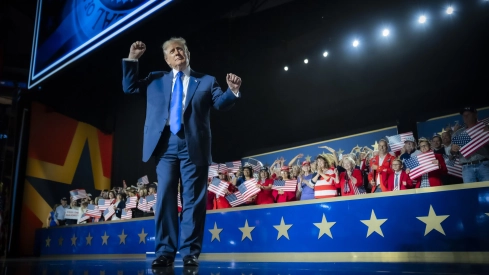
The President of the United States, Donald Trump, has promised to give 5,000 dollars to every adult citizen of the country if the Republican Party retains control of the House of Representatives and the Senate in the legislative elections on November 3.
The offer came this Wednesday during the first Republican convention organized expressly for a midterm election. Before his supporters in Dallas, Trump openly linked the payment to the election results. "If Republicans win, you win with us and you will receive 5,000 dollars," he proclaimed before baptizing the transfer as the "Trump dividend."
The president assured that the money would have to be spent within the United States, although he left practically all the necessary questions unanswered to turn the announcement into a real policy. He did not present a program, access criteria, a timeline, or a financing formula. The White House also did not subsequently offer the details requested by the media.
The promise transforms a possible transfer of federal funds into an electoral reward associated with the president's surname. Trump speaks of the State as if it were a company he owns, presents himself as the one in charge of distributing the profits, and conditions the check on his party maintaining the legislative power it would need to approve it.
A 1.2 trillion hole
The United States has around 240 million adult citizens, according to Census calculations. Giving 5,000 dollars to each would entail an outlay close to 1.2 trillion dollars, an amount greater than the combined cost of all federal checks distributed during the pandemic.
Trump stated that the United States is "making a fortune" from tariffs. Vice President JD Vance tried to shape the idea shortly after and suggested that higher-income citizens could be excluded. He also argued that tariff collection would serve to finance the payments.
The figures dismantle that explanation. The Congressional Budget Office estimates that tariffs have contributed about 167 billion dollars during the current fiscal year, about one-seventh of what the promise would cost. The country also faces a projected deficit of 2.1 trillion and a public debt that already exceeds 40 trillion.
The president also cannot unilaterally order a transfer of this magnitude. The U.S. Constitution reserves to Congress the power to authorize public spending, so any check would need the backing of both chambers. Republicans have narrow majorities and could try to use a special budgetary procedure, although Trump has presented the payment as a direct consequence of his will.
Marc Goldwein, policy director for the Committee for a Responsible Federal Budget, reminded 'Associated Press' that corporate dividends are distributed when there are profits. "We don't have surpluses to distribute," he warned, given public accounts marked by deficit.
The Republican already promised in 2025 another supposed dividend of $2,000 financed by tariffs. The proposal remained an announcement and never reached Congress. The precedent requires caution with a figure now more than twice as high and presented without budgetary backing.
Public Money as an Electoral Lure
The formula used by Trump has led to accusations of an attempt to buy votes. Federal law punishes payments made to directly influence a voter, although specialists consulted by U.S. media consider it difficult for this announcement to fit that crime. The check would be given to all adults included in the program regardless of their vote or even whether they participated in the elections.
The legal discussion leaves open a much deeper political question. Trump has expressly linked a transfer of public money to his party's victory, presented it as a personal concession, and placed his own surname on a payment that only Congress could approve. The line between Government, party, and leader is once again blurred by a president accustomed to treating institutions as extensions of his power.
The announcement comes as his approval is at 33%, the lowest level of his second term, while 64% of Americans disapprove of his management, according to the latest 'Reuters/Ipsos' poll. Republicans face a serious risk of losing the House of Representatives, and control of the Senate remains open.
Numerous candidates competing in tight states and districts avoided attending the Dallas convention to distance themselves from the president's unpopularity. The upper stands of the venue remained partially empty during an event conceived around his figure and unofficially dubbed "Trumpapalooza" by the organization itself.
Trump again presented the elections as a personal battle and asked his followers to act as if he were a candidate again. "I ask you to pretend my name is on the ballot," he told them. Two years after returning to the White House, he has placed his surname on a still non-existent public check and linked it to the outcome of polls that will decide who controls the president from Congress.
