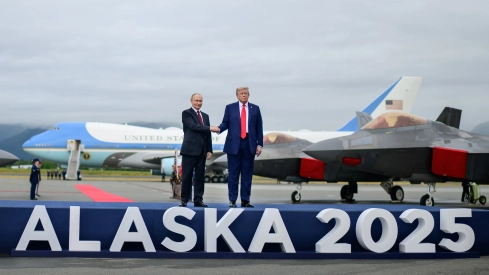
Donald Trump has asked Vladímir Putin this Tuesday to end the war in Ukraine as soon as possible. After an hour-long phone conversation, the Russian president has publicly supported that aspiration, although he maintains his military objectives intact and avoids committing to a ceasefire. Russia and Ukraine have also resumed attacks after the brief pause of recent days.
The call leaves many words and no concrete progress. Trump wants to close the conflict during his term, which ends in January 2029, and has offered Putin the full recovery of relations between Washington and Moscow. The White House is trying to convince the Kremlin with "enormous commercial and economic benefits" if it agrees to halt an invasion that began in February 2022.
Putin took advantage of the contact to convey his own reading of the front and explain what steps the United States should take to accelerate the end of the war. The Kremlin has avoided revealing these conditions, although Moscow has been demanding for months that Ukraine hand over all of Donbas, limit its military capacity, and renounce integration into NATO.
The public account so far comes from Putin's international policy advisor, Yuri Ushakov. The White House has not yet released its own version of a conversation that Moscow has described as "constructive and quite frank". Trump and Putin have agreed to keep contact open and continue prisoner exchanges, according to information gathered by 'Reuters'.
This is the first call between the two since July 4th. The two leaders have spoken fifteen times since Trump's return to the White House in January 2025, five of them this year. The new contact comes after Steve Witkoff and Jared Kushner, special envoy and son-in-law of the US president, visited Moscow and Kyiv last weekend to try to reactivate negotiations that had been stalled for more than six months.
The emissaries met with Putin on Saturday and with Volodímir Zelenski on Sunday. Despite the optimism shown by the Kremlin, these conversations have ended without a decisive agreement. Putin remains determined to conquer the entire Donetsk region, and Ukraine refuses to hand over the belt of fortified cities that Russia has been trying to occupy for years.
Putin denies a threat against Europe amid hybrid offensive
Putin has also assured Trump that Russia has no hostile plans against European countries. "Aggressive plans regarding Europe have not even crossed our minds," Ushakov stated, reproducing the words conveyed by the Russian president.
The guarantee comes amid a succession of incidents that several European governments attribute to Moscow. Germany has pointed to Russia for the failed attack with explosive drones against Leipzig airport, while Moldova denounced this Tuesday a new entry of a Russian Shahed drone into its airspace. Poland and Romania have also registered incursions in recent months, and Hungary has now expelled ten Russian diplomats.
The Kremlin maintains that the Russian threat serves the European Union to justify increased military spending and support for Kyiv. Its denial to Trump lacks verifiable commitments and coincides with an intensification of sabotage, disinformation, and military pressure campaigns denounced by various NATO countries.
The US position also does not clear up its allies' doubts. Trump has repeatedly questioned Washington's commitment to the collective defense of the Atlantic Alliance. This same Tuesday, Under Secretary of Defense for Policy, Elbridge Colby, asked European governments to prepare for "a prolonged conflict" in Ukraine over the coming "months and years."
Russia resumes bombings and maintains its military plan
Diplomatic activity has coexisted with the return of attacks. Russia and Ukraine have resumed bombings on their respective capitals after a 72-hour pause linked to the visit of US envoys.
Ukrainian authorities have reported at least five civilians killed and 25 injured in Kyiv. More than fifty locations have suffered damage, including homes, schools, shops, and a flour factory. In the territories occupied by Russia, authorities have reported three dead and thirteen injured. Ukrainian Foreign Minister Andrii Sybiha has accused Putin of sabotaging US mediation and warned that his ballistic missiles "speak louder" than his statements about peace.
Moscow continues to present its military situation as favorable. Kremlin spokesman Dmitry Peskov has assured that Russian victory is "very close," although advances on the ground remain slow and costly. The Institute for the Study of War estimates that, at the current pace, it would take Russia until 2032 to conquer the entire Donetsk region.
Zelensky expects to meet with Trump around September 20, during the United Nations General Assembly in New York. Ukraine aims to secure more Patriot anti-aircraft systems and explore possible agreements on energy and grain exports, as it prepares for another winter under Russian attacks.
Russian Foreign Minister Sergey Lavrov has clearly defined Moscow's position after the call between Trump and Putin. "Fighting and diplomacy. I see no reason why they cannot develop in parallel and simultaneously," he stated.
