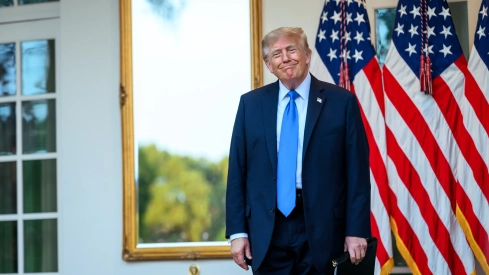
Donald Trump has found in the migratory crisis in Ceuta yet another argument to attack Spain. The President of the United States has taken advantage of an interview with the British channel 'GB News' to predict the country's ruin, question Pedro Sánchez's Government again, and reiterate his reproaches against Madrid for defense spending.
"Spain will be a ruined country," Trump affirmed when asked about what happened in the autonomous city. He then linked the crisis to one of his recurring confrontations with Sánchez. "I have had my own problems with Spain because it does not behave very well with respect to NATO. It does not pay what it should pay," he added.
The US president also described the massive entry of migrants recorded on July 30 and 31 as "very sad to see" and compared the Spanish situation with that of the United Kingdom. "They don't have thousands of people breaking into their country like that. I've never seen anything like it," he assured.
Trump already intervened in the crisis during its first days. He then blamed what happened on alleged "weak laws" and the "poor management" of Sánchez's Executive and assured that the Spanish authorities "did not know what to do."
He also used an incorrect interpretation of the Supreme Court ruling on the returns of migrants who arrive in Spanish territory by swimming. The Government has precisely included that interpretation among the hoaxes that circulated before and during the massive crossing, considering that it contributed to spreading the idea that reaching the coast of Ceuta prevented any return procedure.
Trump's new economic disqualification also does not fit with the latest available indicators. The Spanish economy grew by 2.7% year-on-year during the second quarter of 2026 and advanced by 0.7% compared to the first three months of the year. The European Commission estimates that Spain will close 2026 with a growth of 2.4%, compared to the 0.9% forecast for the eurozone as a whole.
An offensive against Spain that comes from afar
Ceuta has now become the latest chapter in a political confrontation that has been escalating for over a year. Trump maintains strong pressure on Sánchez since Spain refused to raise the annual spending linked to defense and security to 5% of GDP, as agreed by most NATO allies with a horizon of 2035.
Spain has defended that it can meet the military capabilities committed to the Alliance with a lower effort. The clash reached its highest point last July, when Trump called Spain a "terrible partner" and claimed to have ordered Treasury Secretary Scott Bessent to cut all trade with the country.
The threat also clashed with the functioning of European trade policy, which is a common competence of the European Union and cannot be unilaterally suspended with one of its member states as if it were an exclusively bilateral trade relationship.
Trump had previously threatened tariff reprisals and even suggested that Spain could be punished within the Alliance itself for its position on military spending. Sánchez has responded on different occasions by claiming Spain's contribution to NATO missions and cooperation between the Armed Forces of both countries.
While Trump again presents Spain as a country heading for ruin, the Government remains focused on the response to Ceuta. The Council of Ministers approved this week a shock plan of 309 million euros to reinforce security, reception, public services and the economic fabric of the autonomous city.
This same Thursday, Pedro Sánchez appeared before Congress to explain the management of the crisis and the measures adopted since the massive entries at the end of July.
