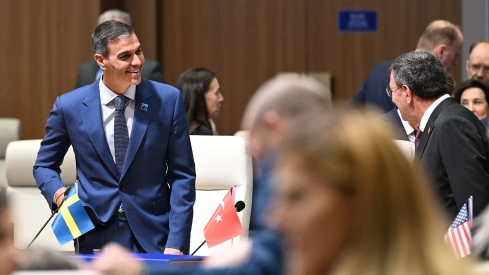
Donald Trump has once again used Spain as a target at the NATO summit, but this time the response has not come only from Moncloa. Brussels has entered the scene to remind of something basic: the United States does not negotiate trade with Spain country by country, but with the European Union.
The US president had arrived in Ankara with his usual playbook of pressure, threat, and public scolding. He called Spain "a lost cause," defined it as a "terrible ally," and called for cutting trade, including visits. He did so in the presence of Mark Rutte, NATO Secretary General, and after months of clashes over the Spanish Government's refusal to raise military spending to 5% of GDP.
Moncloa has not wanted to engage in a direct confrontation. Executive sources have responded with "tranquility and normality," have claimed a "magnificent" social, cultural, and economic relationship with the United States, and have stressed that Washington maintains a trade surplus with Spain. In other words, if Trump wanted to break off, he would also hit American interests.
Pedro Sánchez has followed the same line after the summit. The president explained that he spoke with Trump about football and the World Cup, without tension and with cordiality, after the Republican leader's harshest statements. The scene well summarizes Moncloa's strategy: not to overreact to the shouting, to take the debate out of the personal realm and bring it to the European framework.
There, Brussels has set the first limit for Trump. The European Commission has asked Washington to respect the trade commitments reached with the EU and has warned that it will protect the interests of all member states. The message is clear. One thing is Trump's political show for the cameras, and quite another is to open a selective trade war against a country integrated into the European single market.
The right moves between Spain, Sánchez, and their reference Trump
Trump's attack has also forced the PP to adjust its pace. Juan Bravo has censored the words of the US president and has defended that, "between Spaniards and Trump," Spaniards come first. The popular leader has recalled the presence of Spanish companies in the United States and has maintained that economic reality weighs more than the phrases of the White House occupant.
But the PP has not let go of the framework against Sánchez. Bravo has accused the Government of having reduced Spain's international relevance and has used the crisis to criticize the Executive's foreign policy. Rafael Hernando, also from the PP, has taken a similar path: he has called it "unacceptable" that Trump attacks a country that does not do what he says, but has added that not distinguishing between Spain and Sánchez is "insulting".
The far-right Vox, on the other hand, has once again been trapped in its own Trumpist mirror. Santiago Abascal has attributed the threats to the loss of international credibility caused by Sánchez and has avoided a frontal condemnation of the US president. The discomfort is evident. Trump attacks Spain, but the Spanish far-right continues to look for ways to turn the blow into ammunition against the Government.
On the other side of the Executive, Sumar has read the clash as a matter of sovereignty. Pablo Bustinduy has defended that Spain "is no one's vassal" and that the country can decide its priorities without accepting impositions from Washington. The argument fits with part of the underlying debate that runs through the entire summit: how much rearmament Europe can assume without putting the welfare state at the service of Trump's military agenda.
Rutte has tried to close ranks. The NATO Secretary General has spoken of a "tremendously successful" summit, has highlighted allied unity and has downplayed the United States' disappointment with its partners to "isolated cases". He has also acknowledged that Spain has taken "a big step" by exceeding 2% in military spending, although he maintains general pressure to advance towards the commitments set by the Alliance.
Sánchez has taken advantage of Ankara's closing to reinforce the other leg of his narrative. Spain, he has said, complies by capabilities, by deployments and by support for allies. The president has also announced that the country will join the NATO mission in Finland to protect the Arctic region, with a concrete participation that will be defined in September. It is not a minor detail: Moncloa seeks to respond to Trump with real military presence, not with the 5% it rejects.
The summit's final declaration maintains the commitment to collective defense and support for Ukraine, but Sánchez emphasizes that the text speaks of capabilities and modernization more than a bare spending figure. That nuance is what Spain has been trying to introduce for a year. Security is also measured by deployed troops, naval capabilities, air support, industry, resilience, and effective contribution to allied missions.
Trump has turned NATO into another scenario of personal pressure. Spain comes out singled out, but not isolated. Brussels has closed the door to a custom commercial reprisal, Rutte has avoided fueling the fire, and Moncloa is betting on letting the threat wear itself out. The test will come if Washington tries to turn Ankara's outburst into a real measure. Then it won't just be Spain speaking. The European Union will speak.
