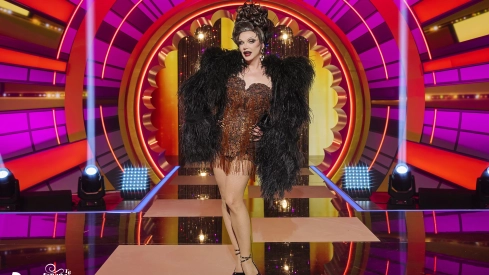
Supremme de Luxe is probably the most famous drag queen in our country. Not only do almost thirty years of profession showing her art in venues all over the country back her up, but her position as host of Drag Race España has catapulted her and made her known to the general public. We spoke with her before the premiere of the sixth season of the format, with a society increasingly polarized and attentive to the rise of the far-right and how it can affect LGTBIQ+ rights.
Arnau Martínez: This year on Drag Race you are premiering a new set and workshop, but what hasn't changed is that your face is still up there presiding. Does it still impress you to see yourself there?
Supremme de Luxe: The answer is yes. If you think about it, yes. Of course, I go in there, which is my job, suddenly when you see the image you say: "Oh, damn it!". That still impresses me a lot.
And judging other people's talent? Because in the end it's something very subjective.
Totally. You already see that we have a hard time, hence the tears. More than judging talent, many times we judge how someone performs doing something specific, because talent, if you pass the casting and you are in Drag Race, talent is indisputable. And in all seasons the queens are overflowing with talent. Being a competition, we focus a lot on the challenges, which you can solve with greater or lesser skill, your day can get complicated... We judge things that in a day-to-day would not happen absolutely anything but that in the competition can play against you and it's a bummer because you can go home. So it's tough, it's tough.
Another novelty this season is that for the first time we have a drag King, Marcus Massalami. How do you value the incorporation of this type of profiles that until now were non-existent?
I think it's great and from my point of view I think it's overdue. Drag is a free art, very varied and very diverse, so I think that the more representation there is of all that, the more we will always win, like everything: as a program, as a format, as a person, as a society... as everything.
Is the existence of Drag Race more important now with the rise of the far-right and its discourses?
The existence of Drag Race and our existence in general. Because nowadays, even signifying yourself already seems like an act of resistance. It's tough that in 2026 we are like this. Right now I am seeing situations at 47 years old that I haven't experienced even as a teenager or very young adult. There are things I hear now that I had never heard before. To go back to that, you say: "My goodness, how is that possible?". I want to think that there aren't as many as it seems and that if as a society we have come this far, we will be able to continue moving forward. Everything that means making visible and taking stances and positions nowadays is necessary. Unfortunately, but it is.
Does it scare you?
It worries me, but it doesn't scare me, which is very different. I can be worried about the loss of rights that were hard to achieve, but not only for the collective. There is a certain discourse like there should only be one vote per family and that women don't vote and things like that, which I say: "Are we seriously dealing with this now?".
Do you think one can be right-wing and at the same time a drag queen?
That is very private and personal and depends on what kind of right-wing. Many times, being right-wing, you throw stones against your own roof, but it depends if it's in economic matters, more in social matters… There are right-wing people who socially don't think they are right-wing and it's only an economic issue, I don't know. I think nowadays we get into many debates where many yes or no or black and white questions are asked and I think there are many nuances. We don't know each person's situation either. If you tell me it's a radical far-right discourse, I would tell you that yes, it is opposite, but that seems to me to be the case for anyone, no matter what they do. I think we should dedicate more time to debating, a healthy debate, not such heated debates as the ones we are experiencing.
Have you been proposed to enter politics?
No. And I would never do it.
You wouldn't be mayor of Fuenlabrada?
No. [Laughs] To Fuenlabrada, if they want, I'll go and give the opening speech delighted and very happy to be there, but no, I don't like politics at all and even less the politics that exist today, which frankly I don't like at all. I can't be in that mud.
You don't consume it either?
Yes, yes. Damn, just by being citizens we are political animals, we live in a society, we have to know what is happening, but I don't like what I see. Maybe someone likes it, but well, making politics for TikTok, which is what I see a lot lately, I don't like it at all.
And speaking a little more about you, how has the format changed your life?
Well, look, not much in life. I still keep my friends, my family, my dog, my house...
Has fame not gone to your head?
It's just that I'm not famous. I can walk through Puerta del Sol calmly without anyone bothering me. How famous you are is measured by how long you can be in Puerta del Sol without people stopping you. [Laughter] People know me, but it doesn't affect my daily life at all. And I like that my life hasn't changed much. Professionally, it has changed a lot. Thanks to Drag Race, I've been able to access many jobs and improve many conditions.
Do you think Drag Race has dignified the profession?
It's just that I don't consider the profession to have been undignified. Perhaps the conditions under which it often had to be practiced were not dignified or ideal. It's like when they ask me: "Do you think people respect you more now?" I say: "No, I've always had the public's respect." What happens is that before, perhaps I reached a much smaller audience. Drag in a very small bar is very dignified. The act of going out every night to entertain an audience seems extremely dignified to me, even more so than what I do on television. It seems like the daily grind, the face-to-face with the audience. Because ultimately, if you see me on TV, you choose what you see of me, you choose to watch the format I present, but if you have to perform in a bar, you have to go out and defend your own. I think Drag Race has made it more accessible to an audience that might not have approached drag if they hadn't encountered it. And suddenly they find it on a platform and it turns out they like it and say: "Hey, this is great, isn't it? How wonderful." And they get hooked and watch the show.
Would you say the format has an expiration date in Spain?
For now, I don't see it, but nothing is infinite. We are all finite, we are going to die, and formats end at some point or another. Hopefully, a lot of Drag Race Spain will be made. But someday it will end.
Do we have enough drag queens and talent?
Yes, yes, yes, yes. There's more than enough talent for many seasons. Plus, the young ones are coming on super strong. You'll see this season, there are very young and super talented people. There's good talent and it's in good hands.
Now let them take our spot in the venues!
Honey, gaps don't disappear, gaps get filled. I started doing drag in '97 and I haven't stopped working, and it's 2026. Young people have always come in, and I was young too and I came in and made my space. Relays are taken, and there are proposals that I won't do because of my age, just like a younger person won't do what I do. There's work for everyone.