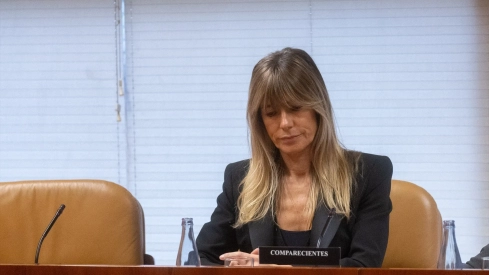
The Provincial Court of Madrid has confirmed the continuation of the proceedings against Begoña Gómez for the procedures of the Jury Court, although it has excluded two of the four crimes initially included: corruption in business and misappropriation. In this way, the trial will continue only for influence peddling and embezzlement of public funds.
The decision raises two relevant issues. The first is why the proceedings continue when the Public Prosecutor's Office considers that there is not sufficient evidence to accuse. The explanation is that the opening of the oral trial can be agreed at the request of the popular prosecution when there is controversy over whether the facts constitute a crime, leaving it to the court to assess the evidence at trial. The Court does not declare Begoña Gómez guilty, but understands that it is up to the trial court to resolve that issue.
Among the facts that the order to open the oral trial considers indicatively relevant are:
• The alleged meeting held at La Moncloa with the rector of the Complutense University.
• The creation of the TSC Chair.
• The alleged irregularities in the process of creating said chair, an aspect that must be proven by the accusations.
• The letters of support signed by Begoña Gómez in favor of a UTE linked to Juan Carlos Barrabés in July 2020, coinciding in time with meetings held at La Moncloa and with the development of the aforementioned chair.
However, the real debate will begin during the oral trial. The accusations must prove something more than the existence of meetings or institutional relations. Specifically, they must demonstrate:
• What specific act of pressure, influence or advantage Begoña Gómez carried out, since holding meetings with university authorities does not, by itself, constitute a crime of influence peddling and so far they have not managed to prove anything else.
• What economic benefit or patrimonial advantage she or a third party obtained as a consequence of that alleged action.
• That there was an illicit use of public resources with knowledge and intent to allocate them to private purposes.
It is precisely at this point where the core of the process will be focused. Another of the issues that has generated the most debate is the jurisdiction of the Jury Court. When judge Peinado issued the order to open the oral trial, the jurisdiction of the Jury was justified by the so-called connection of crimes. Influence peddling and embezzlement are crimes whose jurisdiction expressly corresponds to the Jury Court, while business corruption and misappropriation were incorporated into the procedure precisely because of their connection with those.
However, after the decision of the Provincial Court, those connected crimes disappear and only the two that the Organic Law of the Jury Court itself expressly assigns to this body remain.
Specifically:
• Article 1.2.g of the Organic Law of the Jury Court assigns to the Jury the crimes of embezzlement of public funds.
• Article 1.2.h likewise assigns the knowledge of the crimes of influence peddling.
Therefore, any jurisdictional doubt disappears: the procedure must be tried by a Jury Court.
The comparison with the procedure followed against David Sánchez is inevitable. In that case, the Provincial Court of Badajoz expressly explained that the procedure could not be processed through the channels of the Jury Court because among the crimes charged was administrative malfeasance. The Chamber itself recalled that the crime of malfeasance excludes trial by Jury according to article 5 of the Organic Law of the Jury Court and the Non-Jurisdictional Plenary Agreement of the Supreme Court of March 9, 2017. There lies the main difference between both procedures.
In the case of David Sánchez there was an accusation of administrative malfeasance, which determined the jurisdiction of a professional court. In contrast, in the case of Begoña Gómez there is no accusation whatsoever for that crime, so only two offenses remain whose jurisdiction expressly corresponds to the Jury Court.
It is necessary to emphasize that the decision of the Provincial Court does not imply a declaration of guilt nor a validation of the accusatory thesis.
In my opinion, since this is a procedure with enormous political repercussions, the fact that the trial corresponds to a Jury Court may constitute an additional guarantee of impartiality, given that anyone with political motivations can be excluded.
The nine citizens who will make up the jury will be selected by lot, the parties may intervene in the selection process to exclude those who do not offer the necessary guarantees of objectivity and, finally, it will be they who, exclusively on the basis of the evidence presented at the trial, decide whether the facts have been proven beyond all reasonable doubt.
