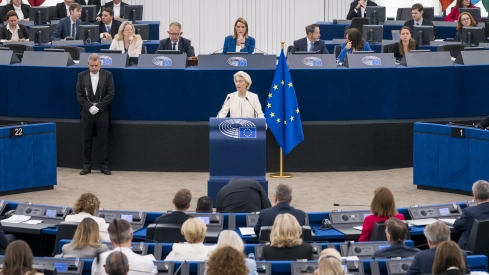
The European Union has taken a decisive step this Wednesday to limit minors' access to social media. The President of the European Commission, Ursula von der Leyen, has announced a future common regulation that will prevent the use of these platforms before the age of 13 and restrict their use until 15 under parental supervision.
The plan will be part of the future European Union Child Law, known as the 'EU Kids Act', whose details will be presented this Thursday. The norm will establish different levels of protection according to age and will oblige large tech companies to demonstrate that their services are safe for minors.
"No social media before 13. No personal accounts before 15," summarized Von der Leyen during her State of the Union address to the European Parliament. Teenagers aged 13 and 14 will be able to access through "mini-accounts" created and monitored by their parents, with limited functions and usage times.
From the age of 15, they will be able to have a personal account, although platforms must maintain a reinforced security design until 18. The proposal seeks to protect privacy, reduce contact with strangers, improve reporting systems, and prevent algorithms from leading to extreme content or deliberately prolonging connection time.
The Commission intends for these rules to be common to the 27 Member States. Currently, the main social media platforms claim to prevent registration for children under 13, but age can be circumvented by entering a false date of birth, and companies lack a homogeneous obligation to verify it.
Tech companies will have to prove their platforms are safe
The most relevant change affects the responsibility of companies like Meta, TikTok, or Google. Brussels wants to reverse the burden of proof so that the platforms themselves are the ones to certify that their products protect minors and avoid mechanisms capable of generating dependence.
Von der Leyen has directly pointed to features such as autoplay, infinite scrolling, personalized recommendations, and constant notifications. "We don't have to accept addictive features. We don't have to accept children being dragged into increasingly extreme content," she warned.
The President of the Commission has also focused on the use of photographs of girls to produce sexualized images using artificial intelligence. European regulation will study how to limit these practices and reinforce protection against harassment, manipulation, and adult contact with minors.
The application of limits will depend on a reliable verification system. The Commission already has a European age verification solution that allows a person to prove they are above a certain threshold without revealing their identity or other personal data. The tool, initially prepared for adult-only content, can be adapted for ages such as 13 or 15.
Brussels supports its initiative with data reflecting the weight screens have acquired in daily life. A Eurobarometer published by the European Commission estimates that teenagers spend an average of 4.5 hours daily connected on school days and more than six hours on weekends. 14% exceed ten hours, and almost one in three claims that social media makes them feel stressed, sad, or excluded.
The World Health Organization has also warned of the increase in problematic use. Its study, conducted among nearly 280,000 young people from 44 countries and regions, placed these behaviors at 11% of adolescents in 2022, compared to 7% recorded four years earlier. The WHO links this pattern to difficulty controlling connection time, abandonment of other activities, and negative consequences in daily life.
During her speech, Von der Leyen recalled the case of Oléa, a 14-year-old Belgian teenager who died by suicide after suffering online harassment. "What we are witnessing is a great capture of our children. A capture of their attention, of their concentration, of their minds," she stated before calling for a European response.
The President of the Government, Pedro Sánchez, welcomed the announcement and highlighted the work done over the last year with France to promote a common minimum age. The head of the Executive assured that the proposal sends a clear message to "techno-oligarchs" and defended that "childhood is not destroyed by algorithms or economic interests".
A year ago, the Governments of France and Spain proposed establishing a minimum age to access social media.
— Pedro Sánchez (@sanchezcastejon) September 16, 2026
Many looked at us with incredulity. Others opposed it. But there were Governments that supported us and joined our cause.
Today, the European Commission has…
Spain wants to raise the limit to 16 years old
The European proposal arrives as Spain is processing its own Organic Law for the protection of minors in digital environments. The text proposes a threshold of 16 years for accessing certain social networks and includes new obligations to protect privacy and combat addictive designs.
PSOE and Sumar have agreed that platforms must certify to the National Commission for Markets and Competition that they offer tools against unwanted contacts and that they have eliminated harmful mechanisms for children and adolescents. The Spanish model would thus raise the age of free access one year above the proposal announced by Brussels.
The Spanish Association of Pediatrics and the Spanish Society of Adolescent Medicine have supported Europe placing child protection at the center of regulation, although they demand more stringent exposure limits. Their recommendations include avoiding screens until age six, setting a daily maximum of one hour between seven and twelve, and keeping usage below two hours between 13 and 16.
Europe also observes the experience of Australia, which since December 2025 requires individuals to be 16 years old to open or maintain accounts on major social networks. Companies are obliged to take reasonable measures to prevent access, and the Australian regulator already supervises compliance, according to the public body eSafety Commissioner.
France also approved a ban for minors under 15, although the Constitutional Council annulled part of the norm in August, considering that the general prohibition disproportionately affected rights and freedoms. That setback has reinforced the commitment to a gradual European framework, accompanied by age controls and direct obligations for companies.
The initiative announced by Von der Leyen now opens the legislative process. The Commission will have to finalize the text and negotiate its approval with the European Parliament and the member states. The limits are not yet in force, but Brussels has already set the ground on which it wants to wage battle with the big tech companies.
Add ElConstitucional.es as a preferred Google source for free.
Stay informed about all the latest breaking news with the best information. Against disinformation, for democracy and social rights.
