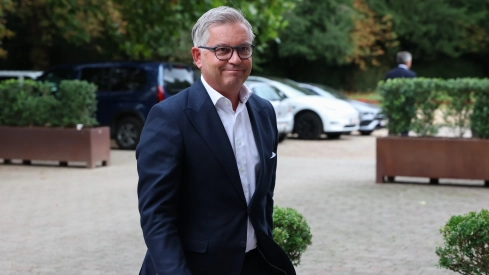
The European Commission launched this Tuesday its strongest message since the migration crisis began in Ceuta. The European Commissioner for Home Affairs and Migration, Magnus Brunner, has demanded an urgent response and has prioritized the return to Morocco of all persons who irregularly crossed the border on July 30 and 31 and do not have the right to remain in Spain.
"All those who entered illegally and do not have the right to remain must be quickly returned to Morocco," Brunner stated during the debate held in the plenary session of the European Parliament. The session addressed the instrumentalization of migrants and the necessary response to protect the external borders of the European Union after a massive entry that reached a figure close to the 80,000 inhabitants of Ceuta.
The commissioner expressed Brussels' solidarity with the people of Ceuta and extended his condolences to the families of those who died trying to reach the autonomous city. He also focused on the criminal networks that took advantage of those people. "Traffickers kill people and we must do everything possible to stop them," he warned.
Brunner pointed out that thousands of migrants are still in Ceuta awaiting resolution of their situation, including some 2,000 unaccompanied minors, according to the figures presented during his intervention. The Commission considers that this presence maintains strong pressure on public services and poses problems of coexistence and public order in a territory of less than 20 square kilometers. Returns must be processed respecting the guarantees provided for minors, asylum seekers, and persons who may have the right to international protection.
Brussels also acknowledged the reaction of the Spanish authorities during the first hours of the crisis and the subsequent cooperation of Morocco. Most of those who crossed the border were quickly returned and none of those people entered the Schengen area, a result that Brunner attributed to the deployment by Spain and Moroccan collaboration.
More vigilance and reaction capacity
The Commission wants the Ceuta crisis to serve to correct the detected failures. Brunner has called on Member States for the full application of the European Pact on Migration and Asylum, a reinforcement of border surveillance, and new instruments for the European Border and Coast Guard Agency (Frontex) to act more quickly.
Among the proposed measures is the improvement of early warning systems to detect calls for mass crossings disseminated on social media. The European Union also intends to intensify surveillance of the digital activity of organizations dedicated to human trafficking and maintain coordination with major platforms to curb disinformation. The objective, Brunner explained, is to react sooner and convey to citizens that "things are under control".
This reinforcement adds to the 114.7 million euros in emergency aid that the Commission has granted to Spain. The funds will finance personnel, reception centers, observation systems, thermal cameras, floating barriers, and underwater drones. Frontex, Europol, and the European Union Agency for Asylum have also committed to a more stable presence in Ceuta.
Brunner has acknowledged Rabat's commitment to accept returns, although he has called for more efforts to prevent departures from Moroccan territory and to prosecute criminal networks. The commissioner will travel to Madrid this Thursday to meet with ministers Ángel Víctor Torres, Fernando Grande-Marlaska, and Elma Saiz. The Popular Party has also announced a meeting between Brunner and Alberto Núñez Feijóo.
The EPP increases pressure on Rabat
The European People's Party (EPP), the main force in the European Parliament, has toughened its tone against Morocco. Its proposed resolution demands that Rabat fulfill its obligations as a partner of the European Union in border control, returns, and migratory cooperation. The document also considers statements questioning Spanish sovereignty over Ceuta and Melilla incompatible with that relationship.
The EPP text does not expressly call for the suspension of the Association Agreement between the European Union and Morocco. Popular MEP Javier Zarzalejos has warned, however, that it is difficult to maintain a normalized political and commercial relationship while returns remain pending and Rabat prevents the transfer of bodies of deceased migrants so they can be buried in Morocco. The far-right Vox has directly requested to suspend the agreement with the North African country.
The Secretary General of the EPP and Vice-President of the group, Dolors Montserrat, has described the massive entry as a "textbook hybrid war". During her speech, she held Morocco responsible "by action or by omission" and defended that the security of the southern European border begins in Ceuta. "Ceuta will always be Spanish and European," she proclaimed before demanding the return of adults and minors with the corresponding legal guarantees.
Montserrat has also criticized Pedro Sánchez and accused the Prime Minister of knowing the previous alerts and going on vacation. Socialist Iratxe García responded by demanding European solidarity and respect for legislation on minors and asylum. "Ceuta is not alone, Ceuta is Spain, Ceuta is Europe," defended the president of the Socialists and Democrats group.
PNV MEP Oihane Agirregoitia took advantage of the debate to reveal the email sent by the Moroccan diplomatic mission to some members of the European Parliament. In that communication, Rabat promised to readmit Moroccan citizens, unaccompanied minors, and third-country nationals affected by the crisis. Agirregoitia demanded that the commitment translate into actions in the face of images that, she warned, still contradict the version offered by Morocco.
The different draft resolutions will continue to be negotiated in the coming hours. The EPP intends to agree on a common text with social democrats, liberals, and greens, so its wording may undergo changes. The European Parliament will vote this Thursday on its definitive response to the Ceuta crisis, the same day Brunner will hold his meetings with the Government and with Feijóo in Madrid.
Add ElConstitucional.es as a preferred Google source for free.
Stay informed about all the latest breaking news with the best information. Against disinformation, for democracy and social rights.
