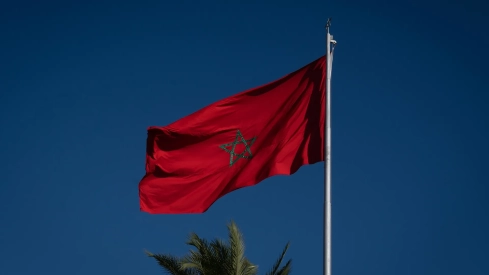
Morocco has activated a diplomatic offensive in the European Parliament to defend its actions during the massive entry of migrants into Ceuta and distance any responsibility from its authorities. The mission of the Alawi kingdom to the European Union and NATO sent a letter this Monday to a portion of Spanish MEPs, just hours before the crisis reached the Strasbourg plenary session.
The email presents Rabat's version of the events of July 30 and 31, when around 80,000 people irregularly crossed the Ceuta border from Moroccan territory. The European resolution will be voted on this Thursday and expressly addresses "hybrid attacks and the instrumentalization of migrants in Ceuta," as well as the necessary response to protect the EU's external borders.
The communication reached representatives of PSOE, PNV, and ERC, as confirmed by several of its recipients. MEPs from PP, the far-right Vox, Sumar, Compromís, Podemos, and BNG claim they were excluded from the mailing. The Moroccan mission has presented its initiative as a "constructive" contribution to the debate, although the selective distribution of the message reveals that Rabat carefully chose a part of its audience.
The existence of the letter came to light during the Eurochamber session itself. PNV MEP Oihane Agirregoitia read one of its main commitments from the rostrum and asked Morocco to fulfill it. "The images we are seeing on television and the information we receive do not say the same thing," she warned.
Rabat's move seeks to influence a European negotiation marked by differences between socialists and popular parties. The diplomatic delegation has tried to establish its narrative before the vote and has presented Morocco as a reliable, collaborative partner, unrelated to any deliberate action against Spain.
Rabat relies on Moncloa to defend itself
Morocco maintains that it is investigating "the causes and actors" that made possible the arrival of tens of thousands of people in Ceuta in a matter of hours. Its letter points to disinformation spread through social media and the manipulation of vulnerable people by organizations dedicated to migrant trafficking and human trafficking.
The explanation, however, does not identify any specific responsible party nor offers results of the investigations that Rabat claims to keep open. Nor does it clarify how so many people could approach the border, cross it, and reach Spanish territory for two consecutive days without Moroccan authorities being able to contain the movement.
A central part of the argument rests on the statements made by the Spanish Government. The Moroccan mission recalls that Pedro Sánchez has assured that the available information does not allow directly attributing responsibility for the events to Morocco and also uses Moncloa's recognition of Rabat's subsequent cooperation to facilitate returns.
The words of the Spanish Executive thus become the main political endorsement of the Moroccan defense in Brussels. Rabat incorporates them into its letter while avoiding addressing the doubts raised in Spain about prior warnings, the actions of its security forces, and the speed with which a specially guarded border was overwhelmed.
The Alawite kingdom also directly addresses the MEPs. "What interest would Morocco have in provoking a serious crisis with Spain and the European Union?", the letter asks. The diplomatic representation recalls that the EU is its main partner and that relations are going through a strengthening phase.
Rabat adds a second argument linked to the date of the massive entry. The events coincided with the Feast of the Throne, one of the most symbolic celebrations for Mohamed VI, and the letter questions whether Morocco could deliberately provoke a crisis during that day.
The explanation of police action is based on the impossibility of using lethal force against a crowd willing to cross the Mediterranean. The argument shifts the debate to that extreme, but leaves unanswered what preventive measures were adopted, why they proved insufficient, and how such a large concentration came to form next to Ceuta.
A promise of readmission still pending
The letter includes the commitment to readmit "all affected persons", including Moroccan citizens, unaccompanied minors, and nationals of third countries. This is an especially relevant promise when several thousand people remain in Ceuta and administrative procedures are progressing with difficulty.
Since August 10, 5,482 people have voluntarily returned to Morocco and another 307 have been expelled by judicial decision. Currently, there are 4,160 migrants housed in temporary accommodations, while Spanish authorities have initiated 1,822 files corresponding to adults.
The situation of minors requires additional guarantees. Ceuta protects 2,048 children and adolescents, of whom 1,612 arrived during the massive entry in July, and around 300 remain in resources dependent on the central government. The Executive estimates that there are still between 700 and 1,000 minors on the streets awaiting affiliation.
The first ten individual files began to be processed this Monday, once the legal representation required by European regulations was incorporated. An eventual reunification in Morocco requires verifying the minor's identity, locating their family, and proving that the return protects their rights, so Rabat's declaration does not translate into automatic returns.
Morocco completes its defense by displaying its migration cooperation figures. It assures that its authorities prevent more than 75,000 irregular entry attempts each year and estimates 227,000 frustrated crossings between 2023 and 2025. It also maintains that during that period, more than 1,050 trafficking and smuggling networks were dismantled.
The battle for the narrative is already reflected in the drafts being negotiated by European groups. Socialists highlight Moroccan cooperation after the crisis, while the European People's Party considers any questioning of Spanish sovereignty over Ceuta unacceptable and demands that Rabat assume its responsibilities in border management.
The two main political families of the European Parliament have still not reached an agreement on the resolution. The negotiation will continue until Thursday, when MEPs will have to decide on Morocco's role, the protection of Ceuta as a European border, and the community's response to the instrumentalization of migratory flows.
Add ElConstitucional.es as a preferred Google source for free.
Stay informed about all the latest breaking news with the best information. Against disinformation, for democracy and social rights.
