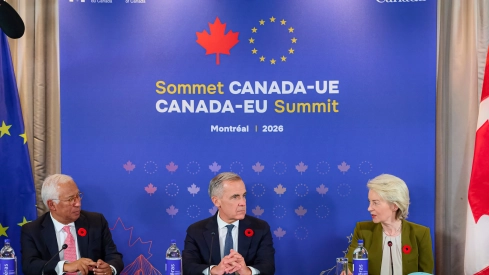
Canada and the European Union have taken a step to strengthen their relations and bring the North American country closer to the community bloc. The two partners announced this Friday in Montreal a new "Alliance for the Future", with which they intend to reinforce their economic, technological, energy, and security cooperation.
Canadian Prime Minister, Mark Carney, has called the agreement a "historic day" and has argued that it will allow for building a much closer relationship with Europe. The proposal contemplates that Canada could become the first "associate member" of the EU, a formula that would bring it closer to the community countries without officially becoming part of the Union.
However, there is still no definitive agreement on this new status. The leaders have committed to specifying its conditions before the next bilateral summit, scheduled for June 2027. In addition, some European countries, including Germany, have expressed their doubts about the designation of "associate member".
Canada moves closer to the European Union amid trade tensions with the United States
The rapprochement between Brussels and Ottawa comes at a time of changes in international relations, marked by trade tensions, competition for natural resources, and disputes over technology and security. Canada maintains a close economic relationship with the United States, its main trading partner, but the Carney government seeks to expand its markets and reduce its dependence on a single country. Trade tensions with the Donald Trump Administration have reinforced Ottawa's interest in strengthening its ties with other international partners.
Europe also has its own reasons for promoting this agreement. The European Union wants to reduce its dependence on external suppliers in strategic sectors and guarantee access to raw materials, energy, and technologies necessary for its economy and defense. Until now, Canada and the EU already maintained a trade relationship through the CETA agreement, which facilitates the exchange of products and services between both markets. The new alliance aims to go further and expand collaboration in areas such as artificial intelligence, research, defense, security, and digital trade.
The "associate member" formula has been defended by both Carney and the President of the European Commission, Ursula von der Leyen. However, it does not appear in the joint statement signed in Montreal. Germany is among the countries that have shown reservations about this possibility, and Chancellor Friedrich Merz reportedly lobbied to prevent the term from appearing in the final document.
Von der Leyen has acknowledged that this category is not currently contemplated in European treaties, but has defended the need to explore a closer relationship. The President of the Commission has stated that Canada is "the most European country outside of Europe" and explained that the proposal does not seek full accession, but a much deeper association.
Gas, strategic minerals, and support for Ukraine: the main agreements
One of the most important points of the new alliance is energy cooperation. Canada and the EU will study the possibility of increasing liquefied natural gas (LNG) exports to Europe. To do this, they will conduct a joint analysis on the long-term viability of these shipments, taking into account market conditions and necessary infrastructure. For now, no concrete increase in exports has been approved. The aim is to study whether it would be possible to strengthen Canadian supply and improve European energy security.
They have also agreed to work to ensure access to critical raw materials, such as minerals needed to manufacture batteries, digital technologies, electronic equipment, and defense material. Among the planned measures is to study the creation of strategic reserves that would allow access to these resources in the face of potential supply problems or international crises.
In the economic sphere, both parties have concluded negotiations for a digital trade agreement that will complement the CETA trade pact. In addition, the European Investment Bank will facilitate European investments in Canadian projects related to strategic raw materials. Cooperation will also extend to technology. Canada will participate in the European EuroHPC initiative, dedicated to supercomputing, and both parties will study its access to certain services of the Galileo satellite navigation system. They also want to promote new digital connections through submarine cables between Canada, Europe, and Asia.
Regarding security, the two partners have agreed to strengthen their defense cooperation and have reiterated their support for Ukraine against the Russian invasion. Canada will join the European loan of 500 million euros aimed at supporting Kyiv. The alliance also contemplates facilitating exchanges between students and workers, with greater Canadian participation in European programs such as Erasmus+. The objective is for citizens on both sides of the Atlantic to have more opportunities to study, work, and research in the other territory.
With all these commitments, Brussels and Ottawa seek to build a closer relationship that allows them to gain economic and strategic autonomy. The next step will be to define the scope of this partnership before June 2027, when they expect to specify what the new relationship between Canada and the European Union will be like.
