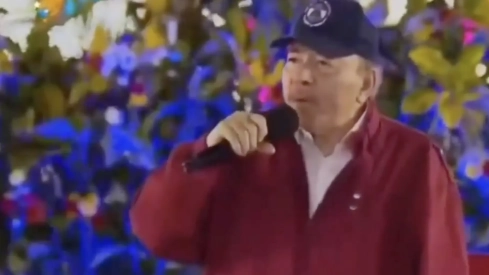
Daniel Ortega has decided to dispense with the last democratic appearance Nicaragua preserved. The president has announced that the country will not hold elections again that allow the opposition to dispute power, a decision with which he intends to ensure the continuity of the regime he shares with his wife and co-president, Rosario Murillo.
"There will be no more elections here," he declared during the event held in Managua for the 47th anniversary of the Sandinista Revolution. Ortega accused his adversaries of trying to "trap the Government" through the ballot box and promised to promote new laws to prevent opposition parties from competing again.
The announcement currently lacks concrete legal development, but its political intention is unequivocal. The National Assembly, dominated by the Sandinista Front, will be used to build the legal "wall" announced against those the regime calls "coup plotters" and "traitors".
Nicaragua was supposed to return to the polls in November 2027 after a constitutional reform extended the presidential term. Ortega's declaration now places even that call under serious threat and leaves citizens without an institutional mechanism to replace their rulers.
A dictatorship that had already emptied elections
Ortega's words represent an especially serious leap, although electoral competition had been dismantled for years. In the 2021 elections, the regime arrested the main presidential aspirants, outlawed parties, and persecuted businessmen, journalists, and social leaders before attributing more than 75% of the votes to the president.
The opposition with real chances of disputing power was left off the ballot. The United States called those elections a "pantomime" and the international community questioned their legitimacy given the absence of guarantees, independent observation, and political pluralism.
The new announcement eliminates even that formal representation. Ortega is no longer limited to organizing elections without adversaries capable of defeating him, but publicly admits that he considers unacceptable any vote that could provoke a change of Government. "The story of the parties put in place by the Yankees and the Somocistas returning to power is over. Never, never, never," he proclaimed to his supporters. Citizen will is thus subordinated to the decision of a family that identifies its permanence with the continuity of the State itself.
The opposition Renacer believes that the regime has stopped pretending to govern with the consent of the population. For this movement, the announcement confirms that elections have been reduced to a tool of legitimation and that Ortega only contemplates processes whose outcome is decided in advance.
Power shared with Rosario Murillo
Ortega, 80, returned to the Presidency in 2007 and since then has been dismantling the constitutional limits that prevented his indefinite permanence. Control of the Executive has extended over Parliament, the Judiciary, the electoral body, the Police, the Armed Forces and a large part of the country's economic and social life.
Rosario Murillo began serving as vice president in 2017 and was elevated to co-president through the constitutional reform that came into force in February 2025. The modification extended terms to six years, blurred the separation of powers, and placed the rest of the institutions under the coordination of the Presidency.
The United Nations then warned that the change granted practically unlimited powers to the couple. International experts described a structure in which state institutions function to preserve power, monitor the population, and neutralize any critical voice.
The co-presidency also prepares a possible dynastic succession. Murillo concentrates the daily management of the Government, controls official communication, and has placed several family members in relevant positions within the political, media, and business apparatus.
The suppression of electoral competition would allow this succession to be resolved within the regime itself, without submitting it to citizen vote. The model that ends up being approved may retain symbolic votes or replace them with internal designations, but Ortega has already made it clear that none of them can threaten family continuity.
From the revolution against Somoza to a new dictatorship
The scene contains one of the greatest contradictions in Nicaragua's recent history. Ortega participated in the revolution that overthrew the dictatorship of Anastasio Somoza in 1979, whose family had controlled the country for more than four decades.
The Sandinista leader then accepted an electoral system and lost the Presidency in 1990 to Violeta Barrios de Chamorro. That peaceful handover demonstrated precisely that a revolutionary force could leave the Government and continue to be part of political life.
Ortega returned through the ballot boxes seventeen years later. From the Presidency, he reformed the rules, subdued institutions, and gradually removed his adversaries to prevent a defeat like that of 1990 from repeating itself.
Repression intensified after the 2018 protests. More than 300 people died during the response of security forces and armed groups affiliated with the Government, according to international organizations. Authorities justified the violence by accusing an attempted coup promoted from abroad.
Since then, persecution has reached opponents, students, human rights defenders, priests, businessmen, universities, social organizations, and independent media. Many of their members have ended up detained, stripped of their assets, or forced into exile.
Prison, exile, and withdrawal of nationality
The United Nations Group of Experts has documented a sustained system of surveillance, arbitrary detentions, trials without guarantees, confiscations, and forced disappearances. Its latest report accuses the Government of financing repression through the illegal diversion of public funds and of persecuting exiles outside Nicaraguan borders.
Authorities have arbitrarily withdrawn the nationality of 452 people and have left thousands of exiles in a de facto stateless situation by denying them passports, documents, or return to the country. Reprisals also extend to family members who remain in Nicaragua, subjected to surveillance, threats, loss of employment, or confiscation of properties.
Thousands of non-profit organizations have been closed since 2018. The closure has affected humanitarian entities, professional associations, universities, religious organizations, and groups dedicated to community development.
The independent press has also suffered the closure of newsrooms, the seizure of facilities, and the imprisonment of journalists. A large part of Nicaraguan media now operates from Costa Rica, the United States, Spain, and other host countries.
UN experts maintain that several of these practices may constitute crimes against humanity. The repressive apparatus already operates beyond national territory through surveillance and harassment networks against those who managed to escape.
Rubio denounces Ortega's "fear" of the ballot box
The United States has led the first major international response to the announcement. Secretary of State, Marco Rubio, has accused Ortega of showing "his true authoritarian nature" and has defined the Nicaraguan system as a family dictatorship.
"Ortega's commitment to abolish elections demonstrates his cowardice and his fear of the will of the Nicaraguan people," Rubio wrote. The head of US diplomacy believes that Ortega and Murillo have abandoned even the appearance of having citizen support.
The Trump Administration and the international community will not stand by as the Murillo-Ortega dictatorship deepens repression at home and manufactures instability that threatens U.S. national security. Ortega’s pledge to abolish elections in Nicaragua proves his cowardice and…
— Secretary Marco Rubio (@SecRubio) July 21, 2026
Rubio has called on the international community to act and has warned that Nicaragua cannot maintain normal relations while destroying the democratic principles of the continent. Washington also links the hardening of the regime with a threat to regional stability and its own national security.
The United States has imposed financial sanctions and visa restrictions against officials, family members, and entities linked to the repressive apparatus in recent years. The Trump Administration has promised to maintain pressure, although it has not yet announced concrete measures in response to the electoral suppression.
The European Union, the UN, the Organization of American States, and numerous Latin American governments had already condemned the 2025 constitutional reform and the persecution of the opposition. The coordinated reaction that Rubio demands must now determine whether those censures translate into new sanctions, diplomatic isolation, or international accountability initiatives.
A stable country at the cost of fear
The regime maintains internal control thanks to a combination of repression, surveillance, and economic stability. Nicaragua has avoided some of the fiscal crises suffered by other countries in the region and maintains the flow of remittances sent by hundreds of thousands of citizens living abroad.
That stability coexists with a disarticulated civil society and a huge diaspora. Hundreds of thousands of Nicaraguans have left the country since 2018, mainly to Costa Rica, the United States, and Spain, for political, economic, or security reasons.
The absence of massive protests also does not imply acceptance. Police controls, punishment of family members, and the possibility of losing one's job, home, or nationality reduce any space for expressing dissent within the country.
Ortega's announcement seeks to transform this de facto situation into a permanent rule. The opposition would be confined to exile, the Sandinista Front would control the mechanisms of succession, and the vote would cease to offer even a future expectation of change.
The next decision will correspond to the National Assembly, which must convert the presidential threat into a legal or constitutional reform. Ortega has not yet presented the text nor has he clarified whether all elections will disappear, but he has already ordered that no ballot box can remove his family from power.
