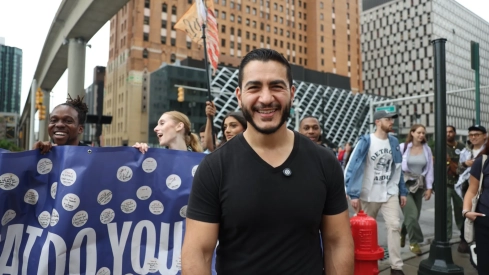
Abdul El-Sayed has turned a Senate primary into a national discussion about the future of the Democratic Party. His narrow victory over Congresswoman Haley Stevens brings to a swing state the progressive wave that already propelled Zohran Mamdani in New York and poses a question that will accompany the party until November. Can a clearly left-wing agenda win back voters that Donald Trump attracted with his populist discourse?
The 41-year-old doctor won with 48.5% of the votes against Stevens' 47.5%. The difference was less than 15,000 votes after a 13-hour recount and a turnout that surpassed all previous Senate and Michigan gubernatorial primaries, as well as almost all presidential primaries held in the state since 1978, according to data compiled by 'Associated Press'.
The result represents a political victory of enormous value for the Democratic left, although it also shows the size of the internal division. El-Sayed has won the nomination, but almost half of the party chose a moderate rival, backed by Governor Gretchen Whitmer, Senator Gary Peters, and a good part of the Democratic leadership in Washington.
A blow to the establishment and AIPAC's money
Stevens entered the primary with congressional experience, the backing of the establishment, and an extraordinary economic advantage. AIPAC and its linked organizations spent nearly 32 million dollars to boost her candidacy and stop El-Sayed, the largest investment made by the pro-Israel lobby group in a single electoral contest. The set of external organizations favorable to the congresswoman dedicated around 50 million to the campaign.
El-Sayed turned that disadvantage into the center of his candidacy. He presented AIPAC's money as proof of a politics conditioned by billionaires, large corporations, and interest groups capable of flooding televisions with advertising. His message found space among voters tired of a party that lost the White House in 2024 and is still looking for a recognizable answer to Trump's second term.
Stevens' defeat also confirms the breakdown of the old Democratic consensus on Israel. El-Sayed has called the Israeli offensive on Gaza a "genocide", demands an end to unconditional military aid, and links each shipment of weaponry to the money Washington stops investing in schools, hospitals, or housing within the country.
The position connects with a shift already appearing in polls. A Gallup study published in February placed Americans who feel greater sympathy for Palestinians at 41%, compared to 36% who lean towards Israelis. Among Democrats, the shift is even deeper. The automatic defense of Benjamin Netanyahu's government has become a burden within broad progressive, young, and independent sectors.
El-Sayed has also rejected accusations of antisemitism launched during the campaign. After his victory, he assured that his commitment to the security of American Jews is the same as he maintains with his own daughters. His position distinguishes between the Jewish community, the State of Israel, and the political power of AIPAC, a separation that Trump is already trying to erase through personal attacks.
A left that talks about the wallet again
Son of Egyptian immigrants and born in Michigan, El-Sayed studied Medicine at Columbia University and earned a doctorate in Public Health at Oxford. He directed the Detroit Health Department and later the Health, Human Services, and Veterans services for Wayne County. In 2018, he tried to be a candidate for governor, but lost the primaries to Whitmer with just over 30% of the votes.
Eight years later, he returns with a simpler campaign better connected to everyday concerns. He advocates for universal public healthcare, higher taxes for large fortunes, cheaper medicines, affordable housing, and a deep reform of electoral financing. His official program concentrates these proposals into three phrases he has repeated throughout the campaign. Money out of politics, money in citizens' pockets, and Medicare for All.
Money out of politics.
— Dr. Abdul El-Sayed (@AbdulElSayed) August 5, 2026
Money in your pocket.
Medicare for All.
Michigan...
We won. I am so proud to be your Democratic nominee for US Senate. Let's win in November. pic.twitter.com/RItVmqrzob
The message with which he celebrated the victory summarizes his main bet. El-Sayed tries to dispute economic populism with Trump, a terrain that Republicans have used for a decade to present themselves as defenders of workers while pushing for tax cuts for large fortunes and receiving record amounts from corporate donors.
His candidacy shares with Mamdani direct communication, effective use of networks, and the priority given to the cost of living. Michigan presents a greater difficulty than New York. It is an industrial state, with large rural areas, a significant African-American population, and a long tradition of split voting. El-Sayed also does not belong to the Democratic Socialists of America and avoids a label that continues to provoke rejection among part of the electorate.
The progressive formula he proposes combines public services, economic patriotism, and rejection of the power of elites. His campaign talks less about ideological categories and more about the price of food, housing, medicine, or gasoline. There lies his main opportunity to enter working-class neighborhoods where the Democratic message lost strength and Trump managed to present himself as a break with Washington.
Michigan will decide if the formula can defeat Trumpism
The definitive test will come on November 3 against Republican Mike Rogers, former FBI agent, former chairman of the House Intelligence Committee, and Trump-backed candidate. Rogers already narrowly lost another Senate seat in 2024 and has oriented his new campaign towards a staunch defense of the White House agenda.
Michigan then yielded two results that explain its complexity. Trump defeated Kamala Harris by around 80,000 votes, while Democrat Elissa Slotkin defeated Rogers by only 19,006 votes on the same day. A part of the electorate supported the Republican for President and then chose a Democrat for the Senate.
The initial data also do not support the certainty with which Trump celebrates El-Sayed's candidacy. The average of polls compiled by 'RealClearPolitics' places Rogers at 44.3% and the Democrat at 44%. The three-tenths difference makes the race a tie and anticipates a particularly tough campaign.
Trump responded to the result with his usual repertoire of insults. He presented El-Sayed as a "failed communist" who "hates Jews and Israel" and assured that his victory was great news for Republicans. The attack anticipates the November strategy. The ultra campaign will try to turn the candidate's Muslim religion, his criticisms of Israel, and his social proposals into a threat to the entire state.
El-Sayed needs to prevent that cultural battle from displacing the economic conversation. He must also win back lower-income, African-American, and rural voters who largely supported Stevens, as well as reassure a part of the Jewish community that received his messages about Israel with concern. The defeated congresswoman has already offered her support, and the national leadership has begun to close ranks after a very aggressive campaign.
Control of the Senate amplifies the importance of that reconciliation. Republicans currently hold 53 seats compared to 47 Democrats. Losing the seat vacated by Gary Peters would greatly complicate any possibility of regaining the majority and would allow Trump to maintain control over the legislative agenda and judicial appointments during the last two years of his term.
On November 3, El-Sayed will have to unite the two halves of the Democratic Party and win back part of the working-class electorate that Trump swept in 2024. The Michigan seat and a good part of the Senate's ability to set limits on the White House depend on that task.
