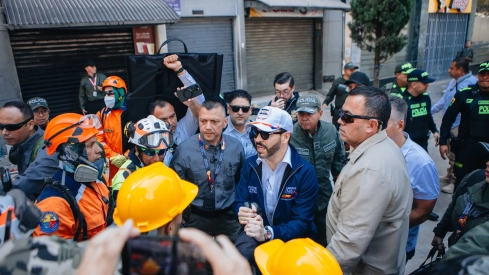
Colombia has surpassed the first 72 hours after the earthquake amidst collapsed buildings, hundreds of families searching for their loved ones, and a management of international aid marked by the hesitations of Abelardo de la Espriella's new Government. The far-right president now proclaims that any collaboration will be welcome, after having limited the arrival of foreign rescue teams for a good part of the decisive hours.
🔴 Actualización de cifras 13 de agosto con corte a las 9:30 a.m.
— UNGRD🇨🇴 (@UNGRD) August 13, 2026
El director de la UNGRD, David Santiago Tamayo, presenta el balance de afectaciones tras el sismo de magnitud 7,4 ocurrido el 10 de agosto.
Manténgase atento a los próximos reportes y consulte únicamente canales… pic.twitter.com/jQp1ZiMsR3
The latest balance from the National Unit for Disaster Risk Management raises the tragedy to 273 deceased, 3,824 injured, 496 missing, and 40,753 affected families. The figures remain open because there are still buildings to inspect and indigenous communities in Chocó with whom authorities have not been able to establish communication.
The 7.4 magnitude earthquake occurred on Monday at 7:34 a.m., with its epicenter in San José del Palmar, in the department of Chocó, and a depth of 103 kilometers. The Colombian Geological Survey considers it the seismic movement of greatest magnitude recorded in the country during this century. As of Wednesday afternoon, 146 aftershocks had been counted.
De la Espriella has declared a national disaster and an economic emergency, has visited Cali, Quibdó, Pereira, and Manizales, and has mobilized available Colombian resources. The country has 23 specialized urban search and rescue teams, made up of around 1,000 professionals, but the dimension of the earthquake has particularly overwhelmed municipalities with less machinery, poorer communications, and more limited healthcare capacity.
Two days of doubts while every hour counted
For a good part of the first 48 hours, the main international response mechanisms remained formally unactivated. The Government informed several countries that their national teams could handle the rescues and concentrated its first requests on food, medicine, water, hygiene products, and other supplies.
The Executive did quickly accept 22 specialists from Los Angeles and Virginia sent by the United States, in addition to one hundred tons of Salvadoran aid. Other proposals remained awaiting authorization. The Chinese ambassador publicly demanded an official link with which to coordinate assistance, while Mexico, Chile, Brazil, Argentina, Spain, and various international organizations offered personnel and resources.
Once the central part of the so-called "window of life" was passed, De la Espriella has changed his tone. The president now assures that all aid aimed at finding missing persons, saving lives, and alleviating suffering will be received, while personally thanking international solidarity.
A través de la Cancillería de Colombia y la UNGRD, estamos canalizando la ayuda internacional para fortalecer la búsqueda de nuestros desaparecidos y brindar respaldo a las familias afectadas.
— Abelardo De La Espriella (@ABDELAESPRIELLA) August 12, 2026
Mi agradecimiento sincero a todos los países que se han solidarizado con Colombia en… pic.twitter.com/zVahyK9mEn
The statement clashes with what happened with Mexico. Claudia Sheinbaum confirmed this Thursday that Colombia did not authorize the deployment of the Mexican Army's rescue brigade, prepared to travel since Tuesday. Bogotá demanded additional certification, despite the fact that the team already has experience in operations carried out in 98 countries.
"It's up to them if they need, if they support the sending of the brigade to Colombia," the Mexican president responded. The decision has also not prevented the shipment of 58.5 tons of water, medicine, food, and other materials between Wednesday and Friday. The Topos Tlatelolco Brigade, specialized in locating people under collapsed structures, was also not requested by the Colombian authorities.
Bogotá's official explanation relies on certification protocols and the need to incorporate aid according to the different phases of the emergency. Foreign Minister Omar Bula has denied that there were ideological criteria. The delay and lack of coordination have been accredited, with countries waiting for instructions and brigades prepared while the hours with the greatest possibilities of finding survivors passed.
The internal response has also advanced at different speeds. In Pereira, hundreds of neighbors removed rubble with buckets and their own tools before receiving sufficient resources. In Chocó, the Ombudsman's Office has warned that there are still territories and indigenous communities without a reliable balance of victims and damages. Cali and Pereira concentrate a large part of the teams, machinery, and searches.
Photographs, videos, and management crossed by religion
Facing these problems, De la Espriella has developed intense personal communication around the emergency. His networks show visits, meetings, rescues, and messages signed with his usual "¡Firme por la Patria!" (Firm for the Homeland!). The president places himself at the center of the public narrative while progress depends on the work of firefighters, health workers, police, volunteers, and specialists deployed on the ground.
His first appearance after the earthquake already provoked criticism. Before offering a victim count, cameras captured him smiling, posing, and blowing kisses while waiting to speak. The sequence was recorded before the appearance, although the lightness of those gestures contrasted with the dimension of a catastrophe that had already left dozens dead.
Abelardo se ríe, manda besos y posa antes de dar un reporte de más de 100 muertos por el terremoto que hoy enluta a Colombia.
— Camilo Romero (@CamiloRomero) August 10, 2026
Ni ante una tragedia tan dolorosa deja de creer que anda en un show y en alfombra roja.
Ya pasó la campaña, dedíquese a atender a las víctimas de la… pic.twitter.com/FeIVgAJXDx
Religious references also occupy a constant space in his communications. De la Espriella has entrusted Colombia to Jesus Christ and accompanies messages about survivors with appeals to God. When reporting the rescue of Daniela Largo in Pereira, he again combined that faith with his political motto and the actions of the emergency teams.
¡Hay esperanza!
— Abelardo De La Espriella (@ABDELAESPRIELLA) August 12, 2026
Confiamos en nuestros rescatistas y en los caninos que trabajan sin descanso, día y noche, para encontrar a nuestros hermanos desaparecidos.
Hace pocos minutos, en Pereira, Daniela Andrea Largo Sánchez, de 30 años, fue encontrada con vida después de siete horas… pic.twitter.com/xw1YCdUZIb
The message also contained inaccurate data. The president presented Daniela as a 30-year-old woman found after seven hours of searching. Daniela Largo is 32 years old and remained under the rubble for about 36 hours, while efforts to free her lasted around ten hours. The operation involved firefighters from Bogotá and Pereira, members of PONALSAR, specialists, and dozens of volunteers.
Spain has also confirmed the first national victim. A citizen with dual nationality has died and twelve other Spaniards remain unaccounted for, a figure that initially exceeded 160. The Spanish Government has activated a first emergency package of one million euros with shelter material, water and sanitation equipment, and health support.
Teams continue excavating in Cali and Pereira after more than 72 hours and keep operations open where possible signs of life have been detected. The Mexican military brigade remains ready to deploy as soon as the Government of De la Espriella authorizes its entry.
