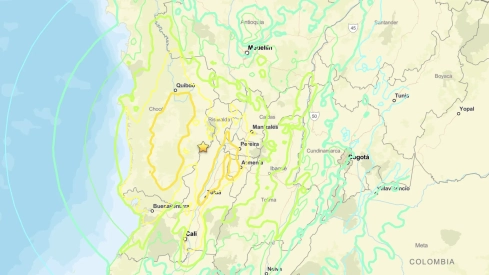
The powerful 7.4 magnitude earthquake that struck western Colombia this Monday has left at least 21 dead, numerous injured and people trapped under the rubble. The Mayors of Pereira and Manizales have confirmed 18 and three fatalities, respectively, while emergency teams continue to search collapsed buildings and damaged homes.
The toll may still increase in the coming hours. Colombian authorities have not yet released a unified national count and communications remain affected in some of the municipalities closest to the epicenter. Rescue services are also working in Cali and Quibdó, where collapses with people inside have been reported.
The tremor occurred at 7:34 in the morning, 2:34 PM in peninsular Spain, with its epicenter in San José del Palmar, in the department of Chocó. The Colombian Geological Survey initially calculated a magnitude of 6.7 and a depth of 82 kilometers, but its updated bulletin has raised the magnitude to 7.4 and placed the hypocenter at 96 kilometers.
#SismosColombiaSGC Evento Sísmico - Boletín Actualizado 2, 2026-08-10, 07:34 hora local Magnitud 7.4, profundidad 96 km, San José del Palmar - Chocó, Colombia ¿Sintió este sismo? repórtelo https://t.co/pgC7OC2O7j https://t.co/63pt8nVsSe #NoticiaEnDesarrollo pic.twitter.com/8LQZs0nsfF
— Servicio Geológico Colombiano (@sgcol) August 10, 2026
The earthquake was felt in a large part of Colombia, from Bogotá and Medellín to Cali, Popayán, Armenia, Manizales, and Pereira. The tremors also reached Ecuador, Panama, and several areas of Venezuela. Pacific monitoring systems have ruled out a tsunami threat.
Pereira concentrates the highest number of victims
Pereira is for now the city most affected by the tragedy. Its Mayor has confirmed the death of 18 people and local authorities have reported significant damage to buildings, homes, and infrastructure. Several constructions have partially collapsed and emergency services are searching for possible survivors.
Matecaña International Airport has also suffered damage. Firefighters, paramedics, and members of the security forces are touring the most affected areas while checking the stability of buildings and attending to the injured.
In Manizales, three more fatalities have been confirmed. Part of the Metropolitan Basilica Cathedral has given way during the seismic movement and numerous facades have been damaged. Images released from the city show collapsed buildings and residents trying to leave the most affected streets.
#EARTHQUAKE. After the strong 6.6 magnitude tremor with epicenter in San José del Palmar, Chocó, shook several regions of Colombia, leaving Manizales as one of the most affected cities, where the dome of the Metropolitan Basilica Cathedral collapsed after the telluric movement pic.twitter.com/5XDOW76y55
— Colombia Oscura (@ColombiaOscura) August 10, 2026
#EARTHQUAKE. Moments when a building collapses in Manizales after a strong 6.6 magnitude tremor with epicenter in Chocó. In the city of Pereira, fallen structures were also reported. Official report of affected people is still unknown.
— Colombia Oscura (@ColombiaOscura) August 10, 2026
In development... https://t.co/GMGoE8cAjS pic.twitter.com/OiNkKc4jYA
Cali also faces a particularly serious situation. Its Mayor, Alejandro Eder, has reported the collapse of at least twenty structures with people trapped and has requested the dispatch of specialized teams from Bogotá and Medellín.
Among the affected properties are a bakery, a supermarket, and several residential buildings. The La Luna hotel has collapsed, and municipal services have received reports of cracks, detachments, and structural damage throughout the city. Electricity, water, gas, and telephone services have also been cut.
In Quibdó, capital of Chocó, injuries and serious damage have been reported. The departmental Governor, Nubia Carolina Córdoba, has warned that aftershocks now represent one of the main concerns for the deployed teams.
"We have just experienced a serious seismic event in the department of Chocó. Although the epicenter was San José del Palmar, in the capital Quibdó there are injured people and serious damage to buildings," she explained.
The earthquake has forced the suspension of operations at the airports of Pereira, Manizales, Quibdó, Armenia, Cartago, and Buenaventura. Aeronáutica Civil is inspecting the terminals, runways, electrical systems, and control towers before authorizing their reopening.
#Earthquake l First official report
— Aeronáutica Civil (@AerocivilCol) August 10, 2026
Damage is reported at the airports of Pereira, Manizales, Quibdo, Armenia, Cartago and Buenaventura.
For safety, air operations at these terminals remain suspended until structural damage to the infrastructure is evaluated.
Pereira, Cali, Manizales, Armenia and Chocó the most affected places by the earthquake in Colombia (images from Pereira airport) pic.twitter.com/z3soRkG2Bb
— Darcy Quinn (@darcyquinnr) August 10, 2026
Bogotá has evacuated numerous buildings as a precaution. Its Mayor, Carlos Fernando Galán, has reported that for now only some cracks have been located and no serious structural damage has been reported in the capital.
The first great challenge of De la Espriella's ultra government
The catastrophe has become the first major emergency for the new government of the far-right Abelardo de la Espriella, who took office last Friday. The president has directly assumed the coordination of the response and has ordered the installation of a Unified Command Post.
"I have directly assumed the leadership of the emergency response in San José del Palmar," he stated. He has also requested a detailed report from the National Unit for Disaster Risk Management on the damages and most urgent needs.
I have directly assumed the leadership of the emergency response in San José del Palmar. I have ordered the installation of a Unified Command Post to coordinate the response to the damages and to those affected.
— Abelardo De La Espriella (@ABDELAESPRIELLA) August 10, 2026
I have requested a detailed report from the director of the UNGRD…
De la Espriella will travel to Pereira to supervise the work and meet with local authorities. The Presidency has also convened the National Committee for Disaster Management, responsible for coordinating the deployment of firefighters, health personnel, security forces, and specialized search teams.
Colombia is located in an area of intense seismic activity due to the confluence of the South American, Nazca, and Caribbean plates. The 1999 Coffee Axis earthquake left more than a thousand dead and devastated parts of Armenia and Pereira, two of the cities that have suffered serious damage again this Monday.
Rescues continue in Pereira, Manizales, Cali, and Quibdó as authorities try to determine how many people remain trapped and close the first national balance of the catastrophe.

This breaking news is being updated. The editorial team of ElConstitucional.es is working to expand the news and offer you the best information.
Add ElConstitucional.es as a preferred Google source for free.
Stay informed about all the latest breaking news with the best information. Against disinformation, for democracy and social rights.
