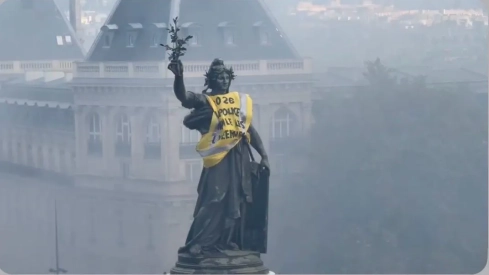
France has experienced a first night of relative calm after imposing a curfew in several areas of Paris to curb the riots, looting, and clashes recorded over the weekend. Authorities have maintained restrictions and are preparing a new security deployment in anticipation of protests scheduled for next Saturday, October 24.
The measures come after a wave of mobilizations against the rising cost of living, problems in the education system, and the deterioration of public services that ended with episodes of violence in several French cities. During the riots, there were fires, damage to businesses, and clashes with the Police. According to data released by French authorities, around 2,400 people were arrested over the weekend.
In Paris, the curfew was applied in areas such as the Place de la République and the Les Halles commercial area, where staying between 11:00 PM and 6:00 AM was prohibited. Demonstrations were also restricted in certain parts of the capital. The Police have assured that the measures contributed to restoring calm during the night.
The French Government acknowledges failures and prepares a new police deployment
The French Prime Minister, Sébastien Lecornu, has acknowledged that there were errors in the authorities' response to the riots. Among them, he pointed to failures in intelligence services and an overly static police distribution, which left some urban areas unprotected against looting. Lecornu has argued that the priority is to restore public order and has warned that next Saturday's security deployment will be "massive." The Government is also considering using military personnel to guard sensitive locations and allow more police officers to concentrate in areas where new clashes may occur.
For his part, the Minister of the Interior, Laurent Nuñez, has acknowledged the difficulties of police action and has apologized for the failures recorded. French President, Emmanuel Macron, rejected his resignation and tasked him with investigating the planning and intelligence errors that contributed to the violence. The Executive attributes part of the riots to far-left groups and looters, although the causes of the protests are also related to social and economic unrest.
Mobilizations could continue in the coming days. Student organizations have announced new protests to denounce the problems of public education, while groups linked to the yellow vest movement have called for actions against the increase in fuel prices.
Meloni announces tougher measures and the UN calls for dialogue and respect for human rights
Tension has also reached Italy, where Prime Minister, Giorgia Meloni, has condemned the riots and looting recorded in cities like Milan. The Italian leader called those responsible for the violent acts "gangs of thugs" and defended a firm response to attacks against businesses and security agents.
The Italian Government has approved new security measures after the weekend clashes. These include the deployment of 500 additional military personnel in Milan, who will be able to exercise police functions, as well as new provisions to make it difficult for minors to participate in violent acts. During the riots in the city, more than 270 people were arrested, around 80% minors, and 14 officers were injured.
In the face of the tightening of security measures, the UN has asked European governments to combine the response to the riots with the protection of fundamental rights. The United Nations High Commissioner for Human Rights, Volker Türk, has condemned all violent acts, but has also expressed concern about reports of unnecessary or excessive use of force against demonstrators, including minors. Türk has argued that the population has the right to demonstrate peacefully and to express their demands.
He has also called for swift and independent investigations into possible illegal police actions and has urged authorities to open channels of dialogue with young people to address problems such as education, housing, the cost of living, and inequality. The crisis, which affects several European countries, thus reflects a double challenge for governments: containing violent acts and responding to the social discontent that has led thousands of people to the streets. While France prepares a new police deployment and Italy tightens its measures, the United Nations insists that security must be accompanied by dialogue, proportionality, and respect for human rights.
