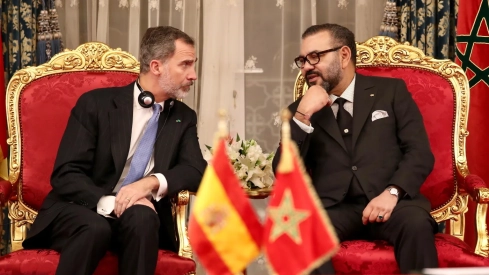
The announced visit by Felipe VI to Ceuta and Melilla has placed the most delicate issue in the relationship with Morocco at the center of the political agenda. The Government maintains that the trip "will take place", although it still lacks a date and will have to be organized together with the Royal Household. It would be the monarch's first official presence in both cities since his proclamation in 2014.
Rabat remains silent for now. The reaction has come from the Moroccan press and some political and nationalist circles. 'Hespress' gathers the opinion of Yahya Yahya, head of a committee that claims Ceuta and Melilla, who considers the displacement an "explicit provocation". 'Yabiladi' wonders if the 2007 crisis can be repeated and 'Alyaoum24' presents the news speaking of "occupied Ceuta".
These positions lack the character of an official response from Mohamed VI, although they reflect the sensitivity with which the announcement is received. Morocco will hold legislative elections on September 23 and territorial claims usually gain more weight during election campaigns.
The crisis caused by Juan Carlos I's visit in 2007
The closest precedent dates back to November 2007. Juan Carlos I and Queen Sofía visited Ceuta and Melilla at a time of good relations between José Luis Rodríguez Zapatero and Rabat. Mohamed VI condemned the trip in a statement, called it "regrettable" and "counterproductive" and presented it as an offense to Moroccan national sentiments.
Rabat then withdrew its ambassador in Madrid, Omar Azziman. The diplomat remained outside Spain for 65 days and returned in January 2008, after the Minister of Foreign Affairs, Miguel Ángel Moratinos, traveled to Morocco to mend the relationship. The protest had a strong component of internal politics, but opened a real diplomatic crisis between both countries.
The current situation incorporates another sensitive element. Spain needs Moroccan collaboration to manage returns after the massive entry of migrants into Ceuta and maintains close commercial, police and anti-terrorist cooperation with the neighboring country. At the same time, the visit would convey a message of institutional support to the people of Ceuta and of full Spanish sovereignty over the city.
A visit still without a date
Pedro Sánchez defends that there are sufficient reasons for the displacement. The government spokesperson, Elma Saiz, has assured that it will happen and has expressed the Executive's confidence that Morocco understands that Ceuta and Melilla are part of Spanish territory.
Felipe VI's official agenda must be agreed upon between Moncloa and Zarzuela, with the Government leading foreign policy. The calendar will allow measuring the gesture and preventing it from interfering with the Moroccan campaign or with the open cooperation to relieve pressure on Ceuta.
Madrid and Rabat assumed in 2022 the commitment to avoid unilateral claims of sovereignty and actions that could be offensive to the other party. Spain has since rejected any negotiation on Ceuta and Melilla. For now, the trip remains without a date and the Moroccan government has not presented a formal protest either.
